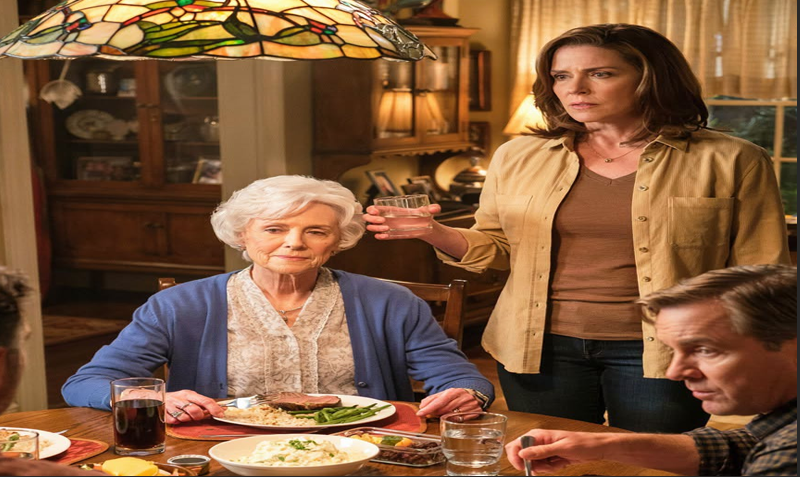
My daughter Denise waited until every chair at my table was full before she stood up, tapped her water glass with a fork like she was announcing an engagement, and told our entire family that the woman sitting next to my empty chair was here to evaluate whether I could still run this house. “It is for your own good, Mother,” she said. “You are not capable of running this house anymore.”
I want to start somewhere else, though, because a woman my age has learned that the moment everyone remembers is never the whole story. It is only the loudest part of it.
I am Marion Halvorsen. I am seventy years old, and I have lived on Larkspur Lane in Birch Hollow, Nebraska, for fifty-two of those years, in a white two story house with green shutters that my husband Elden and his father built with their own hands the summer after we married. Elden ran the scale house at the Birch Hollow grain elevator for thirty-eight years. I taught fourth grade at Lindqvist Elementary for twenty-nine of them, and between the two of us we raised three children in that house: Gary, our oldest, who moved to Colorado for the mountain air and a good engineering job and calls me every Sunday night whether I ask him to or not; Faith, our middle child, who lives two hours west with her own family and comes home for holidays; and Denise, our youngest, who never left Birch Hollow at all, and who I would have told you, right up until the Fourth of July this year, was the child who loved this house the most.
Elden died three years ago in March, on a Tuesday, of a heart that had been giving out quietly for longer than either of us wanted to admit. I buried him in the churchyard at Trinity Lutheran with the whole town in attendance, because that is what happens when a man spends thirty-eight years being fair to farmers who came through his scale house angry about weights and left calm. I went home that night to a house that had two names on the mailbox and only one person answering to them, and I want to tell you plainly that I considered, in those first raw months, whether the house was too big for me now. I sat with that question honestly. I did not run from it.I decided the answer was no. Not because I could not bear to leave it, though I could not, but because I still climbed the stairs every night without holding the rail, still drove myself to church and to the Piggly Wiggly and to Thursday bingo at the VFW hall, still balanced my own checkbook to the penny the old fashioned way with a ledger and a pencil, and still hosted Sunday dinner for whichever of my children could make it, the way I had done every Sunday of my adult life. A house is not too big for a woman who is still entirely capable of living in it. I was entirely capable. I want that established before I tell you what happened next, because everything that follows only makes sense once you understand that I was not confused, forgetful, or frail. I was simply a widow who owned something my daughter had started to want.
The wanting did not announce itself all at once. It came in pieces, the way water comes into a basement, slow enough that you can talk yourself out of noticing it.
It started, I think now, looking back, about a year after Elden passed, when Denise began bringing up “the market” at Sunday dinners. Not aggressively. Almost like small talk. Home values in Birch Hollow were up, she’d say, passing the green beans. A lady from her church had sold her place in eleven days. Wasn’t that something. I nodded along the way you nod along to weather talk, because I did not think my daughter was casing my house the way a realtor cases a listing. I thought she was making conversation.
Then came the assisted living brochures. The first one showed up tucked inside a birthday card, of all things, a glossy tri-fold for a place called Golden Willow Senior Residences in Kearney, with a photograph of two silver-haired strangers laughing over a chessboard on the cover. Denise said she’d “just seen it and thought of me.” I put it in the recycling and did not think much more of it, because grief does strange things to grown children too, and I told myself she was working out her own fear of losing me by trying to control the shape of my future.
The second brochure came four months later. Then a third. By the spring of this year, Denise was no longer subtle about it. She started asking, at nearly every visit, whether I’d “thought any more about downsizing.” She started phrases with “when,” not “if.” When you move into something smaller. When the house sells. When Dad’s old workshop isn’t sitting empty anymore. I began to notice that Denise’s husband Kyle, a mortgage broker who had built a comfortable business refinancing half the county through the good years, had gone quiet and thin around the edges in a way that worried me more than anything Denise was saying. Kyle used to talk shop at my table, cheerful about closings and rates. By this spring he barely spoke at all, and twice I caught him doing arithmetic on a napkin during dessert, the kind of tight, urgent arithmetic a man does when the numbers are not behaving.
I did not know yet what was actually happening in their house. I only knew what was happening in mine, which was that my younger daughter had developed a very specific and increasingly impatient interest in the value of a property that was not hers.
In May, on a Tuesday morning while I was watering the tomatoes I keep along the south side of the house, a car I did not recognize idled at the end of my driveway for the better part of ten minutes, engine running, no one getting out, before it pulled away. I noted it and moved on, the way you note a strange bird at the feeder. Two weeks later it happened again, same silver sedan, same idling, same silence. That time I walked to the end of the drive with my garden gloves still on and got a good look at the plates before it pulled off. Nebraska plates, nothing I recognized, a county sticker from two counties over.
The following week I was in my own kitchen with the window cracked for the breeze, shelling peas at the sink, when I heard Denise’s voice carrying from the driveway where she’d stepped out to take a call. She did not know the window was open, or she had forgotten, the way you forget the walls in your childhood house have ears when you have not lived behind them in twenty years. I heard fragments. “Once it’s settled, we can move fast.” “She doesn’t need to know the details yet.” “It has to look like her idea, or it gets messier.” I heard my own name, and I heard the word “house,” and I heard, distinctly, the word “sell.”
I did not confront her that day. I want to be honest about why, because it matters to everything that came after. I did not confront her because I am a schoolteacher of twenty-nine years, and twenty-nine years in front of a classroom teaches you that catching a child mid-scheme rarely produces the truth. It produces a better cover story. If I wanted to understand what was actually happening, I needed to gather more than a fragment through a kitchen window. So I did something my daughter, to this day, does not fully understand I am capable of. I got quiet, I got careful, and I got organized.
The first call I made was to Howard Lindqvist, who has been our family’s attorney since before Denise was born, and whose father taught alongside me at Lindqvist Elementary, which is not a coincidence, it is simply what a town the size of Birch Hollow looks like after two generations. I told Howard what I’d overheard and what I’d seen in the driveway, and I asked him a question I imagine he does not get asked often by a seventy-year-old woman with all her faculties: how does a person protect a house from her own child.
Howard did not treat the question as dramatic. He treated it as prudent. He told me what I suspect he tells every widow who sits across his desk sharp enough to ask the question before she needs the answer, which is that the cleanest protection against a guardianship overreach is not a lock on the door, it is paperwork that removes the temptation entirely. Over the course of three visits that May and June, visits I scheduled on weekday mornings when Denise believed I was at the beauty parlor or at bingo, Howard and I moved the house on Larkspur Lane, along with Elden’s pension survivor benefit and my modest savings, into a revocable trust. We did something Howard called adding a corporate co-trustee, a bank trust department in Kearney, specifically so that no single family member, present or future, could ever unilaterally sell, mortgage, or transfer the property, even with a court-appointed guardianship in hand. A guardian over my person is one thing. A guardian cannot simply seize a house that legally belongs to a trust with an institutional co-trustee, not without a fight that would take years and cost more than the house was worth. Howard also, at my request, arranged for my own physician, Dr. Renfro, who has treated me for eleven years, to administer a full cognitive baseline that June: memory, reasoning, executive function, the whole battery. I passed every measure in the top range for my age group. I asked Dr. Renfro to put that report in writing and date it, and I put a copy of it in the same drawer where I keep Elden’s discharge papers from the Army and the deed to the plot at Trinity Lutheran.
I did all of this quietly, not because I was ashamed of it, but because I understood something Denise did not yet know I understood. If my daughter was building a case that I was no longer capable, the worst thing I could do was hand her evidence of a paranoid, defensive old woman rearranging her affairs in a panic. The best thing I could do was become, calmly and on the record, exactly what I already was: a sharp, organized, well-documented woman who had simply gotten ahead of her.
There was one more thing I did that June, and it is the thing that changed everything, though I did not plan it the way it turned out.
My hearing has been going for a few years now, nothing dramatic, just the ordinary fraying that comes with seventy years of living, and this spring I finally gave in and got a pair of hearing aids, the kind that connect to a phone app and can, among other things, function as a small recording microphone when you press and hold the button on the case, a feature the audiologist showed me mostly so I could record my own doctor’s appointments and play them back later, since doctors talk fast and I have never been shy about wanting to understand my own care.
On the second Sunday in June, I had Kyle and Denise over for coffee after church, just the three of us, Gary and Faith both out of town that week. I had set my hearing aid case on the counter to charge, the way I always did, and I had, out of habit more than intention, pressed record before they arrived, because Dr. Renfro had suggested I record our next appointment and I had simply forgotten to reset the habit. I was in the pantry looking for the good coffee when I heard Kyle’s voice drop into the low, urgent register he’d been using all spring, and I heard him say words that I will not forget as long as I live.
He said the refinancing business had lost two of its biggest lenders in the spring rate shakeup. He said they were four months behind on their own mortgage. He said the word “underwater,” and then he said, “Denise, if we don’t do something before fall, we lose the house, not your mother’s. Ours.”
And I heard my daughter, in her own voice, in my own kitchen, say the sentence that ended any doubt I had left. “Once she’s declared incompetent, the guardianship gives us power of attorney over the estate. We sell the house, split it three ways on paper, but Gary and Faith don’t need to know the real numbers until it’s done. It has to happen fast, and it has to look like it was for her, not for us.”
I stood in my own pantry with a bag of coffee in my hand and I did not drop it, and I did not go in there and say a word, because I understood in that moment that I was holding something far more valuable than my own outrage. I was holding proof.
I did not confront Denise that day either. I brought out the coffee, we talked about Sophie’s summer volleyball schedule, and I let them leave believing nothing in the world had changed. That is the part of this I am least proud of and least ashamed of at the same time. I let my daughter keep talking, for three more weeks, believing her mother was an obstacle to be managed rather than a woman standing three feet away holding a recorder.
Which brings us back to the Fourth of July weekend, to the Sunday dinner, to Dr. Okafor sitting in a chair Denise had pulled from the hall closet and set at my own table without asking.
I want to describe that dinner honestly, because I have thought about it every day since. My table was set the way it always is on the second Sunday I host, with Elden’s mother’s good china that only comes out for family, a pot roast I had been cooking since eight that morning with carrots and potatoes from my own garden, and a peach cobbler cooling on the sideboard that Sophie had helped me make the day before, standing on the step stool she has been too tall for since she was thirteen and still uses anyway because it is ours.
Gary had flown in from Denver two days earlier for what I understood to be an ordinary visit. Faith had a swim meet for her youngest and could not make it, which turned out, later, to matter. Kyle came in behind Denise looking like a man walking into a dentist’s office, and Sophie trailed them both, sixteen and already carrying the particular unhappiness of a child who has been told something and told not to tell it.
I did not know Dr. Okafor’s name yet when she walked through my own front door behind my daughter, carrying a leather folder and wearing the careful, practiced neutrality of a woman who does this professionally and has learned not to let her face give anything away before the work begins. I greeted her the way I greet anyone who crosses my threshold, because whatever my daughter had done, I was not going to be the one who made a stranger feel unwelcome in my house.
We sat. We passed dishes. And then, over the mashed potatoes, before anyone had taken a second bite, Denise stood up, tapped her water glass with a fork, and said the words that opened this story, in front of her brother, her daughter, her husband, and a hired professional she had brought into my home without telling me she was coming. “It is for your own good, Mother. You are not capable of running this house anymore.”
I have replayed that sentence more times than I can count, and what strikes me now is not even the cruelty of it, though it was cruel. It is the staging. My daughter did not sit me down privately and say she was worried about me. She did not ask me, one on one, how I was really doing three years after losing the love of my life. She assembled an audience, first, and delivered the accusation to the audience, second, with me positioned as the subject rather than the participant. That is not concern. That is a prosecution.
Gary set his fork down hard enough that it rang against the china, and I watched, from the corner of my eye, real shock move across his face, the shock of a man who had flown fifteen hundred miles for what he thought was a family dinner and had just been made an unwitting witness for the state. Sophie’s eyes went straight to her plate. Kyle did not look up at all.
I did not raise my voice. I want to tell you honestly that I wanted to, that some old animal part of me wanted to stand up and ask my daughter how dare she, but I have taught fourth grade long enough to know that the loudest voice in a room rarely wins the room, and I had, by that point, spent six weeks becoming a woman who did not need to win the room by shouting. I looked at Dr. Okafor, who had the professional grace to look uncomfortable at how this had been sprung on both of us, and I said, “Well. You’ve come a long way for a Sunday dinner. Sit down and have some pot roast, and afterward we’ll do whatever it is you came here to do.”
I want to walk you through the evaluation itself, because it is the part Denise least expected me to survive, and the part I am proudest of.
Dr. Okafor set up in my own front room, the one with Elden’s reading chair still by the window, and explained gently that she would be asking me a series of questions covering memory, orientation, reasoning, and what she called “activities of daily living” and “financial capacity.” I told her I understood, and I told her I was ready. What I did not expect, and what turned out to matter more than any of my answers, was that Denise did not leave the room.
She sat in the doorway on a kitchen chair she had dragged over, arms crossed, and every time Dr. Okafor asked me a question that required a moment’s thought, Denise answered before I could. When Dr. Okafor asked me to name the current president, Denise said, “She gets confused about politics, don’t worry about that one.” When Dr. Okafor asked me to describe how I managed my monthly bills, Denise said, “I’ve actually been helping her with that, haven’t I, Mom,” which was a lie, since I have balanced my own checkbook to the penny every month of my adult life and Denise has never once seen my ledger. When Dr. Okafor asked me a simple reasoning question involving what I would do if I smelled smoke in the kitchen, Denise actually started to answer for me a third time.
That was when Dr. Okafor, without raising her voice any more than I had at the table, closed her folder and said, “Mrs. Pruitt, I’m going to need you to step outside for the remainder of this assessment. I can’t get an accurate picture of your mother’s capacity if I can’t hear your mother answer.”
Denise’s face, in that moment, told me everything I needed to know about how confident she truly was in her own case.
Alone in the room with Dr. Okafor, I answered every question fully and, if I may say so, well. I recalled a list of five unrelated words after a ten minute delay. I named the date, the season, the town, the county, and the current president without hesitation. I described my monthly finances in detail, down to the property tax escrow I keep separate in a savings account so November never surprises me. I walked her through the smoke scenario and three others like it, each one a plain, sensible answer any competent adult would give. At the end, Dr. Okafor told me, in the careful language professionals use before the official report is written, that she saw no clinical indication of cognitive impairment, and that in fact my scores placed me in the highest percentile for my age bracket, consistent, she noted, with the cognitive baseline Dr. Renfro had already documented three weeks earlier, a copy of which I handed her from the very drawer I had prepared for this exact evening.
But it was what Dr. Okafor said next that I did not expect, and that I have thought about every day since. She told me that in twelve years doing this work, she has learned to watch not only the person being assessed, but the family member who requested the assessment, because coercive control and elder financial exploitation, she said, very often present exactly the way that evening had presented: a family member who insists on remaining in the room, who answers for the elder repeatedly, who frames the evaluation as urgent and the elder as already declining before any evidence supports it, and who has a clear financial interest in the outcome. She told me she was required, under state law, to document what she had observed and to file a report not only on my capacity, which she found intact, but on the circumstances under which the evaluation had been requested and staged, which she found concerning enough to flag to Nebraska’s Adult Protective Services as a potential case of attempted undue influence.
I had not asked her to do that. I want to be clear about that, because it would be easy to tell this story as though I orchestrated Denise’s downfall from beginning to end, and I did not. I protected the house. I protected myself. What happened to Denise after that was not my doing. It was the natural weight of the truth landing where it had always been going to land.
After Dr. Okafor left that night, apologizing to me personally at the door in a way I do not think is standard professional practice but that I appreciated all the same, the house went quiet in the particular way a house goes quiet after a storm no one has finished arguing about yet. Gary stood up first. He looked at his sister and asked her, in a voice I had not heard him use since he was a teenager furious about something fair, how long she had been planning this. Denise did not answer him. She looked at me instead, and I think, in that moment, she was still hoping I would somehow smooth it over the way I had smoothed over disagreements between my children their whole lives, take the family peace onto my own shoulders the way mothers are trained to do.
I did not smooth it over. I asked everyone but Denise and Kyle to give us the room, and Sophie, God bless that girl, hugged me hard on her way out and whispered that she was sorry, that she hadn’t wanted to lie to me about the car in the driveway, that her mother had told her it was nothing. I told her she had done nothing wrong, and I meant it entirely.
Then I sat back down at my own table, across from my daughter and her husband, and I set two things on the table between us. The first was a folder from Howard Lindqvist’s office, the trust documents dated that May, with the Kearney bank listed as corporate co-trustee, showing that the house on Larkspur Lane had not been mine to lose to a guardianship since before Denise had ever hired an appraiser or an assessor or driven a silver sedan to the end of my driveway to idle and think it over. The second was my phone, with the recording from that June coffee visit queued up and ready.
I did not play the whole thing. I did not need to. I played eleven seconds, the eleven seconds where Denise’s own voice said the words about declaring me incompetent, about power of attorney, about making it “look like it was for her, not for us.” I watched my daughter’s face go the color of the tablecloth. I watched Kyle put his head in his hands. And I watched Denise, my youngest, the child who never left Birch Hollow, finally stop performing concern and start, for the first time in over a year, telling me something that sounded like the truth.
She told me about the two lenders they’d lost. She told me they were four months behind and the bank had sent a letter with a date on it. She told me she had panicked, that somewhere in that panic the idea of the house had stopped feeling like her mother’s home and had started feeling like a number, a solution, a way out that did not require her to admit to her own family, to her brother and sister, to me, that she and Kyle had built their comfortable life on a foundation that had quietly given out from under them the same way Elden’s heart had. She cried in a way I had not seen my daughter cry since she was small, and I want to tell you honestly that some part of me, the part that carried her for nine months and rocked her through croup and sat up with her through every fever of her childhood, ached for her even then.
But I did not fold. Twenty-nine years in front of a classroom and seventy years of living teach you that love and accountability are not opposites, and that a mother who lets fear excuse cruelty is not being kind, she is simply postponing the reckoning to a day when it will cost more.
I told Denise the house was not, and would never be, on the table. I told her the trust made that a settled fact, not a negotiation. I told her that what happened at my table that night, in front of her daughter and her brother, was something I would need real time to forgive, not because she was afraid, fear I could understand, but because she had chosen to solve her fear by trying to make the world believe her mother’s mind was going, and that particular lie, once told about a person, follows them. I told her Dr. Okafor’s report would say what it would say, and that I had not asked for it and would not try to soften it.
What I offered instead, once the anger in the room had cooled enough for offering to mean something, was help of a different shape. I told Kyle and Denise that I had resources in the trust beyond the house itself, money Elden and I had saved carefully over thirty-eight years at the elevator and twenty-nine at the school, and that I was willing to have Howard structure a real loan, on paper, with terms, through the trust’s corporate co-trustee, to help them through the refinancing crisis, on the condition that Kyle sit down with an actual financial counselor and that the loan be documented the honest way, the way a family that trusts each other does it, not the way a family that is trying to seize an old woman’s house does it.
It has been eleven days since that dinner as I write this. Denise and Kyle took the loan, and they took the counseling, and Kyle’s business, while still shaky, has stopped the bleeding. Denise called me four days ago, not to apologize in the sweeping way I think she wanted to, but in the smaller, truer way that actually means something: she asked if she could bring Sophie by on Saturday to help me can tomatoes, the way we used to every August before all of this started, and she asked, almost shyly, if I would show her my ledger sometime, the real one, so she could understand how I actually managed things instead of assuming. I said yes to both.
Gary flew home to Colorado angrier at his sister than I have ever seen him, and it will take longer to mend that than it will take to mend things between Denise and me, because a brother’s fury on his mother’s behalf burns hotter and slower than a mother’s own. Faith, when she heard the whole story secondhand, drove the two hours from her house the very next day just to sit with me at my own kitchen table and hold my hand, and she has called every single day since.
Dr. Okafor’s official report arrived by mail six days after the dinner. It states, in the flat clinical language these documents use, that I demonstrated full capacity across every measured domain, and that the circumstances of the referral raised sufficient concern regarding potential undue influence that the matter was forwarded, as required, to the state. I have not heard yet what, if anything, comes of that forwarding, and I have told Howard I do not intend to push it further than the law already will on its own. My daughter is going to have to live with what she tried to do, and I have decided that is a heavier consequence, in the end, than anything a caseworker’s follow-up call could add to it.
I still live in the house on Larkspur Lane. I still climb the stairs without holding the rail. I still balance my own ledger every month, in pencil, the old fashioned way, and this Saturday, for the first time, I am going to show my daughter exactly how I do it, line by line, so that the next time she wonders whether her mother is still capable of running this house, she will not need to hire a stranger to find out.