My name is Ashmore Corford. I am sixty nine years old, and I have lived on the same hundred and forty acres outside Hollow Elm, Arkansas since I was a bride of twenty. My husband, Ashbury, farmed this ground for forty six years. He has been gone a year and a half now, and until one Saturday in June, the barn behind my house still smelled like him. Diesel and cut hay and the orange hand soap he kept by the sink out there. I would walk past that barn most mornings on my way to feed the chickens and I would not go in, but I liked knowing it was there, exactly as he left it, the way you like knowing a person is in the next room even if you are not talking to them.
I want to tell you what my son did to that barn while I was two counties over burying my sister. I want to tell you the words he said to my face when I asked him why. And I want to tell you about an old man named Danby, and a coffee tin with a torn label, and the thing inside it that my husband hid from everyone in the world except a jeweler in the county seat, because I think you should know that some kindnesses in this life arrive so late and so quiet that you almost miss them walking past you on the way to something else.
Ashbury and I met at a Baptist potluck when I was seventeen, at the folding table by the ham, and he asked me if I was going to eat that second roll or if I planned on just guarding it. I married him three years later in the sanctuary of First Baptist Church of Hollow Elm, and I moved out to his family’s place the same week, and I never lived anywhere else since. We raised cattle, mostly Angus crosses, and hay on the bottom acres, and one boy, our son Ashwell, who was born the same spring we finally paid off the north pasture.Ashbury was not a man who talked a great deal. He showed you what he meant instead. He built the kitchen table I still eat breakfast at. He built the porch swing, and the hog pen, and half the fence line with his own two hands and a posthole digger older than our marriage. And in the back third of the barn he built himself a workbench, eight feet of rough pine he planed smooth over one whole winter, with a vise bolted to one end and a pegboard behind it holding every wrench and clamp and coping saw a man could want. That workbench held our whole life in some way I cannot fully explain to somebody who never had one. Every broken thing in this house got carried out to that bench before it got carried to the dump. A busted lamp. A rocking chair leg. My grandmother’s clock, twice.
He died out there. I want to say that plainly because I have found that saying it plainly, once, gets it over with, and then I can go on and tell you the rest. It was a Tuesday in November, cool and clear, and he had gone out after supper to true up a wheel hoe for the spring garden, and when I went to call him in for coffee I found him on the concrete floor with a box wrench still closed around a bolt he never finished turning. Heart, the doctor said. Fast, at least. I have held onto that word, fast, the way you hold onto the one small mercy in an otherwise ruined night.
After that, the barn changed for me. I could not go in for the first few months. Then I could stand in the doorway. Then I could walk as far as the workbench and put my hand flat on the wood, still warm from the afternoon sun through the west window, and just stand there breathing. His reading glasses were still folded on the corner where he’d set them down that last evening. His grease rag hung on the same nail. I never touched a single tool. Not to use them, not to tidy them, not even to dust them, because dusting them felt like erasing him one wipe at a time, and I was not ready to erase anything.
Ashwell is forty six now, my only child, and I love him the way you love your only child, which is to say completely and also, if I am honest with you, a little blindly for longer than I should have been. He and his wife, Corton, live twenty minutes from me nearer the county seat, in a newer house with a truck in the driveway he is still paying on. He works in equipment sales, selling other men the same kind of tractors his father used to keep running with baling wire and stubbornness. For the last two years he had been telling me, in that gentle, reasonable voice grown children use when they have already decided something, that I could not keep this place up alone. That the barn full of his father’s old iron was doing nobody any good sitting there rusting. That I ought to think about “simplifying.”
“Simplifying” was the word he used. I have turned that word over in my mind so many times since that Saturday that I think I could grind it down to nothing, the way water grinds down a stone.
I told him no every time he brought it up. I told him the tractors ran fine, that Danby next door serviced them for me twice a year in exchange for hay, that I was not some feeble old woman who needed her life managed for her. I believed that when I said it. I still believe it. But I will tell you now, ahead of where the story goes, that believing a thing does not always protect you from the people who have decided not to believe it back.
My younger sister, Danman, had been fighting cancer for the better part of a year, quietly, the way she did most things. She lived two counties over, past the river, in a little house she’d kept since her own husband passed. I drove down every other weekend those last months to sit with her, and near the end I stayed longer stretches, a week at a time, sleeping in her spare room and holding her hand through the bad nights. She died on a Wednesday in June, at four in the morning, with me right there beside her bed, and I want to tell you that even though I had braced for it as hard as a person can brace, it still knocked the floor out from under me the way it always does.
The funeral was set for that Saturday. I would be gone from Thursday morning until Sunday afternoon, handling arrangements, standing at a graveside in a dress I hate, receiving casseroles from women I’ve known my whole life and could not, in that moment, have named to save my soul. Before I left, I called Ashwell and asked him to run out to the farm and put feed down for the cattle Friday and Saturday, and to check that the chickens had water, since it was already climbing into the nineties. A small thing. The kind of small thing you ask your grown son without a second thought, because you raised him and you trust him and it never once crosses your mind that trust is a door somebody could walk through carrying something other than a bag of feed.
“Don’t worry about a thing, Mom,” he told me. “Go be with Aunt Danman’s family. I’ve got the farm.”
I believed him. I want that on the record too, because I think it matters, later, that I believed him completely and without one flicker of doubt, standing in my sister’s driveway with a suitcase in my hand, worrying about the wrong things entirely.
I will tell you what I only pieced together afterward, because I was not there to see it happen, and for a long while that not being there was its own kind of grief on top of a grief.
Ashwell had called Caldmont, the auctioneer who works out of the county seat and handles most of the farm sales and estate liquidations for three counties around, on the Monday before my sister died. He told Caldmont he was helping his elderly mother downsize after his father’s passing, that she had a barn full of equipment going unused, and that he wanted to move quick, before the summer auction calendar filled up. Caldmont had no reason on this earth to question a grown son calling on his mother’s behalf. It happens all the time out here, families settling an estate, clearing a place out for a parent who can’t manage it alone anymore. Ashwell signed the consignment papers himself. He picked the date. He picked it, I would learn later, for the one Saturday he already knew, because I had told him myself, that I would be standing in a cemetery two counties away with no way to get home in under two hours even if somebody called me.
Signs went up along the county road Thursday afternoon. FARM AUCTION SATURDAY, they said, with an arrow pointing down our gravel drive. CALDRIDGE FARM. TRACTORS, TOOLS, EQUIPMENT, MISC.
I did not see those signs. I was already two counties over, sitting up with my dying sister in her last conscious hours, holding a hand that was getting lighter by the day. I had my phone, but the service out at Danman’s place has never been worth much, one bar if you stand by the kitchen window and hold the phone just right, and I was not thinking about my phone. I was thinking about my sister’s breathing.
Everstead, who sits two pews behind me at church and has known me since we were girls, tried to call me that Thursday evening. She left a voicemail I did not hear until Sunday. Her voice on it sounds worried, careful, the way people sound when they are about to tell you something they are not sure is their business to tell. “Ashmore, honey, I don’t want to alarm you, but I drove past your place and there’s an auction sign at the end of your drive for Saturday, and I wanted to make sure you knew, because it didn’t seem like something you’d have set up during all this with Danman.” I have listened to that voicemail more times than I can count. Everstead knew. Everstead, two pews back at church, knew something was wrong before I did.
Saturday came. The funeral was at ten that morning, a good service, my sister’s grandchildren read scripture, and I stood at the graveside in the heat with my hand on the casket rail and I did not think about my farm one time. Not once. I want you to understand that. While a stranger with a bullhorn microphone stood in my driveway calling numbers on my husband’s life’s work, I was three counties away thinking only about the woman I had just lost, the last of my parents’ children besides me, gone.
The auction, I learned later from three different people who were there and felt sick enough about it to tell me the whole thing straight, started at nine that morning and ran until early afternoon. Cars lined the county road on both shoulders. A crowd gathered in the yard I had swept a hundred times, standing in a rough horseshoe around Caldmont on his little platform, and one by one they walked my husband’s forty six years out to their trucks.
The Farmall went first, the one Ashbury bought secondhand the year Ashwell was born and rebuilt twice with his own hands. Then the newer tractor, the one we’d financed together in 1998 and paid off two years early because Ashbury hated owing anybody anything. Then the bush hog, the disc harrow, the hay rake, box after box of hand tools sorted into what Caldmont calls “flats,” and finally, near the end of the day, lot ninety one: the workbench itself, eight feet of hand planed pine with a vise still bolted to the end, sold as is, contents included.
I did not know any of this while it was happening. I was folding a paper fan someone handed me at the graveside, trying to get a little air moving in that June heat, thinking about my sister’s face gone slack and peaceful for the first time in months.
Danby was there. I have to tell you about Danby now, because without him this story ends somewhere much worse than where it ends.
Danby farmed the section next to ours for as long as I can remember, a widower himself these eleven years, a quiet, sun cured old man who still wears his ball cap indoors out of habit and forgets to take it off at the table until his daughter reminds him. He and Ashbury worked side by side more Saturdays than I could ever count, trading equipment back and forth, standing at that very workbench together fixing whatever needed fixing, drinking coffee out of the same two chipped mugs Ashbury kept just for him. Danby knew that workbench the way you know a room in your own house.
He told me later that he drove past the auction signs Thursday and felt something go cold in his stomach, because he knew good and well I had not mentioned any such thing to him, and he and I talk most weeks. He called my house Friday and got no answer, because I was already gone. He almost called Ashwell to ask what in the world was going on, and then thought better of it, because if something was wrong, tipping off the person doing the wrong seemed like a poor way to stop it.
So instead, on Saturday morning, Danby put on his good boots and drove over to my place with cash in an envelope and a plan.
He told me he stood at the back of that crowd with his jaw tight the whole morning, watching strangers bid on Ashbury’s tractors like they were nothing but iron and rubber. He bought what he could afford. The Farmall went for more than he had, some dealer from two counties over trailered it off before Danby could get his number up fast enough, and he told me that loss still sits on him even now, that he wishes every day he’d brought more cash. But when lot ninety one came up, the workbench, he raised his number before Caldmont even finished the description, and nobody in that yard wanted to bid against a red faced old man who looked like he might come across the grass at them if they tried.
“Sold, to the gentleman in the green cap,” Caldmont called, and Danby paid cash on the spot and had it loaded onto his own flatbed before the next lot even started.
He did not know, standing there in my yard writing a check, what he had actually just bought. None of us did. Not even Ashwell, who had walked past that workbench a hundred times in his life and never once thought to open every drawer, because to him it was just a bench, just wood and tools, a thing his father used and now a thing his mother didn’t need.
I came home Sunday afternoon, worn thin from three days of grief, wanting nothing on this earth but my own bed and a cup of tea. And I saw the empty spot in the yard before I even got the car in park. The gravel where the tractors always sat, bare. The barn doors standing open in a way I never leave them, and inside, an emptiness so total it took my breath clean out of my chest. The pegboard bare down to the nail holes. The floor swept clean where the workbench had stood for forty years, a rectangle of concrete a shade lighter than the rest, like a chalk outline.
I stood in that barn doorway and I could not make a sound. Not a cry, not a word, nothing. I just stood there with my sister’s funeral program still folded in my purse, looking at the place where my husband’s whole hand-built life had been, and it was gone.
Ashwell came out an hour later, easy as you please, and told me he had a surprise for me. That is the word he used. Surprise.
“I got the barn cleared out for you, Mom,” he said. “You don’t have to worry about any of that anymore. It’s done.”
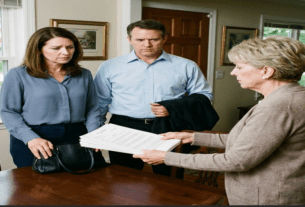
I asked him where. I asked him where his father’s tractors were, where the tools were, where the bench was, and I watched my son’s face and I saw, for one terrible second, that he still thought he had done something good.
“I sold it, Mom. All of it. There was an auction Saturday. I know it’s a lot to take in right now, but you weren’t using any of it, and it was just sitting out there rusting, and it’s not like Dad’s coming back to use it. Somebody had to make the call, and you were gone, and I made it.”
“You held an auction,” I said, “during my sister’s funeral.”
“I picked that day on purpose,” he said, and I want you to sit with that sentence the way I had to sit with it, standing in my own barn doorway. “I knew if I asked you first, you’d say no. And I didn’t have time to fight you about a bunch of rusted junk, not with everything else going on. I figured you’d be grateful once it was done.”
I have turned over a great many hard things in sixty nine years, but I do not know that I have ever felt the floor drop out from under me the way it did standing there, hearing my only child tell me, calm as anything, that he had timed his father’s belongings going out the driveway to the exact hours he knew I would be standing at a grave, defenseless.
“That was not junk,” I told him, and my voice came out smaller than I wanted it to. “That was your father.”
“It was a workbench, Mom.” He said it like I was the one being unreasonable. “Dad’s dead. The tools don’t miss him. You’re the one who can’t let him go.”
I did not answer that. I do not think there was an answer in me that would have come out as anything but a scream, and I was not going to give him that. I turned around and walked into my empty house and I did not speak to my son again for six days.
I called Everstead first, because her voicemail had been sitting there the whole time, unheard, and once I finally played it Sunday night I understood how close I had come to losing everything without a single soul in this county telling me in time to stop it. Everstead cried on the phone almost as hard as I did. She told me half the church had heard about the auction by Saturday supper and nobody knew quite how to say anything to me, not wanting to pile grief on grief while I was still standing at my sister’s grave.
I did not sleep that whole first night home. I walked out to the barn twice in the dark, as if maybe I’d been wrong, as if the moon might show me the workbench still sitting there and the whole thing had been some grief-fogged mistake. It was not a mistake. The barn stayed empty both times I looked.
Monday morning, before I’d had my coffee, I heard a diesel engine coming slow up my gravel drive, and I went to the window half afraid it was Ashwell come to argue with me again. It was Danby, in his old flatbed, and on the back of it, strapped down with the same kind of ratchet straps Ashbury always used, sat the workbench.
I walked out to that truck in my housecoat and I could not get a single word past my throat.
“Heard what happened,” Danby said, climbing down slow, favoring the hip that’s bothered him since a bull threw him twenty years back. “Heard it Thursday, when the signs went up, and I didn’t like the smell of it one bit, but I didn’t know for certain it was wrong until I saw you standing in a graveyard on Saturday’s obituary page and realized nobody’d told your boy to pick a different day.”
He told me, standing there in my driveway with the June sun already hot, how he’d bought what he could. The workbench. A crate of hand tools. He’d lost the Farmall to a dealer with deeper pockets and he was sorry for it, sorrier than I have ever heard that man sound about anything. But he’d gotten the bench.
“Ashbury and I built half of what’s wrong with our farms right at this piece of wood,” Danby said, running his hand along the edge the same way I used to. “Wasn’t about to let some stranger haul it off to be a potting bench in somebody’s yard sale. Figured you’d want it back more than I wanted the cash in my pocket.”
I asked him what I owed him. He would not hear one word of payment, not that day, not the day after, not ever, no matter how many times I have tried since. He said Ashbury would have done the same for him ten times over without blinking, and that a man who won’t return a favor to a friend’s widow isn’t much of a neighbor to begin with.
We got the bench unloaded and set back in its rectangle on the barn floor, and I stood there with my hand flat on that pine, and for the first time since Sunday afternoon I could breathe all the way down again.
It was two days later, going through the drawers to see what all had come back with it and what had not, that I found the crate of small parts was missing. A shallow drawer under the main surface, where Ashbury kept a coffee tin full of odds and ends, screws and washers and the little brass fittings he was forever needing for one repair or another. That tin was not in the drawer. Danby came back over when I called him about it, looking troubled, and told me the small parts lots at these auctions get sold separate from the big pieces most times, boxed up together as “shop miscellaneous,” and that he honestly hadn’t thought twice about a coffee can of screws.
“Might not be anything,” he said. “Might just be washers.”
But I knew that tin. I had seen it on that bench my whole married life, an old Marvel Grease can with a torn label, and Ashbury never once let anybody else touch it, not to borrow a bolt, not to tidy up, nothing. I had always thought that was just a particular man’s particular fussiness about his own workbench. Standing in the barn that afternoon, I could not shake the feeling that fussiness had never made sense for a can of hardware, and now that it was gone, it was the only thing in that whole barn I could not stop thinking about.
Danby went back to Caldmont that same afternoon, and I will tell you Caldmont was decent about it once he understood the whole shape of what had happened. He was not a party to Ashwell’s cruelty, only his tool, and once he heard the timing of it, the funeral, the deliberate Saturday, he went red in the face and pulled his sale records without being asked twice. The shop miscellaneous lot, three flats of small hardware including one dented Marvel Grease tin, had gone for eleven dollars to a young man named Beckstead, who ran a booth some weekends at the flea market over in the county seat, buying up estate lots to resell piece by piece to whoever wandered by.
Danby drove me over himself, the very next morning, both of us not saying much in the truck, because neither one of us knew if eleven dollars’ worth of screws had already been picked apart and scattered across some folding table to strangers.
Beckstead turned out to be a decent young fellow, maybe twenty five, and when we found him at his booth and I explained, as steady as I could manage, that my husband had died and his workbench got sold out from under me during my sister’s funeral, and that there might be something of mine still in a coffee tin he’d bought, he did not haggle with me for one second. He went straight to a tote under his table and pulled out the Marvel Grease can, still sealed with its lid, and said he hadn’t even opened it yet, had been meaning to sort it that weekend.
“Ma’am, I’m real sorry for your loss,” he said, and he would not take a dime for it either, once he understood.
I did not open that tin in the parking lot. Something in me needed to be home, in my own kitchen, at my own table, with Ashbury’s chair pushed in across from me the way it’s stayed for a year and a half, before I could look inside.
The lid was stuck with age and I had to work it with a butter knife. Inside, wrapped in a shop rag gone soft from handling, was not washers.
It was my mother’s ring.
I want to explain what that ring was to me, because otherwise you will not understand what I felt sitting at that table. My mother wore that ring fifty one years, a small diamond set high in an old fashioned prong mount, and when she passed it came to me, and I wore it myself for years after, until one September during canning season the stone worked loose and dropped somewhere between my kitchen and the garden and I never found it. I searched that yard on my hands and knees for two full days. I cried over it more than I have cried over some funerals, because it was not just a stone, it was the last piece of my mother I could put my hands on, and I had lost it through pure carelessness, and I never told a soul how much that loss cost me, not even Ashbury, because I was ashamed of how hard I took the loss of a thing.
Except I had told him. I must have, at some point, in some ordinary evening I do not even remember, mentioned it in passing the way you mention old griefs to the person who shares your bed. And Ashbury, a man who did not say much and showed you what he meant instead, had apparently spent a good deal of the last year of his life doing something about it without ever letting on.
Wrapped with the ring was a slip of paper from a jeweler in the county seat, a repair ticket dated the March before he died, describing a reset diamond in an “antique prong mount, customer supplied stone.” Ashbury had found that stone. I do not know how, or when, whether he’d been searching that yard himself on some evening I never knew about, on his knees in the dirt looking for what I’d lost, or whether he’d simply had a matching stone cut new because he could not bear for me to keep grieving an empty setting. The ticket did not say. What it said was that the ring had been resized and reset and picked up in April, seven months before he died, and that inside the band, at the jeweler’s own suggestion, he’d had two words engraved, small enough you’d need to turn it to the light to catch them.
Still yours.
He had been carrying that ring, finished and ready, for seven months. Through a whole autumn and into the winter he died in. I do not know what he was waiting for. Our anniversary was not until April, and I have decided, because it is the kindest thing to decide and because I believe it of him, that he was simply waiting for the right ordinary evening to put it in my hand without ceremony, the way he did everything, and that evening never came for him.
He hid it in a coffee tin on his workbench, in the one place in this house he knew, better than anywhere else, that nobody would think to look. Not because he did not trust me. Because he wanted the finding of it to feel the way it must have felt to him the day he found that lost stone: like a small miracle, arriving sideways, when nobody was watching for it.
I sat at my kitchen table for a long while with that ring in my open hand, and I am not ashamed to tell you I cried harder over a torn coffee tin than I had cried at my own sister’s funeral six days before, because grief does not queue up politely and wait its turn, it comes at you sideways too, and sometimes it takes a ring to loosen a week of it all at once.
I called Ashwell that evening. I had not spoken to him in six days and I did not call to forgive him, not yet, not fully, though I have come around to more of it since than I expected to. I called because I wanted him to understand exactly what he had come within eleven dollars and one careless afternoon of erasing forever, without ever once knowing it was there.
He was quiet a long time on the phone after I told him. Quieter than I have heard my son in years. He did not try to defend himself that call, which was the first thing he’d done right since the whole business started. He asked if he could come see it, and I told him not yet, and he did not push.
It took some weeks, but he did come around, in the slow, halting way grown children come around to the size of what they’ve done. He drove out one Sunday afternoon with Corton, and he stood in the barn doorway looking at that workbench the way I imagine he’d never once really looked at it in his whole life, and he told me he was sorry, and for once it did not sound like a word he was using to get past a conversation he wanted over. He told me he’d been scared, about money, about the truck payment, about looking like he couldn’t manage his own life, and that he’d told himself a story about helping me so he wouldn’t have to look straight at the fact that he needed the cash and had gone looking for the easiest place to find it.
I did not hand him back any keys to my decisions. I want to be plain about that, because I think it matters as much as the forgiving does. I sat him down that same Sunday and told him that from here forward, nothing on this farm moves, sells, or leaves this property without my say so, spoken directly to me, in person, with time enough for me to think it over. I called Caldmont myself the following week and told him the same, friendly enough about it, but final: no consignment, ever again, on my name or my property, without my own signature and my own two eyes on the paper first. I do not believe Ashwell meant to become a man capable of what he did that Saturday. I believe grief and money and a bad idea found him at a weak moment, the way they find most people who do wrong, and I believe he is sorrier now than he has ever been sorry for anything. But sorry does not hand back a Saturday, and it does not get to hand back my trust either, not all at once, not for free.
I wear my mother’s ring every day now, on my right hand since my wedding band still sits on my left where Ashbury put it forty nine years ago. I turn it to the light sometimes, out at the workbench, where I have started going most mornings again, and I read those two words he hid there for me to find whenever I finally found my way back to looking.
Danby still comes by most Saturdays. We do not talk much about that June anymore, and we do not need to. He sits at the workbench with me sometimes, in the two chipped mugs still on the shelf, and he tells me about his grandkids and I tell him about mine, and the barn smells like diesel and cut hay and orange soap, same as it always did, same as it will as long as I have breath to walk out there.
I lost a sister and very nearly lost my husband’s whole life’s work in the same terrible week, and I got most of it back because one old neighbor could not stand by and watch a stranger haul off a friend’s memory for scrap, and because a young man at a flea market table had more decency in him than my own son managed that Saturday. I have thought a great deal, since, about what it means that the kindness came from a neighbor and a stranger before it came from my own blood. I have decided it does not make the neighbor and the stranger family exactly, but it makes them something close enough to it that the distinction has stopped mattering to me the way it used to.
What I know for certain is this. My husband built that workbench with his own hands over one long winter, and forty six years later it still had one more thing to give me, hidden in a torn coffee tin, waiting for the day I would need it most. Some men leave you a will. Ashbury left me a ring, two words, and a proof, delivered so late and so quiet I almost missed it entirely, that he had been taking care of me long after I thought his caring for me was over.
This story is a dramatization. Names, characters, and details are invented, and any resemblance to real people or events is coincidental.