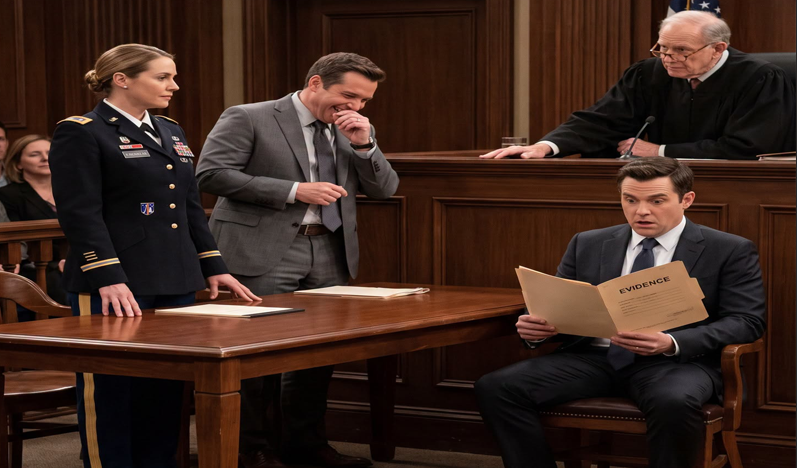
My father grinned from across the courtroom and said, “You don’t even have the money to hire a lawyer,” loud enough for strangers to laugh.
A few of them did. Not loudly. Not the kind of laugh you would remember as cruel later, if anyone ever asked you about it. Just enough to travel. Just enough to land.
I stood at the respondent’s table with both hands resting flat on the wood, my fingers still in a way that had nothing to do with peace and everything to do with training. I did not turn around. I did not give him the satisfaction of watching me absorb it.
Across the aisle, my father leaned back in his chair like he owned the room, one arm draped over the back of it, ankle crossed over his knee, wearing the same loose, superior posture he had used on me my whole life whenever he wanted the people nearby to understand that he was the one who knew how the world actually worked.
“She thinks she can walk in here alone,” he said, shaking his head at his attorney like the two of them were sharing a private joke about the weather. “No counsel, no case. Just a uniform and an attitude.”
A murmur moved through the gallery behind me. Curious. Quiet. Almost embarrassed on my behalf, which was somehow worse than if they had laughed with him.
Then the judge spoke.
“Mr. Carter,” he said, even and unhurried, the kind of voice that has said the same three words to the same kind of man a thousand times before, “that will be enough.”
My father smirked, but he settled back into his chair.
The judge turned to me. “Ms. Carter.” He paused just long enough for the room to notice the pause. “You understand you have the right to representation.”“Yes, Your Honor.”
“And you are choosing to proceed on your own.”
“Yes, sir.”
He looked at me a beat longer than most people ever did. Not with judgment. With recognition, which was the part that unsettled me, because I had not said anything yet that should have earned it. He had already seen something, in the file in front of him, or in the way I was standing, or in the shape of that whole morning, that the rest of the room had not caught up to.
He gave one nod.
“Very well,” he said. “For the record, she won’t be needing one.”
That was the moment everything in that courtroom changed, though almost nobody watching it happen could have told you why yet.
I did not react. Not outwardly. But across the aisle, my father’s attorney, a tall, silver-haired man named Gerald Whitlow who billed by the six-minute increment and had the unbothered polish of a man who had never once lost a case in Portsmouth County, went completely still. He had been thumbing through his folder with the easy confidence of a man expecting a short morning and an easier win.
Now his fingers stopped in the middle of a page. His eyes dropped to whatever was printed there, lifted to me, dropped again.
“Wait,” he muttered, so quiet I almost didn’t catch it.
My father leaned toward him. “What is it?”
Whitlow did not answer right away. He kept staring at that page like he could make it say something else if he looked hard enough.
Then, almost to himself, he said, “Oh my God.”
I kept my eyes forward. But I felt it, the shift in the air, the particular pressure that gathers right before something breaks open. I had been waiting two years, in one way or another, for that exact feeling.
The Envelope
The Portsmouth County Courthouse smelled the way old county buildings always smell when they have held too many lives inside too little space for too many decades: floor wax, paper dust, the metallic breath of radiators that have never once been replaced, and underneath all of it, something like patience worn thin at the edges.
It was colder inside than outside, though I have never decided if that is really true of old courthouses or if it only feels that way because of what people carry into them.
I had arrived forty minutes early and sat by myself on a wooden bench near the back, watching clerks move in their careful, practiced lines, watching attorneys greet each other with the relaxed familiarity of people who live inside the same small weather system every day. A bailiff nodded once when I walked in. His eyes lingered half a second on the ribbons above my left breast pocket. Recognition, maybe, or just habit. He didn’t say anything, and I preferred it that way.
I had not come to be thanked.
I had come because I had no other choice left.
Two weeks before that morning, I had been out in the backyard of the little rental house I kept just outside town, trying to fix a fence panel that Knox had put his shoulder through chasing a squirrel he was much too old and much too slow to actually catch. He was a shepherd mix, gray around the muzzle now, more gray than black most days, but he still had sudden bursts of total certainty about things only he could see, and that morning it had cost me a fence post.
My right knee ached in the deep, familiar way it does when weather is changing or when a memory is getting too close, and after a certain number of years in this life you stop being able to tell the difference between the two.
That was when the mail truck came up the gravel and the envelope arrived.
Thick. Official. The kind of white paper too expensive to be carrying good news.
Portsmouth County Civil Court.
I didn’t open it right away. I already knew who it was from before I read the return address, because some things announce themselves by weight alone, the way a phone ringing at three in the morning announces itself before you ever pick it up.
I wiped my hands on my jeans and leaned back against the fence post. Knox came and pressed his head into my thigh, all his old, unspoken loyalty settling there without needing a word from either of us.
“I guess it’s time,” I said.
He didn’t answer. He never had to.
What My Father Called Me
To understand why a grown man would stand up in a public courtroom and try to humiliate his own daughter over the cost of a lawyer, you have to understand what my father, Warren Carter, had spent twenty-eight years calling me at his kitchen table, on the porch of the house I grew up in, and eventually, once I stopped coming around, to anyone in town who would still listen.
A failure. A runaway. A stain on the Carter name.
The Carter name meant something in that part of the county. My father had run the feed and hardware store on Main Street since before I was born, the kind of place where men still settled accounts with a handshake and a promise to pay come harvest, and he had built a reputation as a man whose word was worth something. What he had never learned to build was patience for a daughter who did not want to spend her whole life standing behind that same counter, ringing up fence wire and stock feed until she was old enough to inherit the register.
My mother, Ellen, was the reason any softness ever made it into that house at all. She kept a garden along the south fence line that outproduced every other garden on the road, and she had a way of putting her hand flat on the middle of your back, right between the shoulder blades, when she could tell you needed steadying but didn’t want to say so out loud. She loved that house. She loved that land, forty acres her own grandfather had cleared by hand, and she loved it the way some people love a person, with a kind of loyalty that doesn’t ask questions.
I left the day after I turned eighteen. Not out of spite, whatever my father told the men at the feed store afterward. I left because I had gotten a scholarship through Army ROTC that would carry me through college and then through law school, and because I had known since I was fourteen years old, sitting in the back of a county courtroom for a civics class field trip, that I wanted to spend my life inside rooms exactly like the one I would eventually have to stand in against my own father.
He never once asked what the scholarship was for. He heard “Army” and stopped listening. To him I had joined the military the way a boy runs off to join the circus, an embarrassment dressed up as an achievement, and he told anyone who asked that his daughter had abandoned the family business to go play soldier.
What he never told them, because I don’t think he ever let himself absorb it, was that I finished law school, commissioned as a second lieutenant, and was assigned to the Judge Advocate General’s Corps. I was a United States Army lawyer. By the time I stood in that Portsmouth County courtroom I held the rank of Captain, four years in, with a deployment to Kuwait behind me and a staff posting at Fort Campbell ahead of me. The ribbons on my chest that the bailiff had glanced at were service ribbons, not decorations for valor, nothing dramatic, but they were mine, earned the slow, unglamorous way most military service actually gets earned.
My father saw a uniform and heard “soldier” and stopped there, the same way he’d stopped at “Army” eleven years earlier. He never once considered that the daughter he’d spent a decade calling a failure had become, by the state bar’s own definition, a fully licensed attorney standing directly across from his six-hundred-dollar-an-hour one.
That gap, between what he assumed and what was actually true, was the whole reason he laughed that morning. And it was the whole reason the judge did not.
The Last Good Year
My mother was diagnosed with pancreatic cancer nineteen months before that courtroom morning. I found out because she called me herself, on a Sunday, her voice carrying the particular calm of a woman who has already decided not to fall apart in front of anyone, least of all her own daughter three thousand miles away.
I put in for emergency leave the same week and flew home. My father met me at the airport, which surprised me, and for about four days something almost like peace settled over that house. He was frightened. Fear does strange, humbling things to men who have spent their whole lives performing certainty.
It didn’t last. It never did with him. But those first four days, watching him sit at my mother’s bedside holding her hand like he was afraid it might dissolve if he let go, are the only four days of my adult life when I let myself believe he might actually change.
I extended my leave twice. I sat with her through the chemo that made her too tired to lift a spoon, through the nights when the pain medication wasn’t quite enough and she’d grip my hand and breathe through it the way she’d probably once breathed through labor with me, through the long, strange middle stretch of illness where a person is still entirely themselves but the body underneath them is already beginning to leave.
It was during that stretch, about seven months in, going through the mail she could no longer manage herself, that I found the first bank statement that didn’t add up.
I am not, by training or temperament, a person who assumes the worst about her own father. But four years of military legal work teaches you to read documents the way other people read faces, and what I read in that statement was a transfer of eleven thousand dollars out of my mother’s personal savings account into something called Carter Contracting Solutions LLC, a company that, as far as I could find in the state business registry two days later, had been formed six weeks earlier and had never filed a single invoice, permit, or tax document anywhere.
I did not say anything to my mother. She had enough to carry. Instead, on my next trip home, I quietly hired an elder law attorney out of the county seat, a woman named Patricia Ames who had built her whole career on exactly this kind of case, and I asked her to look at everything.
What Patricia found, over the following months, working carefully and privately so as not to alarm my mother or tip off my father, was a pattern going back nearly two years: over eighty-one thousand dollars moved out of my mother’s accounts in small, deliberately unremarkable increments, routed through that same shell LLC, and from there into an account my father controlled alone. Not stolen in one dramatic theft. Bled out, slowly, the way a man bleeds a business he has already decided he’s entitled to before anyone else has agreed to it.
Patricia also insisted, gently but firmly, on something else: a formal, recorded competency evaluation for my mother, done by an independent physician with a second attorney present as witness, specifically so that if my mother ever chose to update her will, no one could later claim she hadn’t fully understood what she was signing. My mother agreed without hesitation. I think some part of her already knew what she wanted to do with that house and that land, and some part of her already suspected why it mattered to get it in writing while she still could hold the pen steady.
Six weeks later, in a quiet room with the doctor, Patricia, and a court reporter present, my mother rewrote her will. She left the homestead, all forty acres, and what remained of her savings to me. The document reads, in part, that she was leaving it to the daughter who “never once let me carry a burden alone, even when she was half a world away.”
She died eleven weeks after that, in the spring, in the bedroom she had slept in for thirty-four years, with my hand on one side of her and Knox, who I’d brought over that final week because she’d asked for him, resting his gray muzzle against her feet.
What My Father Did With His Grief
Grief did not soften my father. It sharpened him.
He read the will three days after the funeral, sitting at the same kitchen table where he’d once told me I’d amount to nothing chasing a uniform, and when he got to the paragraph naming me sole beneficiary of the homestead, something in him went cold in a way I have still not fully found language for. He did not cry. He did not ask me a single question about why my mother might have made that choice. He picked up the phone and called Gerald Whitlow before the ink on the burial permit was even dry.
The petition he filed, three months later, alleged that my mother had lacked testamentary capacity, and separately, that I had exercised undue influence over her during her final illness, using my “prolonged, unsupervised access” during her decline to manipulate a dying woman into cutting her only son, my younger brother Denny, out of her estate entirely, and pushing her toward a version of the will that favored the daughter who had “abandoned the family for the Army” over the son who had “stayed and built the business.”
That last part was its own particular cruelty, because Denny had never asked to be part of any of it. He’d told me himself, the week the petition was filed, sitting on my porch with his hat in his hands, that he wanted no part of contesting Mama’s will and had told our father as much. Warren filed anyway, in Denny’s name, without really asking him. That, more than almost anything else, told me exactly what kind of case I was actually up against.
My father began telling the story around town before it ever reached a judge. At the feed store. At church, standing in the fellowship hall after the second service with a cup of bad coffee in his hand, shaking his head like a man truly wounded by circumstance, telling anyone who would listen that his own daughter had come home just long enough to talk a sick, medicated woman out of her right mind and her family land, and had gone right back to her Army life without a backward glance, leaving her own brother with nothing.
People believed him. Not everyone, but enough. I lost a friendship of fifteen years over a version of events that had almost nothing to do with what had actually happened in that house. I stopped going to the grocery store on Saturday mornings because I got tired of the sideways looks.
I never once told anyone in that town about the eighty-one thousand dollars. Not out of protection for him. Out of strategy. Patricia had been very clear about that from the beginning: we do not spend that card early. We do not let it become gossip. We let it land exactly once, in exactly the right room, in front of exactly the people whose job it is to weigh it.
Building The File
For eleven months, while my father told his version of the story to everyone willing to listen, I was doing something he never once suspected, because he had already decided, years earlier, that I was not capable of it.
I was building the case.
Patricia and I worked with a forensic accountant, a quiet, precise woman named Ruth Okafor who had spent twenty years untangling exactly this kind of slow-motion theft from vulnerable elderly clients across three counties. Ruth traced every one of those transfers, matched bank routing numbers to the shell LLC, matched the LLC’s single account to my father’s personal one, and built a timeline so complete it could be read like a clock: the withdrawals had accelerated in direct correlation with my mother’s diagnosis, not before it, which meant this had not been some long-standing arrangement she’d agreed to years earlier. It had started the moment she got sick and became less able to watch her own accounts closely.
We filed a formal report with the county’s Adult Protective Services division nine months before that court date, along with a request that it be sealed pending the outcome of any probate or civil litigation, so that my father’s own attorney would have no advance warning of what already sat in an official file with his client’s name on it.
What Warren and Whitlow believed they were walking into that morning was a straightforward will contest: an aging, well-liked local man contesting his late wife’s estate against a daughter who’d been mostly absent, no lawyer of her own in the room, an easy morning’s work in front of a judge who might reasonably split the difference just to keep the peace in a small county where everyone knew everyone.
What they did not know, and what the judge already did know, sitting in the same file that had crossed his desk two weeks earlier when the probate matter was formally consolidated with the APS referral, was that the hearing they had scheduled that morning was never going to be about whether my mother’s will should be honored.
It was going to be about my father.
Back In The Courtroom
“Ms. Carter,” the judge said, once the room had settled back into something resembling order, “you may proceed.”
I stood. I did not raise my voice, because I had learned a long time ago, both in courtrooms and in that kitchen growing up, that volume is what people reach for when they don’t actually have the ground under them, and I had spent eleven months making sure I did.
“Your Honor, the petitioner’s claim rests on two allegations,” I said. “First, that my mother, Ellen Carter, lacked testamentary capacity when she executed her final will. Second, that I exerted undue influence over her during that process. I’d like to enter into evidence Exhibit A, the recorded competency evaluation conducted by Dr. Marcus Feld on March the fourteenth of last year, with elder law counsel Patricia Ames and a certified court reporter present as witnesses.”
Whitlow, still pale, half rose. “Your Honor, we haven’t had opportunity to review that exhibit.”
“It was filed and served to opposing counsel forty-one days ago, Your Honor, per the court’s standing scheduling order,” I said. “I have the certified receipt if the court would like it.”
The judge glanced at his own copy of the file. “It was filed, Mr. Whitlow.”
My father shifted in his seat. The smirk was gone now. In its place was something I had rarely seen on him in twenty-eight years, which was uncertainty.
“I’d also like to enter Exhibit B,” I continued, “a forensic financial report prepared by Ruth Okafor, certified fraud examiner, documenting a pattern of financial transfers from Ellen Carter’s personal accounts into an entity called Carter Contracting Solutions LLC, and from there into an account held solely by the petitioner, Warren Carter, totaling eighty-one thousand four hundred dollars over a period of nineteen months preceding Ellen Carter’s death.”
The gallery, which had been murmuring, went completely silent.
“This report,” I said, “along with a formal complaint, was filed with the Portsmouth County Adult Protective Services division nine months ago, and I understand the court received notice of that referral when this matter was consolidated for today’s hearing.”
The judge nodded slowly, and for the first time that morning, he looked directly at my father instead of at me.
“Mr. Carter,” he said, “are you aware of the contents of Exhibit B?”
My father’s mouth opened. Nothing came out of it right away. I watched something happen to his face that I had never once seen happen to it before, not in my whole life, not even at his own mother’s funeral. He looked, for the first time I could remember, afraid.
“I can explain that,” he finally said, though he did not sound like a man who believed his own sentence.
“You’ll have the opportunity,” the judge said, “in the appropriate proceeding. This court is not going to entertain a will contest built on the theory that Ellen Carter was not of sound mind, when the record now before me suggests she may have had very sound reasons indeed for the choices she made in that will.”
He looked down at the file one more time, then back up.
“The petition to invalidate the will of Ellen Carter is denied,” he said. “The will as executed stands. Furthermore, given the contents of Exhibit B and the existing APS referral, I am directing that this matter be forwarded to the Portsmouth County District Attorney’s office for review of potential financial exploitation of a vulnerable adult under state elder abuse statutes. Mr. Whitlow, I’d suggest a private conversation with your client before this court reconvenes on anything else.”
Whitlow did not argue. He sat back down slowly, the folder still open in his lap, and did not look at my father again for the rest of the proceeding.
What Happened After
My father did not speak to me on his way out of the courtroom. He did not look at me either. He walked out through the double doors at the back with Whitlow half a step behind him, already talking low and fast, already, I imagine, beginning the work of trying to survive what came next.
I found out later, through Denny, that the DA’s office did pursue the case, and that my father eventually accepted a plea to a reduced charge of financial exploitation of a vulnerable adult, a Class 6 felony under the state statute, along with an order of restitution for the full eighty-one thousand four hundred dollars plus interest, to be paid back into the estate over five years. He avoided active jail time. I did not fight for more than that. I had not built the case to destroy him. I had built it because my mother deserved the truth to exist somewhere official, permanent, and impossible to argue with, even if I was the only person who ever fully understood why it mattered that much to her.
Denny and I talked more in the months after that hearing than we had in the previous five years combined. He told me, sitting on my porch again, hat in his hands again, that he’d had no idea about the money, that he’d only signed onto the petition because our father told him it was the only way to “keep what was left of the family together,” and that he felt sick about it the moment he understood what it had actually been. I believed him. I still do.
I kept the house. I go out there most weekends now, and I have been slowly repairing the things that had gone quietly unfixed during the last years of my mother’s illness: the roof over the back porch, the gutter that had pulled loose from the eave, the garden along the south fence line, which I have replanted every spring since, not as well as she did it, but better every year than the year before.
Knox comes with me every time. He is older now, slower still, more gray than not, but he still walks the fence line with me like he’s checking the property for both of us, and some evenings I sit on the back steps with him and think about how strange it is that the two things my father was most certain would never amount to anything, the uniform and the daughter wearing it, were the two things that ended up standing between him and getting away with what he did.
I never once wanted to be the person standing in a courtroom exposing her own father. I became a JAG officer because I believed, and still believe, in the slow, unglamorous work of making sure the record reflects what actually happened, especially when the people involved would rather it didn’t. I did not go looking for a reason to use that training against my own family. My family handed me one, eighty-one thousand dollars at a time, and I made the only choice that ever felt like honoring my mother rather than burying her twice.
The last thing my mother ever said to me, two days before she died, her hand resting light as paper in mine, was that she trusted me to take care of what mattered. I used to think she meant the house. I understand now she meant all of it: the land, the truth, and the difference between the two of them when someone tries hard enough to blur the line.
My father grinned at me from across that courtroom because he believed, right up until the moment the judge spoke, that I had walked in there with nothing.
He was wrong about that the same way he had been wrong about me for twenty-eight years. I had not walked in with nothing. I had walked in with everything I needed, and I had simply waited, the way you learn to wait in the Army and in the law both, for the exact right moment to put it on the record.