I used to think I would know the exact shape of my life by now. Not the details, nobody gets the details, but the shape. A husband snoring beside me. A porch that needed painting every other summer. Six kids who would eventually stop needing me every minute of every day and start needing me in smaller, quieter ways instead. I got the six kids. I got the porch. I did not get the husband, and for eleven years I told myself I had made peace with that.
Then I saw him across the produce aisle of a grocery store on Route 9, and I understood I had never made peace with anything. I had just gotten tired of fighting it out loud.
My name is Denise Sutter, and this is the whole story, not the version that fits in a caption.
The miracle family
Grant and I met at a county fair in Bellwood, Missouri, the kind of town where the water tower has the high school mascot painted on it and everybody’s grandmother goes to the same three churches. I was twenty-two, working the register at my aunt’s feed store, wearing a t-shirt that smelled like grain dust no matter how many times I washed it. He was twenty-five, home from working construction two counties over, and he bought a funnel cake he didn’t want just to have a reason to stand at my register a second time.
We married eleven months later in the Methodist church on Third Street, the one with the crooked steeple that the town never got around to fixing. My mother cried through the whole ceremony. My father, who did not trust Grant Sutter as far as he could throw him, shook his hand anyway and told him to take care of his girl. Grant said he would. I believed him the way you believe a sky is blue, without ever once thinking to check.Within the first year, I was pregnant with Emma. Fourteen months after that, I found out I was carrying twins, Wyatt and Colton, and the whole town treated it like we’d won some kind of lottery. My mother-in-law started calling us the miracle family before either boy had even opened his eyes for the first time, and the name stuck the way nicknames do in small towns, worn smooth by everyone saying it.
Two years later came Josie. And then, when I was thirty and had already resigned myself to being done, I found out I was pregnant with twins again. Hannah and Micah arrived nine weeks early, so small that Grant could hold each of them in one hand, and for three weeks we lived in a hospital waiting room in Springfield eating vending machine sandwiches and praying harder than either of us had ever prayed for anything.
He was good, in those years. I want to say that plainly, because it makes what came later mean something different than if he had always been a stone. He drove two hours each way to sit with those babies in the NICU before his shift started. He learned to change a diaper one-handed while holding a bottle in the other. He came home from long days pouring concrete and hauling lumber, and even when he was gray with exhaustion, he would lift whichever kid was crying loudest and walk them around the kitchen until they settled, humming some tune he never could carry right.
People in Bellwood used to stop me at the grocery store just to say how lucky I was. Six kids and a husband who still kissed me like he meant it. I would smile and agree, because it was true, and because I had no idea that a man could love a life and still decide, one day, that he didn’t want to live inside it anymore.
The distance
It started small, the way rot always does. A little softness in a floorboard you don’t notice until your foot goes through it.
Grant had picked up a second job doing weekend framing work for a contractor two towns over, or that was what he told me. He started keeping his phone face down on the counter, which he had never done before, not in ten years. He’d step outside to take calls that used to happen right in front of me while he built a fort out of couch cushions for Josie. He stayed late on nights he used to rush home for, and when he finally walked in, he smelled like someone else’s perfume layered under sawdust, and I told myself it was cleaning solvent, or a coworker’s wife’s kitchen, or anything at all that wasn’t the truth.
I want to be honest about something. I knew. Somewhere under the version of myself that was folding six loads of laundry a day and packing six lunches and refereeing fights over the last waffle, I knew exactly what was happening. I just didn’t have anywhere to put that knowledge. There was no spare hour in my day to fall apart in. So I didn’t. I kept folding laundry and packing lunches, and I let the knowing sit in my chest like a stone I’d swallowed and couldn’t cough back up.
The woman’s name, I would learn later, was Whitney. She was twenty-four, worked the front desk at the contractor’s office in the next county, and by the time I found out about her, she was already three months pregnant with Grant’s child.
He wasn’t sloppy about hiding it forever, but he wasn’t careful either, not really, not at the end. I think some men want to get caught. It saves them the trouble of having to be the one to say the words out loud first.
The night he packed a bag
It was a Tuesday. I remember because Tuesday was the night I made the same pot of chili every week, the recipe stretched further and further as the kids got older and hungrier, and the whole house still smelled like cumin and onions when he came upstairs after I’d finally gotten the twins down.
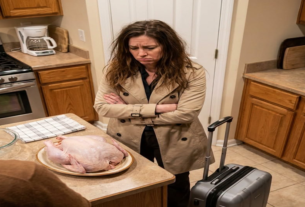
I was sitting on the edge of our bed with a baby monitor in my hand, half listening to Hannah’s breathing on the little speaker, half folding a basket of towels, when I noticed the suitcase. Our good one, the hard-shell navy one we’d bought for our honeymoon to the Ozarks and never used since. It was open on the bed, and he was filling it with a kind of calm that should have terrified me more than it did, because I still, even then, thought I was watching a man pack for a work trip.
“Where are you headed?” I asked.
He didn’t look up. He folded a shirt the way he folded everything, badly, in a hurry, and set it in the case.
“I’m done,” he said. He said it the way you’d say the mail’s late, or it looks like rain. “I’m tired of the routine. Of the noise. Of always being needed. I want to live for myself.”
I have replayed that sentence more times than I can count in eleven years, and I still don’t know which part cuts deepest. That he called our children noise. That he called being their father a routine, like clocking in somewhere he no longer cared to work. Or that he said it wanting to live for himself, as if the six of us had been some kind of sentence he’d finally served out.
I stood there in the doorway of the room where four of my six children had been conceived, holding a baby monitor that crackled faintly with the sound of my youngest daughter breathing, surrounded by toys someone had tracked upstairs and towels I’d have to refold, and I understood something with a clarity that felt almost violent. He had not left that night. He’d left a long time before that, maybe a year before, maybe longer. That night was just the first time he bothered to tell me the truth about it.
He zipped the case. He didn’t hug me. He didn’t look in on the kids sleeping down the hall, not one of them, not even to press a kiss to a forehead the way he used to every single night without fail. He walked past me, down the stairs, and out the front door, and I heard his truck start in the driveway and pull away, and then the house was just very, very quiet, the kind of quiet that has a weight to it, that presses on your chest until you remember to breathe again.
I didn’t cry that night. I remember being surprised by that. I think some part of me had already been grieving him for months, quietly, in the background of everything else, and by the time he actually left, there wasn’t a fresh wound left to open. There was just the enormous, flat fact of it. Six children asleep down the hall. One of me standing at the bottom of the stairs.
What disappearing actually looks like
People imagine a man walking out means a dramatic absence, a hole shaped exactly like him. What it actually meant, in practical terms, was much colder than that.
No visits. Not for Emma’s tenth birthday, not for the twins’ eighth, not for a single one of the seventeen birthdays that passed over the next few years while he was gone. No calls on Christmas morning. No showing up to Josie’s kindergarten graduation, where she stood on a folding chair in a paper cap looking for a face that wasn’t there and finding mine instead, which I made sure was enough, even though I knew it wasn’t the same.
No child support, not one dollar, not for years, because Missouri’s system moves slow and Grant moved faster, picking up work under the table two states over so nothing could ever be garnished. No help when Micah broke his arm falling off the porch rail and I sat in the ER at two in the morning with five other kids asleep in a row of plastic chairs because I had no one to leave them with. No help when the transmission went out on our van and I walked to the feed store, three miles each way, for six weeks, pushing a stroller with groceries balanced on top because bus fare mattered more than my knees did.
I became everything in that house. Mother, father, provider, shield. I want to say I did it gracefully, but that would be a lie for the sake of a better story. I did it exhausted. I did it angry, some days, so angry I’d sit in my truck in the church parking lot after dropping the kids at Sunday school and just grip the steering wheel until my knuckles went white, because I couldn’t let them see it, not once, not ever. Six kids cannot watch their mother come apart. So I came apart in parking lots and in the shower with the water running loud enough to cover it, and then I dried off and went back to being the only wall standing between my children and the world.
My mother helped when she could, which was less than either of us wanted, since her own health wasn’t good. My sister, Kathy, stepped in more, taking the twins some weekends so I could work a double at the diner in town without paying for a sitter I couldn’t afford. The women from the Methodist church, the same crooked-steeple church where I’d married him, showed up more than once with casseroles and hand-me-down winter coats, and I learned something about pride during those years, which is that it’s a luxury, and I couldn’t afford that either.
There were weeks all six of us ate the same pot of beans and rice because it stretched the farthest and cost the least. There were nights I stood at the stove stretching a single package of ground beef across two meals, doing math in my head that had nothing to do with recipes and everything to do with survival. There were nights I cried after the kids were asleep, silently, into a pillow, because I had promised myself a long time before that they would never once hear it.
And somewhere in there, I stopped waiting. I couldn’t tell you the exact day. There wasn’t a scene, no dramatic moment where I threw his old college t-shirt in the trash and declared myself free. It was slower than that, and quieter. One day I noticed I hadn’t thought about him at all, not the whole day, not even when Micah did that thing with his eyebrows that was so exactly like his father’s it used to stop my heart. I had just been too busy living to keep grieving a man who’d already made his choice clear.
Building something honest out of the wreckage
I want to tell you what those years actually built, because the ache is only half the story, and it’s the less important half.
I took a job at the diner on Main Street first, waiting tables for tips that I counted out on our kitchen table every night like it was a small ceremony. Within two years, the owner, an older woman named Pearl who’d buried a husband of her own and had no patience for men who didn’t finish what they started, made me assistant manager. She taught me how to read a ledger, how to order inventory, how to fire someone kindly and quickly when it needed doing. I started taking in alterations on the side, sewing hems and taking in waistbands for half the women in town, because my grandmother had taught me to sew before she taught me to drive, and it turned out that skill was worth real money when I stopped being too proud to charge for it.
By the time Emma was fourteen, I had enough saved, along with a small business loan from the bank in town that a loan officer named Walt approved mostly, I think, because he’d watched me raise six kids alone and figured I wasn’t a woman who defaulted on anything. I bought the little brick building two doors down from the diner and opened Denise’s Alterations and Tailoring. I did prom dresses and funeral suits and wedding gowns and everyday work pants for men at the plant outside town, and slowly, that shop became something that was entirely, completely mine.
The kids grew up fast, the way kids do when there’s no other option. Emma became the kind of oldest daughter who could get four younger siblings fed and dressed and out the door for school while I opened the shop early, and I have never once, not for a single day, taken that for granted. Wyatt and Colton played football for Bellwood High and filled our small house with the particular chaos of teenage boys who ate everything in the refrigerator and left cleats in every doorway. Josie turned out to be sharper than any of us, all A’s, talked her way into a scholarship at the state university two hours north. Hannah and Micah, my second set of twins, the two who’d started life so small Grant could hold them in one hand, grew up loud and inseparable and stubborn in exactly the way that made me proudest, because it meant nothing in this world had managed to make them small.
It was a hard life. I won’t dress that up. But it was an honest one, built by people who loved each other and showed up for each other every single day, which is a different thing entirely from the life I might have had, the one with a man in it who only showed up when it suited him.
The man across the street
Eleven years passed. I want you to sit with that number for a second, because it matters. Eleven years of birthdays he missed. Eleven years of report cards and broken bones and church potlucks and a hundred small, ordinary Tuesdays that made up the actual substance of a family, all of it happening without him, none of it slowing down to wait and see if he’d come back.
It was a Saturday in early spring, the kind of gray Missouri day where the sky can’t decide if it wants to rain. I’d walked to the market on Route 9 instead of driving because my truck was in the shop, and I came out with two paper bags loaded heavier than I should have carried on foot, the plastic handles of one bag long gone, the paper cutting thin red lines into my fingers as I shifted the weight from one hip to the other.
That’s when I saw him. Across the street, near the bus stop bench outside the old hardware store, which had closed down two years before and never reopened.
At first, I truly did not know who I was looking at. I want to be truthful about that, because it’s the part of this story that still unsettles me the most. I looked at that man the way you look at any stranger, a passing shape on a sidewalk, and I nearly kept walking.
Something made me look again. Maybe it was the way he stood, weight shifted onto one leg, a habit Grant always had, or maybe it was some deeper recognition that worked faster than my conscious mind could keep up with. Whatever it was, I stopped on the sidewalk, bags cutting into my fingers, and I looked, and I looked, and then all at once the shape resolved into a face I had once known better than my own.
My heart dropped, but not from pain. From shock.
Because the man standing across that street looked nothing like the one who had walked out of our bedroom eleven years before.
What eleven years had done to him
Grant had always been a big man, broad through the shoulders from years of construction work, the kind of build that made him look like he could carry anything. The man across the street was thin in a way that looked less like weight loss and more like something had been hollowed out of him. His jacket, a canvas work coat gone gray at the seams, hung off him the way clothes hang off a wire hanger. His hair, which had been thick and dark the last time I’d seen it, was mostly gone, and what remained had gone white in patches, not the distinguished gray of a man aging well but the uneven white of a man who’d aged badly and all at once.
He was using a cane. Grant Sutter, who had once climbed scaffolding two stories up without a second thought, was leaning on an aluminum cane with a rubber grip worn smooth, and even from across the street I could see the tremor in his other hand as he reached up to adjust his collar.
I stood there long enough that he must have felt it, the weight of being looked at, because he turned his head and his eyes found mine. For a moment neither of us moved. I don’t know what he saw when he looked at me, a woman standing on a sidewalk with grocery bags cutting into her hands, but I know what I felt looking at him. Not the triumph people probably expect me to describe. Not satisfaction. Just a strange, hollow shock, the kind you feel when something you buried a long time ago is suddenly standing in front of you, dug up and changed almost past recognizing.
He crossed the street. I let him.
“Denise,” he said, and his voice had changed too, thinner, roughened at the edges in a way that made me think of cigarettes or something worse. “I almost didn’t know you.”
“I almost didn’t know you either,” I said, and it was the truest thing either of us said for the next several minutes.
What he told me
I didn’t ask him what had happened. I want to be clear about that, because I think there’s a version of this story where the wronged wife demands an accounting, and that was never who I was going to be, not that day, not on a sidewalk with my arms aching from grocery bags and four of my six kids waiting for me to bring home the makings of Saturday dinner. But he told me anyway, the way people do when guilt has been sitting in them so long it starts leaking out on its own.
Whitney had left him three years after he left us. Not gently, either, from what he said, though I noticed he told that part of the story like a man still surprised by it, like he hadn’t seen the shape of his own pattern even after living inside it twice. She’d taken their son, a boy named Colt who would have been about eight by then, and moved to Tulsa to live near her mother, and Grant hadn’t seen him in over a year. He said it plainly, no more emotion in his voice than if he were reading a grocery list, and I understood in that moment that he plainly did not see the mirror he was standing in front of. A woman had taken his son away from him the exact way he had walked away from six children of his own, and he talked about it like something that had simply happened to him, weather again, nobody’s fault, nothing to be done.
After Whitney, there’d been a run of bad luck he described in a tone that made it sound like fate rather than consequence. A construction accident two years back had crushed three vertebrae in his lower back, the kind of injury that ends a man’s ability to do the only work he’d ever known how to do. Worker’s comp had run out. He’d burned through what little savings he had on medical bills the insurance didn’t cover. He’d been staying, he admitted, in a room above the old hardware store that a cousin let him use in exchange for what odd jobs his back would still let him do, which by the sound of it wasn’t much.
He asked about the kids. All six names, in order, which surprised me, that he still had them memorized, until I realized a man doesn’t forget the names of six children so much as he simply stops using them for eleven years.
I told him the truth, plainly, the way I’d learned to tell hard truths without flinching, because raising six kids alone teaches you that skill whether you want it or not. Emma was twenty, in her second year of nursing school, engaged to a good man from Willow Creek. Wyatt and Colton were nineteen, one working at the plant and saving for a truck, the other headed to community college in the fall on a partial football scholarship. Josie was seventeen, top of her class, already accepted early to the state university. Hannah and Micah, his youngest, the twins born nine weeks early who he’d once held one in each hand, were fourteen, loud and stubborn and thriving in a way that had nothing to do with him.
He asked if he could see them.
What I said, and what I didn’t
I thought about lying to him in that moment. I thought about telling him it wasn’t my decision to make, that they were old enough now to choose for themselves, which was technically true and would have let me walk away without having to be the one who said no. But I have never in my life been a woman who hides behind a technicality when a direct answer is owed, and I didn’t start that day.
“I’ll tell them I saw you,” I said. “What they do with that is theirs to decide, not mine. But I’m not going to pretend to you that it’s going to be easy, or that they’re going to come running. You missed every single day it would have mattered most. You don’t get to just show back up on the days it’s convenient.”
He didn’t argue with that. I think some part of him, standing there thin and stooped and leaning on a cane, already knew it before I said it. There’s a particular kind of clarity that comes to people, I’ve noticed, once the world has finally stopped indulging them. He’d spent ten years being the man who got to decide when he was needed and when he wasn’t. Eleven years later, standing on that sidewalk, he was finally on the other side of that arrangement, waiting to find out whether anyone still needed him at all.
“I know,” he said. “I know I don’t deserve it.”
I didn’t tell him he was wrong. I also didn’t tell him what I felt in that moment, which was not the sharp, satisfying kind of vengeance you might expect from a story like this. It was something quieter and sadder than that. I looked at the man I had married at twenty-three, the man who had once hummed off-key lullabies while walking a colicky baby around our kitchen at three in the morning, and I saw someone who had traded every single thing that might have anchored him, for a version of freedom that had left him alone, broken-backed, and estranged from two families instead of one.
He had wanted to live for himself. He had gotten exactly that. And it had cost him everything worth living for.
What I told the kids
I walked the rest of the way home with my bags cutting deeper lines into my fingers than they had on the way to the market, though I don’t think it had anything to do with the weight of the groceries.
I told them that evening, all six of them, sitting around the same kitchen table where I’d once counted out diner tips one crumpled bill at a time. I told it plainly, the way I’ve always tried to tell them things, because I decided a long time ago that raising six kids without their father meant I owed them the truth even when it was hard, especially when it was hard.
Emma cried, quietly, the way she does everything, and asked if I was okay. I told her I was, and I meant it, which surprised me even as I said it out loud.
Wyatt got angry, the fast, protective kind of anger that reminded me so much of my own father that it nearly undid me. Colton was quieter about it, the way he’s always been the quieter of the two, but I saw his jaw working the whole time I talked.
Josie asked practical questions, wanting details, timelines, whether he was sick, whether he needed money, and I told her the truth, that I didn’t know everything and hadn’t asked, because some questions weren’t mine to ask on their behalf.
Hannah and Micah, the youngest, the ones who’d been babies in an incubator the last time their father had held them close, mostly just listened, and when I finished, Micah asked the question that ended up mattering more than any other one asked that night.
“Do you want us to see him?”
I told him the truth. I told all of them the truth. It wasn’t my choice to make anymore, none of it was, not who saw him and who didn’t, not who forgave what and on what timeline. I had spent eleven years being the only parent in that house, making every decision alone because there was no one else standing there to make it with me. This one, finally, wasn’t mine to make at all.
In the weeks that followed, some of them chose to see him and some didn’t, and I made peace with the fact that it would look different for each of my six children, because their wounds from his leaving had never been identical to begin with, and their paths back toward him, if there were paths at all, wouldn’t be identical either. Emma went once, sat with him for twenty awkward minutes over coffee at the diner where I used to work, and came home saying it felt like visiting a stranger who happened to know her middle name. Josie has not gone at all, and has told me plainly she doesn’t intend to, and I have never once tried to talk her out of that. Hannah and Micah, the babies he once held one in each hand, asked to see a photograph of him as he is now, looked at it for a long moment, and then asked me to make Saturday dinner instead, which I did, and which felt like the truest answer any of them gave.
What I understand now, that I didn’t understand then
People sometimes ask me if I felt vindicated, seeing him that way, thin and stooped and alone on a sidewalk outside a hardware store that used to sell nails and paint and now sold nothing at all because it had closed its doors the same way he’d once closed the door on us. I understand why they ask. It’s a satisfying shape for a story to take, the cruel man brought low, the wronged wife standing tall in the wreckage of his choices.
But that isn’t quite what I felt, and I think the truth matters more than the satisfying version.
What I felt, watching him lean on that cane and talk about a second family that had also, somehow, slipped through his fingers, was something closer to sorrow. Not for myself. I had long since stopped needing sorrow on my own behalf, because I had built something real and lasting out of the wreckage he left behind, six good kids and a business with my name on the window and a life I was, on the whole, proud of. The sorrow I felt was for him, and for the version of him I had married at twenty-three, the man who used to lift babies without complaint and kiss my forehead like he meant it. That man had traded everything that might have held him steady for a freedom that turned out to be nothing more than an empty room above a shuttered hardware store, and I don’t think there’s any way to call that a victory, even for the person he wronged.
What I know for certain, walking that last stretch home with my grocery bags and my six grown and growing children waiting for me, is this. The routine he found so tiresome, the noise he wanted so badly to escape, the constant state of being needed that he described like a burden, that was never a cage. It was the whole entire architecture of a good life, and he walked straight out of it in search of something he called freedom and found, eleven years later, that it had cost him every single thing worth having.
I did not get vengeance that day on that sidewalk. What I got instead, standing there in the gray spring light with my hands aching and my heart, strangely, steady, was proof of something I had already built for myself in the years he was gone. I had not needed him to become whole. I had become whole in his absence, one hard year at a time, one alteration shop and one diner shift and one silent, pillow-muffled cry at a time, and no version of him walking back across that street, however changed, however diminished, could take that away from me now.
He asked, before we parted ways that day, if he could call me sometime. I told him he could call his children, if they were willing to hear from him, and that whatever was left after that would be between them and him, not me. Then I picked my bags back up, feeling the paper cut deeper into my fingers, and I walked the rest of the way home to the life I had built, which was, in every way that mattered, still mine.
—
This story is a dramatization. Names, characters, and details are invented to protect privacy, though the experience they represent is one many families have lived through.