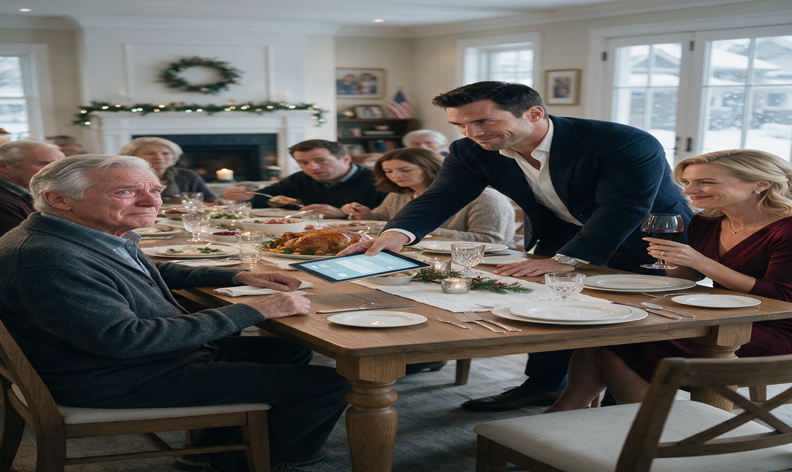
On Christmas Eve, my son shoved a $2,000 rent demand across the dinner table and said, “Pay the rent or get out.” His wife laughed while twenty-two guests watched me pack my bag and walk into the snow. I didn’t argue or ask to stay. I simply left the house and climbed into my truck. Before I could start the engine, my phone lit up with a banking alert: someone inside that house was trying to move $15,000 from my emergency account.
The rent demand landed between the turkey and the cranberry sauce.
Two thousand dollars.
Tyler shoved the tablet across the Christmas Eve table so hard that it clipped a water glass and sent a thin sheet of ice water across the white tablecloth.
“Pay the rent or get out.”
Twenty-two people watched me.
No one said a word.
My daughter-in-law, Megan, sat three seats away with one hand wrapped around a glass of Pinot Noir. She looked from the glowing payment screen to my face and laughed.
Not nervously.
Not because she thought Tyler was joking.
She laughed because she had been waiting for this.
“Let’s see how you survive out there, old man.”
Outside the dining-room windows, snow was falling hard enough to soften the streetlights.
I was seventy-one.
For six months, I had been living in the guest room at the back of Tyler’s house, wearing old flannel shirts, driving my pickup, and allowing my only son to believe I had nowhere else to go.
He thought I was broke.
Megan thought I was worse than broke.
She thought I was dependent.
Tyler leaned back in his chair and looked around at the guests as if he had finally gathered enough witnesses for some important act of courage.
“I’m tired of carrying everybody,” he said. “I provide for my wife. I provide for this house. I’m not supporting another grown adult for free.”
The irony was so complete that I almost smiled.
The twenty-pound turkey in front of him had been paid for with a card linked to one of my companies.
So had the heating bill keeping the house at seventy-two degrees.
So had part of the insurance on the luxury SUV sitting in his driveway.
Even the business Tyler liked to describe as his proof of being a self-made man had survived because I had quietly guaranteed the commercial loan behind it.
He knew none of that.
That had been intentional.
My name is Bruce. I built a national logistics company from one used cargo truck and four decades of work that left me with more memories of loading docks than vacations.
Ten years earlier, I sold the company.
Tyler believed the sale had gone badly.
He thought competitors had crushed me, creditors had picked over the remains, and I had been left with a modest pension and Social Security.
That was the version I allowed him to believe.
The truth was that I had sold the company for enough money to never worry about a bill again.
Most of the proceeds were held through a private company called Apex Holdings. I owned property, investments, and the quiet kind of security that did not need to be displayed in a driveway.
I hid that wealth because I had watched entitlement growing in my son for years.
As a teenager, Tyler wanted expensive things before he understood what they cost.
As a young man, he wanted the appearance of success before doing the work required to build it.
Whenever life cornered him, I rescued him.
I helped with credit cards.
I helped with failed ventures.
I helped when lenders stopped returning his calls.
Every rescue came with the same promise.
This is the last time, Dad.
It never was.
Six months before that Christmas dinner, I told Tyler I needed somewhere to stay.
I wanted to know something I had been afraid to ask directly.
If he believed I had nothing left to give him, would he still treat me like his father?
At first, he did.
He carried my duffel bag upstairs.
He told me the guest room was mine as long as I needed it.
Then Megan started counting.
Extra groceries.
Extra laundry.
Another person using the shower.
She began making comments about my pension.
Then about my clothes.
Then about how difficult it must be for Tyler to support “another household.”
By November, Tyler had started repeating her language.
By Christmas Eve, they wanted an audience.
I looked at the tablet again.
$2,000.
“Right now,” Tyler said. “Transfer it in front of everybody.”
One of his golf friends shifted in his chair.
Megan smiled over the rim of her glass.
I pushed the tablet gently away.
“I won’t be doing that.”
Tyler’s cheeks reddened.
“Then you know where the door is.”
I stood.
My knees made the small popping sound they had made for years.
The guests looked everywhere except at me.
I folded my napkin and set it beside my plate.
“Enjoy dinner,” I said.
Tyler laughed once.
“That’s it?”
“That’s it.”
I walked down the hall to the guest room.
The faded canvas duffel was under the bed.
I packed three shirts, jeans, socks, medication, my laptop, and nothing else.
A cheap gold-plated watch Tyler had given me the previous Christmas remained on the nightstand.
Megan appeared in the doorway while I zipped the bag.
“You’ll be calling by New Year’s.”
I put on my coat.
“The shelters are full this time of year,” she added. “I hope that truck has a good heater.”
I looked at her for a moment.
She expected anger.
Maybe pleading.
Instead, I lifted the duffel.
“Merry Christmas, Megan.”
Her smile faded slightly.
When I passed the dining room, twenty-two people watched me walk out.
Tyler did not follow.
Snow had already collected along the driveway.
I climbed into my truck, threw the bag onto the passenger seat, and closed the door.
Through the windshield, I could see the house glowing behind me.
Christmas lights along the roofline.
Candles in the dining room.
People returning slowly to their conversations.
I reached for the ignition.
My phone buzzed.
A banking alert appeared.
TRANSFER REQUEST: $15,000.
I frowned.
The request came from an emergency account I had opened three years earlier with Tyler listed as an authorized user.
The money was supposed to remain untouched except for serious family medical needs.
I opened the alert.
The destination was a luxury travel company.
A Caribbean booking.
For several seconds, I sat motionless in the dark cab.
They had waited until I walked outside.
That mattered.
The rent humiliation had not been the end of the evening.
It had been cover.
Someone inside that brightly lit house was trying to move fifteen thousand dollars from an account they believed I would be too hurt or distracted to notice.
I denied the transfer.
Then I removed Tyler’s access and contacted the bank’s fraud department through the secure application.
I did not go back inside.
I started the truck.
Tyler had given me the answer I came for.
There was nothing left to test.
I drove north.
The subdivisions thinned, then disappeared into wooded hills where houses sat behind stone walls and long private drives.
Forty minutes later, my truck stopped before a wrought-iron gate.
A transponder opened it.
The driveway beyond was clear despite the snow because heating lines beneath the concrete kept ice from forming.
At the end stood a four-bedroom cedar-and-stone house I had owned outright for seven years.
My real home.
I carried the same canvas duffel inside.
Motion sensors brought the lights up gradually.
I dropped my bag onto the leather sofa, took off the coat Megan thought was my best winter coat, and walked into the home office.
Three monitors waited above a walnut desk.
Apex Holdings appeared after several layers of authentication.
For years, I had used that company as an invisible support structure under Tyler’s life.
That night, I began removing myself from it.
Not to punish him for embarrassing me.
Because his attempt to take money from the emergency account showed that the arrangement had become dangerous.
First were the two luxury SUVs.
Tyler liked telling people that the vehicles proved his consulting firm was growing.
His credit had not qualified for favorable lease terms, so one of my entities had guaranteed the arrangement and quietly covered roughly $2,800 in monthly costs.
I ended that subsidy and notified the leasing company that future payments were Tyler’s responsibility.
The vehicles would not vanish at midnight.
Real contracts do not work that way.
But his next payment was now his.
Then came Megan.
Three years earlier, she had left a marketing job and announced she was becoming an independent strategic consultant.
Months passed without meaningful clients.
Tyler panicked.
He asked me for help but begged me not to tell Megan.
“She’ll feel humiliated taking money from you.”
So I created a small consulting arrangement through an inactive subsidiary.
Megan submitted a basic monthly market report.
The company paid her three thousand dollars.
She believed she had a legitimate corporate client.
I told myself I was protecting their marriage.
What I was really doing was financing an illusion.
I terminated the contract.
Then I opened Tyler’s commercial loan file.
His logistics consulting firm had borrowed heavily for office space, staff, and equipment.
The bank had approved the loan partly because Apex provided a guarantee.
I had prepared withdrawal documents months earlier but never used them.
Christmas Eve finally gave me the answer I had been avoiding.
I instructed our attorneys to begin the lawful process of withdrawing that support under the loan terms.
The remaining balance would not magically come due that second.
But the bank would review his credit facility after the holiday.
For the first time since Tyler started the company, he would have to stand behind it without me.
My phone rang.
TYLER.
I watched it.
Then let it go to voicemail.
He called again.
And again.
On the fourth call, I turned the phone facedown.
Christmas morning arrived clear and cold.
I had barely finished my coffee when my attorney called.
His name was Stanley, and he had handled my corporate and personal affairs for more than twenty years.
“Bruce,” he said, “your son is sitting in my reception area.”
I looked at the clock.
“Christmas morning?”
“He seems highly motivated.”
“What does he want?”
Stanley paused.
“He brought a medical letter.”
I leaned forward.
“What kind of medical letter?”
“It claims you are experiencing rapid cognitive decline. Dementia. He says your behavior last night was confused and unstable.”
I stared through the office windows at snow-covered pines.
“He is asking about emergency authority over your finances and medical decisions.”
The disappointment arrived more slowly than anger.
“He wants me declared incompetent.”
“He appears to.”
“Can he?”
“Not by walking into my office with a letter. Legal incapacity and financial authority do not happen because a son requests them.”
“Good.”
“But the document itself concerns me.”
“Why?”
“Because it appears to be signed by a physician.”
I closed my eyes.
Throwing me out was cruelty.
Trying the emergency account was theft.
This was something else.
“Preserve everything he gives you,” I said.
“I already am.”
“Don’t tell him what I own.”
Stanley was quiet for a second.
“He still believes you lost the logistics company?”
“Yes.”
“And that Apex is unrelated to you?”
“Yes.”
“That may not survive much longer.”
“I know.”
Stanley suggested a meeting the following morning at my primary bank.
Not to grant Tyler power.
To force the documents into proper review, establish exactly what he was claiming, and stop him from shopping the same false story around to other institutions.
Tyler agreed.
So did Megan.
That afternoon, Stanley also brought in Blake, a forensic investigator our firm had used in previous business matters.
We gave him one question.
Where had the medical letter come from?
The answer came through legitimate records, communications voluntarily provided during the investigation, and material later obtained by authorities.
The physician was Richard Vance.
He ran a modest clinic on the edge of the county.
He had financial problems.
Serious ones.
Evidence eventually showed that Tyler had arranged to clear approximately twenty thousand dollars of Vance’s gambling debt in exchange for paperwork supporting a false diagnosis.
That discovery made the situation no longer something Stanley and I could handle as a private family dispute.
Evidence was preserved.
The appropriate authorities were notified.
But before all of that was resolved, Blake found something else in Tyler’s business records.
Megan had been using the company expense card for luxury hotels and spa weekends.
Some charges were connected to meetings with her personal trainer.
The pattern suggested an affair.
More importantly for Tyler’s company, other records showed approximately forty thousand dollars in operating money had been diverted into an account Megan controlled.
I hated knowing it.
Not because I felt sorry for Megan.
Because part of me still felt sorry for my son.
I had come to understand that Tyler had become selfish and dishonest.
That did not mean I enjoyed seeing every part of his life collapse.
The following morning, I dressed in the charcoal suit I had worn when I sold my company.
No flannel.
No worn boots.
No effort to appear smaller.
I arrived at the bank before Tyler.
The branch manager knew me well.
When the private conference-room doors opened at ten, I was already sitting at the head of the table.
Tyler walked in beside Megan.
Stanley followed.
Tyler did not recognize me immediately because my chair was angled toward the window.
“I appreciate everybody moving quickly,” he said. “This is a medical emergency.”
I turned.
Tyler stopped.
Megan’s handbag slipped against the side of her chair.
For several seconds, nobody spoke.
“Dad?”
“Good morning.”
His eyes moved from my suit to Stanley.
Then to the branch manager.
“What is this?”
“The meeting you requested.”
“You look…”
“Competent?”
Megan found her voice first.
“This is some kind of stunt.”
I placed the medical letter on the table.
“No. This is your stunt.”
Tyler sat slowly.
“I was trying to protect you.”
“From what?”
“Yourself.”
I looked at Stanley.
He nodded.
I returned my attention to Tyler.
“Tell the bank manager what you told Stanley yesterday.”
Tyler shifted.
“I said you’ve been behaving erratically.”
“And what authority are you asking for?”
“I’m your son.”
“That wasn’t my question.”
His mouth tightened.
“I want temporary control so we can make sure you don’t lose whatever money you have left.”
I almost admired the wording.
Whatever money you have left.
He still believed he was digging for scraps.
I slid a corporate ownership statement across the table.
Tyler looked at it.
APEX HOLDINGS.
Then my name.
He read it twice.
“What is this?”
“The company that owns the house you live in.”
Megan stared at me.
“No.”
“Yes.”
Tyler shook his head.
“My name is on that house.”
“Your name is on a lease-to-own agreement. Your credit did not qualify for the financing you thought you had. Apex acquired the property and gave you the purchase option you insisted you would eventually exercise.”
He looked toward Stanley.
Stanley said quietly, “That is accurate.”
I continued.
“The same company has supported portions of your vehicle leases.”
Another page.
“And guaranteed the commercial loan behind your business.”
Another.
“And for three years, one of its subsidiaries has paid Megan three thousand dollars a month for consulting work.”
Megan stared at the paper.
“You?”
“Yes.”
Her face flushed.
“You were my client?”
“I was the reason the client existed.”
Tyler looked at her.
Then at me.
The balance of the room had changed completely.
But I did not enjoy it.
I had spent years hiding my help because I thought protecting their pride was kindness.
Now every secret kindness looked like another mistake.
I handed Tyler the notice concerning the house.
“This begins the process of ending your occupancy.”
He pushed the paper away.
“You can’t evict me.”
“Not today.”
I kept my voice even.
“There will be a legal process. You’ll have notice and whatever rights the agreement gives you. But you told me on Christmas Eve to pay rent or leave.”
I looked at him.
“I left.”
Megan stood.
“This is insane.”
“No. Insane is trying to have a healthy man declared incompetent because you want access to his accounts.”
“We were worried about you.”
“Richard Vance says otherwise.”
The name landed hard.
Tyler stopped breathing for a second.
Megan looked at him.
“Who is Richard Vance?”
I watched her carefully.
She genuinely did not seem to know.
Tyler recovered too late.
“Just a doctor.”
“The doctor whose letter says I have dementia.”
Megan turned.
“You told me your father’s regular doctor signed that.”
Tyler said nothing.
Stanley spoke.
“The letter and the circumstances surrounding it are under formal review.”
Tyler’s face had gone pale.
Then the branch manager placed another file on the table.
Tyler’s commercial loan review.
The guarantee from Apex was being withdrawn according to its terms.
The remaining credit line was at risk.
That was when Megan panicked.
“Tyler, tell me the company can cover this.”
He stared down.
“Tyler.”
“I need time.”
“How much money do you have?”
He did not answer.
I wished the meeting could have ended there.
It didn’t.
The bank’s review contained recent company expenses.
Hotel charges.
Spa charges.
Weekend stays.
Tyler frowned at the pages.
“What is this?”
Megan moved toward him.
“Those are business expenses.”
“At the Grand Plaza?”
No answer.
“Twelve thousand dollars?”
“Tyler.”
He looked at her.
“I’ve never stayed there with you.”
Her face hardened.
The fear disappeared.
Something harsher took its place.
“I knew your company was failing.”
“What?”
“I knew six months ago.”
Tyler looked down at the statements again.
Another account appeared.
Forty thousand dollars diverted from company operating funds.
His voice became very quiet.
“You took this?”
“I protected myself.”
“With company money?”
“You were going to lose everything.”
“I was trying to save the company.”
“And I wasn’t going down with it.”
Tyler stared at her.
“Who were you at those hotels with?”
She hesitated.
That hesitation answered him.
His chair scraped backward.
Stanley immediately said, “Tyler, sit down.”
Instead, Tyler reached toward Megan’s handbag where her phone was visible.
She grabbed it first.
“Don’t touch me.”
He lunged for the bag.
Bank security was inside the room within seconds.
They separated them.
Megan accused him of attacking her.
Tyler accused her of stealing company funds.
The branch manager ended the meeting.
I packed my documents.
Before leaving, I looked at my son.
He was breathing hard, held several feet from Megan by security.
“Dad.”
I stopped.
“You did this.”
“No.”
“You set this whole thing up.”
“No, Tyler.”
I looked at the medical letter.
“You did.”
I walked out.
The legal and financial consequences moved forward over the following weeks.
The bank reviewed the business loan.
The vehicle lessors pursued what Tyler owed once my subsidies ended.
Apex began the formal process required under the housing agreement.
Megan filed for divorce.
Investigators examined the false medical letter and the evidence surrounding the payment to Dr. Vance.
They also reviewed Megan’s transfers from Tyler’s company.
I did not need to manipulate any of it.
For the first time in years, I stopped rescuing people and allowed institutions to do what they were designed to do.
Tyler did not accept that quietly.
One night, several days after the bank meeting, an alert from my home security system woke me.
Someone had crossed the eastern edge of my property.
The camera showed Tyler.
He had parked down the county road and walked through the snow.
A crowbar was in his hand.
He struck one camera.
Then he broke a sunroom window.
I called emergency services immediately and followed the security dispatcher’s instructions.
Then I waited at a safe distance in the interior part of the house.
Tyler entered shouting my name.
He tore open drawers.
Opened cabinets.
Knocked a picture from the wall.
“Dad!”
I finally answered from across the living room.
“Stop.”
He turned.
His coat was wet with snow.
His face looked exhausted and wild.
“I need money.”
“You need to leave.”
“I need two hundred fifty thousand dollars.”
“No.”
“I can save the company.”
“No.”
“You owe me.”
That word.
Owe.
I had heard it in different forms his entire adult life.
I stood still.
“I paid for your education. I helped you start businesses. I guaranteed loans. I subsidized your cars. I supported your household.”
I looked at the crowbar.
“And when you thought I had nothing, you threw me into the snow.”
“You were never there when I was growing up.”
His voice cracked.
“You worked all the time.”
“I did.”
“You missed things.”
“I did.”
“You chose that company over me.”
That accusation hurt because part of it was true.
I had missed games.
Birthdays.
School events.
I had convinced myself that providing was the same as being present.
It wasn’t.
But neither did it excuse what stood in front of me.
“I made mistakes as your father.”
Tyler stared.
I continued.
“But my mistakes do not entitle you to forge a diagnosis, take my money, or break into my house.”
He tightened his grip on the crowbar.
“You can fix this.”
“No.”
“You can.”
“I won’t.”
He raised the metal bar.
Before he came closer, the sound of approaching sirens rose outside.
Tyler froze.
The security system had already transmitted the break-in.
Lights began flashing through the windows.
His arm lowered.
“Dad.”
I did not answer.
“Tell them it was a misunderstanding.”
“No.”
“They’ll arrest me.”
“Yes.”
His knees seemed to weaken.
“I’m your son.”
“You are also a seventy-one-year-old man’s adult son standing inside his house after breaking a window while holding a crowbar.”
The front of the house filled with voices.
Commands.
Tyler dropped the tool.
When officers entered, I told them the truth.
“He did not have permission to enter. He broke the window. The crowbar is his.”
Tyler looked at me as they secured his hands.
“Please.”
I said nothing.
He was taken outside.
The strange thing was that when the vehicle disappeared through the gate, I did not feel victorious.
I sat alone in my living room and cried.
Not for the money.
Not for the property.
For the little boy Tyler had once been.
For the father I could have been more often.
For every rescue I had mistaken for parenting.
The cases took months.
The medical-document scheme brought serious consequences for Tyler and for Dr. Vance.
The break-in created separate charges.
Megan’s handling of business funds became part of the financial dispute surrounding the company and their divorce.
Tyler’s business did not survive.
The house was eventually vacated through the proper legal process.
The vehicles were returned after the leases could no longer be maintained.
The luxury life Tyler had presented to the world disappeared more quietly than it had been built.
No dramatic crowd watched.
No twenty-two guests gathered around.
There were notices.
Lawyers.
Boxes.
Canceled contracts.
Debt statements.
That was enough.
Thirty days after the break-in, Stanley came to my house with a different kind of document.
An irrevocable charitable trust.
For years, I had hidden my money because I feared what wealth would do to Tyler.
After everything that happened, I realized hiding it had not solved anything.
Wealth without purpose had become another secret I carried around.
I wanted the money to build something real.
The trust would fund a vocational education program for young adults who wanted practical careers.
Electrical work.
Carpentry.
Plumbing.
Automotive repair.
Trades where skill mattered more than appearances.
I imagined a workshop filled with sawdust and welding sparks.
Young people leaving at the end of the day tired because they had actually built something.
That felt closer to the life I understood.
I signed.
Stanley closed the folder.
“You sure?”
“Yes.”
“What about Tyler?”
“He had opportunities.”
Stanley nodded.
After he left, I made coffee.
The house was quiet.
Snow outside the windows was beginning to melt beneath a pale winter sun.
My phone rang.
The screen showed an incoming collect call from a correctional facility.
I knew who it was.
For several seconds, I watched the phone.
Once, I would have answered before the second ring.
I would have listened.
Paid for an attorney.
Fixed a bill.
Found another path.
Rescued him.
Instead, I declined the call.
Not because I stopped being his father.
Because being his father no longer meant standing between him and every consequence he had earned.
I carried my coffee to the window.
A month earlier, I had been sitting in a truck outside Tyler’s house while snow fell around me, staring at a fifteen-thousand-dollar banking alert.
I had thought that alert was the moment everything changed.
It wasn’t.
The real change came when I finally understood that generosity without boundaries can become another form of harm.
I had spent years keeping Tyler from falling.
He never learned how to stand.
Now that lesson belonged to him.
And for the first time in a very long time, my life belonged to me.
If you found this story on Facebook, please return to the post, tap Like, and leave “Worth reading” in the comments. That small gesture truly matters—it shows your support, helps stories like this continue to be shared, and I sincerely appreciate you being part of the journey.