Part 1 — The Look on My Mother’s Face
The last thing my mother said to me before disappearing from my life for three years was:
“You’re choosing that life.”
She said it like she was sentencing me.
Like marrying the woman I loved meant I had voluntarily stepped off a cliff.
Three years later, my mother stood in my front doorway again.
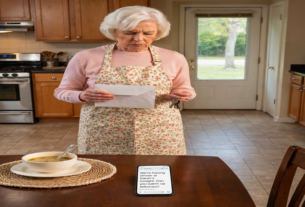
She was wearing a cream-colored blazer, pearl earrings, and the same expression she used to wear whenever a waiter brought the wrong bottle of wine.
Her eyes moved slowly across the room.
The high ceilings.
The restored hardwood floors.
The sunlight pouring through the big windows.
The photographs covering one entire wall.
My wife laughing on a beach.
My stepson holding a fishing pole beside me.
The three of us painting a bedroom.
Another picture of the four of us in front of the house on the day we bought it.
And in the center, a photograph taken only two months earlier.
Anna was holding our baby daughter, Sophie.
Caleb—now ten—had one arm around my shoulders.
I was looking at them instead of the camera.
My mother stared at that photograph for several seconds.
Then she looked toward the dining room, where a long wooden table was covered with construction paper, crayons, half-finished homework, and a vase of grocery-store flowers.
She looked toward the kitchen.
At the coffee maker.
The school calendar.
The refrigerator covered in magnets and drawings.
At a crooked piece of paper in Caleb’s handwriting that said:
BEST DAD EVER — EVEN WHEN HE MAKES ME CLEAN MY ROOM.
Then she saw the framed business certificate hanging near my office door.
Her eyes widened.
She reached for the doorframe as though she suddenly needed something to steady herself.
And for the first time in my life, my mother looked genuinely speechless.
“Oh my God,” she whispered.
Then she turned toward me.
“What is this?”
I almost laughed.
Not because the question was funny.
Because three years earlier, she had been so sure she knew exactly what my life would become.
She had pictured failure.
Regret.
Debt.
Chaos.
A woman who would “drag me down.”
A child who would “never really be mine.”
She had imagined me crawling back to her eventually, embarrassed and defeated.
Instead, she was standing inside the life she had warned me against.
And she had no idea what to do with what she saw.
But to understand why that moment mattered so much, you have to understand my mother.
And the strange thing about growing up with everything…
except the freedom to choose your own life.
Part 2 — The Life My Mother Planned for Me
My father left when I was five.
I remember very little about the day itself.
Just a suitcase by the stairs.
My mother standing beside the kitchen counter with her arms crossed.
And my father crouching in front of me, promising he would call.
For a while, he did.
Then the calls became less frequent.
Birthdays.
Christmas.
Eventually, not even those.
My mother never remarried.
She raised me alone, although “alone” probably gives the wrong impression.
We were never struggling.
My grandparents came from money, and my mother had built a successful career of her own in commercial real estate.
We lived in a beautiful house in a neighborhood where every lawn looked professionally trimmed.
I went to private school.
I had tutors when I struggled with math.
Piano lessons every Wednesday.
Tennis every Saturday.
Summer programs chosen according to how impressive they would eventually look on college applications.
By sixteen, my mother had already decided where I should attend college.
By nineteen, she had opinions about graduate school.
By twenty-two, she had begun commenting on the women I dated.
She rarely shouted.
She didn’t need to.
My mother controlled people through disappointment.
A sigh.
A pause.
A raised eyebrow.
A quiet:
“I thought you had better judgment than that.”
When I was younger, her approval mattered more than I wanted to admit.
After my father left, I think part of me became terrified of disappointing the only parent who stayed.
So I followed the plan.
I graduated.
I got a good job working in project management for a development company.
I bought respectable clothes.
I went to respectable dinners.
I dated women my mother considered respectable.
And I was miserable in such a quiet way that it took me years to notice.
Then I met Anna.
And nothing about her fit my mother’s plan.
Which was probably part of the reason I noticed her.
Part 3 — Anna
I met Anna because I cut my hand trying to open a cardboard box.
Not exactly the romantic story people expect.
I had been helping a friend move into a new apartment when the utility knife slipped.
The cut wasn’t serious, but it was deep enough that my friend insisted I go to a walk-in clinic.
Anna was working the front desk that evening.
She had dark hair tied into a messy bun, tired eyes, and a coffee mug that said:
I SURVIVED ANOTHER MONDAY.
It was Thursday.
I pointed that out.
She looked at the mug, then at me.
“I’m emotionally still on Monday.”
That made me laugh.
When she smiled, she had this way of looking completely present, as though nothing else existed for those few seconds.
After the nurse patched up my hand, Anna happened to be walking out at the same time I was leaving.
Her car wouldn’t start.
It was an old blue Honda with one hubcap missing.
I offered to help.
Twenty minutes later, after a lot of useless staring under the hood, we admitted neither of us knew what we were doing.
We called roadside assistance.
While we waited, we sat on the curb and talked.
That was when she told me about Caleb.
“He’s seven,” she said.
She pulled out her phone.
“Want to see?”
Before I could answer, she was already showing me pictures.
Caleb missing his two front teeth.
Caleb wearing a dinosaur costume.
Caleb asleep with his face in a bowl of popcorn.
“You really love being a mom,” I said.
Anna smiled.
“He’s the best thing I ever did.”
There was no apology in her voice.
No embarrassment.
She wasn’t trying to hide the fact that she had a child from a previous relationship.
She was proud of him.
That impressed me.
We exchanged numbers that night.
A week later, we had coffee.
A month later, I met Caleb.
Six months later, I couldn’t imagine my life without either of them.
Anna never pretended her life was simple.
Caleb’s biological father had disappeared before Caleb turned two. Occasionally he sent a birthday message or made a promise to visit, but he never followed through.
Anna worked nights whenever she could because the shift differential paid more.
She clipped coupons.
She knew exactly how long she could drive after the gas light came on.
She could turn leftovers into meals that somehow tasted better the second day.
But she never asked me to rescue her.
That was important.
Anna wasn’t looking for someone to fix her life.
She had already built one.
It was just exhausting.
And I wanted to be part of it.
Part 4 — The Dinner That Changed Everything
I waited almost eight months before introducing Anna to my mother.
I knew what was coming.
I just underestimated how quickly it would happen.
My mother invited us to dinner at her house.
The conversation was polite for the first twenty minutes.
Too polite.
My mother asked Anna about work.
Anna told her she was working at the clinic while taking classes to move into healthcare administration.
“And the child’s father?” my mother asked.
Anna’s fork stopped.
I looked at Mom.
“His name is Caleb.”
“Yes, of course. Caleb.”
She didn’t apologize.
Anna answered calmly.
“His father isn’t involved.”
My mother’s lips tightened almost imperceptibly.
“And you support him yourself?”
“I do.”
“Interesting.”
That one word told me everything.
After dinner, Anna offered to help carry plates into the kitchen.
My mother immediately said, “No, no. You’re a guest.”
But once Anna went upstairs to use the restroom, Mom turned toward me.
“What are you doing?”
I knew exactly what she meant.
“Having dinner?”
“Don’t be childish.”
“Then say what you want to say.”
My mother lowered her voice.
“She has a child.”
“I know.”
“Whose father disappeared.”
“I know.”
“She works nights at a clinic.”
“So?”
Mom stared at me.
“She comes with baggage.”
I felt something inside me go cold.
“Don’t call her son baggage.”
“I’m being realistic.”
“No. You’re being cruel.”
“I sacrificed everything to give you opportunities most people can only dream of, and you’re throwing your future away.”
I couldn’t believe what I was hearing.
“By loving someone?”
“By making someone else’s problems your responsibility.”
Then Anna appeared at the bottom of the stairs.
She had heard enough.
I could tell from her face.
She walked over, picked up her purse, and looked at my mother.
“Thank you for dinner.”
Then she left.
I followed her.
In the car, she stayed quiet.
Finally, she said, “You don’t have to fight with your mother because of me.”
“I’m not fighting with her because of you.”
Anna turned toward me.
“Then why?”
“Because I should’ve done it years ago.”
That was the moment I understood something I had spent my entire life avoiding.
My mother wasn’t angry because Anna was wrong for me.
She was angry because Anna hadn’t been chosen by her.
Part 5 — The Ultimatum
I proposed to Anna four months later.
Nothing extravagant.
We were walking through a park after Caleb’s school concert.
Caleb was twenty feet ahead of us trying to balance on a curb.
I stopped beneath an oak tree and pulled out the ring.
Anna stared at me.
Then she immediately started crying.
“Is that a yes?” I asked.
She laughed through her tears.
“You didn’t even ask yet.”
So I asked.
She said yes.
Caleb came running back because he thought something was wrong.
When Anna showed him the ring, his eyes got huge.
“Does this mean he’s staying forever?”
Anna laughed.
“If he’ll have us.”
Caleb looked at me seriously.
“We’re kind of loud.”
“I noticed.”
“And Mom burns pancakes.”
“I noticed that too.”
“So you’re sure?”
I looked at Anna.
Then at him.
“Completely sure.”
I told my mother two days later.
Her reaction was exactly what you would expect.
“You can’t be serious.”
“I am.”
“You’ll regret this.”
“I won’t.”
“You’re twenty-seven years old. You don’t need to become responsible for another man’s child.”
“I’m choosing to become responsible for a child I love.”
“He is not your son.”
That sentence ended the conversation for me.
I stood.
My mother did too.
“If you walk out that door and marry her,” she said, “don’t ever ask me for anything again.”
I stared at her.
“I’ve never asked you for money.”
“This isn’t about money.”
We both knew it partly was.
Money had always been one of the tools she used to keep people close.
Then she delivered the sentence that stayed with me for the next three years.
“You’re choosing that life.”
I looked at her.
“Yes.”
She seemed surprised.
“So choose it.”
I nodded.
“I just did.”
And I walked out.
Part 6 — Our First Home
Anna and I were married six weeks later.
There were thirty-two people at the wedding.
No ballroom.
No orchestra.
No designer flowers.
We got married in a friend’s backyard beneath strings of white lights.
Caleb carried the rings.
Halfway down the aisle, he dropped one and spent thirty terrifying seconds crawling around in the grass looking for it while everyone laughed.
It was perfect.
My mother didn’t come.
I had sent her an invitation anyway.
She never responded.
After the wedding, Anna and I moved into a two-bedroom rental on the edge of town.
The carpet was beige.
The kitchen was tiny.
The dishwasher sounded like an airplane taking off.
If you turned on the microwave while running the toaster, the breaker sometimes tripped.
My mother would have hated it.
I loved it.
Because every evening, I came home to people who were happy I was there.
No performance.
No measuring.
No wondering whether I had achieved enough that week to deserve affection.
Just home.
Money was tight sometimes, although not desperate.
Anna kept working.
I kept my job.
We saved.
We budgeted.
We made mistakes.
Once, the Honda needed a transmission repair the same week our washing machine died.
Anna sat at the kitchen table staring at the bills.
“Well,” she said, “we can either have clean clothes or transportation.”
“We can wash clothes by hand.”
She looked at me.
“You’re doing them.”
So I did.
And one night, about four months after the wedding, something happened that I will remember for the rest of my life.
Caleb had a nightmare.
I found him sitting on his bed crying.
I sat beside him until he calmed down.
Then he leaned against me and whispered:
“Dad?”
I froze.
He froze too.
Neither of us said anything.
I think he realized what he’d called me only after the word came out.
“You don’t have to call me that,” I told him gently.
Caleb looked down.
“Can I?”
My throat tightened.
“If you want to.”
He nodded.
“Okay.”
Then he lay back down.
“Goodnight, Dad.”
I barely made it into the hallway before I started crying.
Anna found me standing there wiping my face.
“What happened?”
I pointed toward his room.
“He called me Dad.”
Anna covered her mouth.
Then she cried too.
That night, sitting on the floor of that ugly little hallway, I realized my mother had been right about one thing.
I had chosen that life.
And I would choose it again.
Every single time.
Part 7 — Building Something of Our Own
The next three years weren’t a fairy tale.
That’s important.
Anna and I argued.
We worried about money.
Caleb struggled in school for a while.
We had a pregnancy scare that turned into heartbreak when Anna miscarried early in the pregnancy.
We held each other through that.
Then we kept going.
Anna finished her certification in healthcare administration and was promoted at the clinic.
I started questioning my own career.
For years, I’d been helping developers turn old buildings into expensive properties.
I was good at it.
But I hated the corporate politics.
What I loved was the work itself.
Planning.
Renovating.
Taking something neglected and making it useful again.
So with Anna’s encouragement, I started doing small renovation projects on weekends.
First, a friend’s kitchen.
Then a coworker’s basement.
Then a full bathroom remodel.
Word spread.
Within a year, I had enough work to start my own small renovation and project-management company.
I named it Second Chance Homes.
Anna laughed when I told her.
“That’s a little dramatic.”
“Says the woman who cried over a toaster commercial last week.”
“The dog found his family!”
Eventually, the business grew enough that I left my old job.
Not because we were suddenly rich.
We weren’t.
But we were stable.
And for the first time, I was building something because I wanted it.
Not because my mother had planned it.
Then we found the house.
It was an old Craftsman on a quiet street.
Structurally solid.
Cosmetically terrible.
Peeling paint.
Broken cabinets.
An overgrown yard.
The upstairs bathroom looked like it hadn’t been touched since 1987.
Anna walked through it and said:
“Absolutely not.”
I walked through it and saw possibilities.
Three months later, we bought it.
For the next year, I renovated it slowly.
Mostly myself.
Caleb helped whenever I could safely let him.
He painted one wall of his bedroom bright blue, hated it, then repainted it gray two weeks later.
Anna chose the kitchen.
I built the dining table from reclaimed oak.
And eighteen months after moving in, Sophie was born.
Suddenly the house wasn’t just finished.
It was full.
Full of bottles.
Laundry.
Laughter.
Arguments about bedtime.
Friends dropping by.
Neighbors borrowing tools.
Caleb doing homework at the kitchen island while Anna fed Sophie.
It was messy.
It was loud.
It was everything.
During those three years, my mother never called.
I didn’t call either.
I heard things about her occasionally through relatives.
She knew I had married Anna.
She knew I was still married.
That apparently surprised her.
She knew, vaguely, that I had “started some sort of construction business.”
She never asked for details.
Pride can be an incredible wall.
Then, last week, my phone rang.
I almost didn’t answer when I saw her name.
But I did.
“Hello?”
There was a pause.
Then her voice.
“I heard you have… a family now.”
I nearly laughed.
“I had a family three years ago.”
Another pause.
“I’m in town tomorrow.”
I waited.
“I thought I’d stop by.”
“Why?”
My mother gave a small sigh.
“I want to see how badly you’ve ruined your life.”
There it was.
Three years of silence, and she still couldn’t resist.
I should have hung up.
Instead, I said:
“Two o’clock.”
Part 8 — “Oh My God… What Is This?”
She arrived at exactly two.
Of course she did.
When I opened the door, my mother looked almost exactly as I remembered.
Perfect hair.
Perfect coat.
Perfect posture.
Older, though.
There were more lines around her eyes.
She looked past me toward the house.
I stepped aside.
“Come in.”
She entered.
And stopped.
That was the moment.
Her eyes moved around the room.
Slowly.
She stared at the family photographs.
At the staircase I had rebuilt.
At the bookshelves.
At Sophie’s toys.
At Caleb’s backpack thrown beside the couch.
At the framed newspaper clipping near my office about Second Chance Homes restoring three affordable rental properties in a neighboring community.
Then she saw the photograph over the fireplace.
All four of us.
Anna.
Caleb.
Sophie.
Me.
Something changed in her expression.
She reached for the doorframe.
“Oh my God,” she whispered.
“What is this?”
I leaned against the wall.
“What do you mean?”
She gestured around the room.
“This.”
“My house.”
“You own this?”
“Anna and I own it.”
Her eyes moved toward the office.
“And the business?”
“Mine.”
“You started it?”
“Three years ago.”
She looked genuinely confused.
“But I thought—”
I waited.
“You thought what?”
Before she could answer, a voice came from upstairs.
“Dad?”
Caleb came running down.
He was ten now.
Tall for his age.
He reached the bottom, saw my mother, and stopped.
“Oh. Sorry.”
“It’s okay,” I said.
He looked at her curiously.
I had shown him old pictures.
He knew exactly who she was.
“Caleb,” I said, “this is my mother.”
He hesitated.
Then, because he was a better person at ten than many adults ever become, he smiled.
“Hi.”
My mother stared at him.
“Hello.”
Then Sophie began crying upstairs.
A moment later, Anna appeared carrying her.
She was wearing jeans and a sweatshirt, her hair pulled back.
She stopped when she saw my mother.
For a second, nobody spoke.
Then Anna smiled politely.
“Hello, Margaret.”
My mother looked at Sophie.
Her voice softened.
“Is that…?”
“My daughter,” I said.
Anna looked at me.
“Our daughter.”
I smiled.
“Our daughter.”
My mother’s face changed again.
For years, she had treated family like a résumé.
Something assembled correctly.
The right spouse.
The right background.
The right schools.
The right social circles.
But now she was standing in the middle of a family that had broken nearly every one of her rules.
And it worked.
Part 9 — The Conversation We Should Have Had Years Ago
Anna took the kids upstairs to give us privacy.
My mother sat at the dining table.
The one I had built myself.
She ran her fingers across the wood.
“You made this?”
“Yes.”
She nodded slowly.
“I didn’t know you could build things.”
“You never asked.”
That landed harder than I intended.
She looked down.
After a moment, she said, “I assumed you’d come back.”
I didn’t answer.
“When things became difficult,” she continued. “I thought you would realize what you had done.”
“Things did become difficult.”
She looked up.
“Then why didn’t you call me?”
“Because difficult isn’t the same as wrong.”
Silence.
I sat across from her.
She stared toward the refrigerator, where family photos and drawings were held up with cheap magnets.
“I thought she would become dependent on you,” Mom said quietly.
“She didn’t.”
“I thought raising another man’s child would eventually make you resentful.”
“It didn’t.”
“I thought—”
“I know what you thought.”
My voice was sharper now.
“You thought Anna was beneath me. You thought Caleb was baggage. You thought if I didn’t follow the life you designed, I would fail.”
My mother’s eyes filled with something I had almost never seen in them.
Shame.
“I was afraid.”
That surprised me.
“Of what?”
“Of watching you repeat my life.”
I stared at her.
She took a breath.
“Your father left me with a child. I told myself I was strong enough not to care. I had money. I had my career. I had my parents. But I was terrified all the time.”
Her voice cracked.
“I thought if I could control every part of your future, I could protect you from being abandoned the way I was.”
Suddenly, I saw something I had never seen clearly before.
My mother hadn’t built my cage because she hated me.
She built it because she was afraid.
But understanding someone’s reason doesn’t erase the damage they caused.
“You weren’t protecting me,” I said.
“I know.”
“You were trying to make me afraid of everything you were afraid of.”
She looked down.
“Yes.”
Then she said the words I never expected to hear.
“I was wrong.”
I sat completely still.
My mother had apologized to me maybe three times in my entire life, usually for things like arriving late.
Never for something that mattered.
She looked toward the stairs.
“I was wrong about Anna.”
Another pause.
“And I was terribly wrong about that boy.”
“Caleb.”
“Yes.”
She swallowed.
“Caleb.”
I leaned back.
“I need you to understand something. If you’re here because you want me back in your life, Anna and the kids aren’t optional.”
“I understand.”
“No comments about her background.”
She nodded.
“No treating Caleb like he’s less than Sophie.”
Her eyes met mine.
“I wouldn’t.”
“You did before.”
She flinched.
“Yes.”
I continued.
“And you don’t get to disappear again the first time you don’t approve of something.”
My mother was quiet for a long time.
Then she said:
“You really love them.”
I almost smiled.
“That shouldn’t be surprising.”
“No.”
Her eyes moved toward the family photograph again.
“But I think it is.”
“Why?”
She looked at me.
“Because no one ever taught you how to have this.”
That sentence hit me unexpectedly hard.
Maybe she was right.
Maybe I hadn’t learned it from my father.
Maybe I hadn’t learned it from her either.
But somewhere along the way, I learned that family isn’t the person who controls your choices because they’re afraid to lose you.
Family is the person who gives you room to become yourself and stays close enough to celebrate when you do.
Part 10 — One More Question
Anna came downstairs twenty minutes later.
She looked at me before looking at my mother.
Everything okay?
That was what her eyes asked.
I nodded.
My mother stood.
For a second, I thought she was leaving.
Instead, she walked toward Anna.
“I owe you an apology.”
Anna said nothing.
My mother continued.
“What I said about you three years ago was cruel. And what I said about Caleb was worse.”
Anna’s expression stayed guarded.
She had every right.
“You don’t have to forgive me,” Mom said. “But I wanted to say it.”
Anna looked at me.
Then back at her.
“Thank you.”
It wasn’t forgiveness.
Not yet.
But it was a door.
Caleb came down a few minutes later carrying Sophie because apparently he had decided he was old enough to carry her without permission.
Anna immediately rushed toward him.
“Both hands!”
“I have both hands!”
“One is holding a granola bar!”
“That still counts as a hand!”
I took Sophie before our peaceful family reunion turned into an emergency-room visit.
My mother laughed.
A real laugh.
I couldn’t remember the last time I’d heard one from her that wasn’t polite.
She looked at Caleb.
“So, you’re the one who calls him Dad?”
Caleb glanced at me.
“Yeah.”
“Why?”
Leave it to my mother to make the question sound like an interview.
Caleb shrugged.
“Because he is.”
That was it.
Three words.
My mother looked at me.
Then at him.
Her eyes became glassy.
She turned away quickly, pretending to examine the bookshelf.
I let her.
A little later, she picked up her purse.
At the door, she hesitated.
“May I come again sometime?”
Three years earlier, she had told me never to ask her for anything.
Now she was asking me.
And for a second, the old part of me wanted to make her suffer.
To remind her of every holiday she missed.
Every birthday.
My wedding.
The day Caleb asked why his grandmother didn’t want to meet him.
Sophie’s birth.
But revenge would have meant carrying her bitterness into the very home I’d worked so hard to build differently.
So I gave her the only answer I could live with.
“Yes.”
Her shoulders relaxed.
“But slowly.”
She nodded.
“Slowly.”
“And Mom?”
She turned.
“This family isn’t something you get to tolerate because you want a relationship with me.”
Her face tightened.
“You need to respect them because they’re my family.”
She looked at Anna.
At Caleb.
At Sophie in my arms.
Then back at me.
“I understand.”
For once, I believed her.
Part 11 — The Life I Chose
After my mother left, Anna closed the door.
“Well,” she said.
“That happened.”
Caleb appeared from the kitchen holding two granola bars now.
“Grandma seems intense.”
Anna and I both burst out laughing.
“What?” he asked.
“Nothing,” I said.
“Go finish your homework.”
He groaned.
“Best Dad Ever shouldn’t make people do math.”
“Best Dad Ever wants you to graduate.”
He disappeared upstairs.
Anna wrapped her arms around me.
“You okay?”
I looked around the room.
At the scratches on the floor from the time Caleb tried to move the couch by himself.
At the baby toys.
At the dishes waiting in the sink.
At the family pictures.
At the life my mother once treated like a catastrophe waiting to happen.
“Yeah,” I said.
“I think I am.”
That evening, after the kids were asleep, I found myself thinking about the sentence my mother had said three years earlier.
You’re choosing that life.
For a long time, I had heard it as an insult.
Now I heard it differently.
Because she had been right.
I had chosen it.
I chose the woman who worked night shifts and drove a battered Honda.
I chose the seven-year-old boy who came with dinosaur pajamas, missing teeth, nightmares, and a heart big enough to call me Dad before I knew how badly I wanted to hear it.
I chose the tiny rental.
The broken washing machine.
The bills.
The arguments.
The miscarriage.
The risk of starting my own company.
The fixer-upper.
The late nights sanding floors.
The Saturday soccer games.
The midnight feedings.
The refrigerator covered in drawings instead of designer art.
I chose all of it.
And in return, I got something my mother’s money had never been able to buy for me.
I got a place where I didn’t have to earn my right to belong.
Three years ago, my mother believed I was walking away from everything she had given me.
She was wrong.
I wasn’t walking away from a good life.
I was walking toward one.
Maybe someday she’ll become part of it.
Maybe she’ll sit at our Thanksgiving table.
Maybe she’ll learn Caleb’s favorite dessert.
Maybe Sophie will one day run toward her yelling “Grandma!”
I hope so.
But whether that happens is no longer something I need in order to feel complete.
Because when my mother stepped into my house and whispered,
“Oh my God… what is this?”
I finally understood the answer.
It wasn’t the house.
It wasn’t the business.
It wasn’t the money we’d managed to save or the life we’d built from the ground up.
It was something much simpler.
Something she had spent years trying to plan for me without ever realizing it couldn’t be planned.