The Envelope
I had been smiling for forty minutes.
This was unusual for me. I am not someone who smiles continuously, who moves through the world with visible contentment as my default expression. I am practical by nature, measured, the kind of person who has been described as composed so often that it has become less a compliment than a category. But I had walked out of Gerald Hutchins’s law office forty minutes ago with the specific understanding that my grandmother Eleanor had spent the last years of her life making sure I would be alright, and the smile had arrived somewhere in the parking lot and had not yet left.
Seven million dollars.
The Aspen estate.
Her jewelry, her books, her garden tools, which she had specified in the will with the same precision she brought to everything, the good trowel and the Japanese pruning shears and the kneeling pad she had used for thirty years, to Claire, who is the only one who understands what a garden requires.
I had cried in Gerald’s office. He had expected this and had a box of tissues positioned for exactly this purpose, and I had used several and apologized and he had said there was nothing to apologize for, which is what people say and which in this case I actually believed.
Eleanor had died eleven days ago. She was ninety-one and had been, in her final weeks, very clear about what was happening and entirely at peace with it in the particular way of people who have lived long enough and well enough that death arrives as a completion rather than an interruption. She had held my hand in the hospice room and said several things I will not put here because they belong to me and to her, and she had also said, with the dry precision that had characterized her humor her entire life, that she had some things arranged that I would find useful.
I had not known about the money.
I had not known about the estate.
I had only known that my grandmother was the person who had always seen me most clearly, and I had driven home from Gerald’s office feeling, for the first time in a long time, seen and held and protected by someone who loved me.
I was still smiling when I turned onto my street.
I was pulling into the driveway when I saw them on the porch.
Daniel was standing slightly behind his mother, which told me something about the dynamic of what I was arriving at, which I read in approximately two seconds with the pattern-recognition of a woman who has been paying attention to her husband’s relationship with his mother for twenty-seven years and has developed a comprehensive literacy in it.
Patricia Hale was sixty-eight years old and had been beautiful in a particular way that had curdled slightly over the decades into something that was still striking but had lost whatever warmth had once accompanied it, if there had been warmth. I had sometimes wondered about that. Whether there had been an earlier Patricia, before the disappointments and the entitlements had calcified into the woman I knew, or whether she had always been this way and I had simply not been present for the period when it was still becoming.
She was holding papers.
A thick stack of them, the kind of thickness that represents preparation, time spent, a plan that has been in development longer than a few days.
“The house is sold,” she said, before I had reached the bottom of the porch steps. She said it the way you announce a weather forecast, factual, settled, not something you are telling someone so much as informing them of a reality they have not yet caught up to. “You have nowhere to live now.”
I stood at the base of the steps and looked at my husband.
Daniel was looking at the driveway. He had his hands in his jacket pockets and his jaw set in the way it gets when he has committed to something and knows it was wrong and has passed the point where changing course feels available to him. I had seen this expression before, on smaller things. The time he had agreed with his mother that we should cancel the vacation I had planned without consulting me. The time he had given her a key to our house without telling me until she used it.
But those were small things.
This was the house.
This was twenty-seven years.
“The movers packed your things while you were at the reading,” Patricia continued. She extended the papers toward me. “Everything is in storage. Sign these and we can make this simple. Daniel finalized the sale while you were with your grandmother. The buyers are arriving shortly.”
I looked at the papers in her hand.
I looked at Daniel.
He did not look up.
I thought about Eleanor in the hospice room. I thought about what she had said, and what she had not said, and what Gerald had told me this afternoon about the specific conditions under which certain elements of the estate would be activated. He had been careful about this, Gerald, in the way of an attorney who has been given detailed and thoughtful instructions and intends to carry them out exactly.
He had said: there are provisions that activate under specific circumstances.
He had said: your grandmother was a careful woman.
He had said: if the circumstances arise, you will not be alone in them.
I heard the tires before I turned.
A black SUV, polished and unhurried, pulling to the curb with the quiet efficiency of a vehicle driven by someone who is never in a visible hurry because they have never needed to be.
“That’s them,” Patricia said, and her voice lifted into the register she used for people she wanted something from, warm and social and as real as stage dressing.
Daniel came down the steps and straightened his collar. He had always straightened his collar when he was nervous, when he needed to present a version of himself that was more settled than he felt, and I had found this endearing for the first twenty years of our marriage and had been watching it with increasing sadness for the last seven.
Two men got out of the SUV.
The younger one was carrying a legal folder.
The older one had silver hair and the particular quality of stillness that belongs to people who have spent a long time being the most significant person in every room they enter and no longer need to announce it. He was perhaps seventy-five, impeccably dressed, and he walked past Daniel’s extended hand and past Patricia’s assembled smile as though neither was a thing he had been asked to address.
He walked to me.
“You must be Claire,” he said. “Your grandmother spoke of you very often. I’m Robert Marsh. Eleanor and I worked together for nearly thirty years.”
“She mentioned you,” I said, which was true. She had mentioned Robert Marsh. She had described him as the most meticulous man she had ever hired and the most loyal, in that order, and coming from Eleanor those were the highest possible categories of praise.
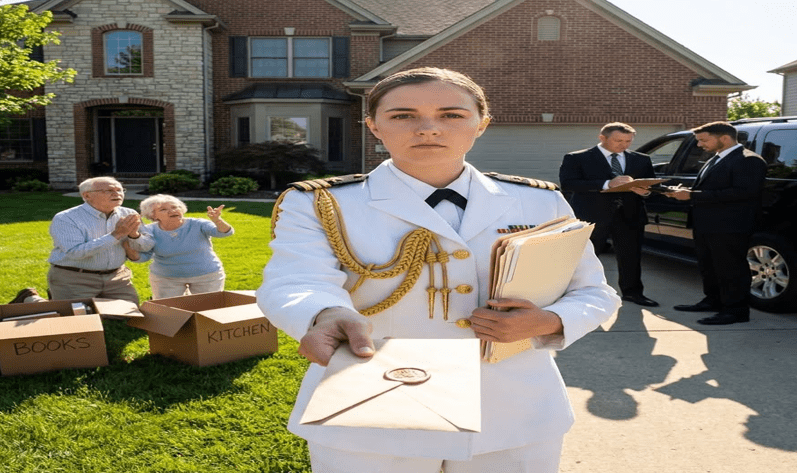
He reached into his coat and produced an envelope.
I knew the handwriting before he had extended it fully. Seventy years of letters and birthday cards and notes tucked into books she was lending me. Eleanor’s handwriting, which had never been pretty but had always been precise.
“She asked me to deliver this personally,” Robert said. “Under specific circumstances.”
He looked at Daniel.
“She was, as I said, a careful woman. She had concerns about this property. She asked me to be present if those concerns were ever realized.”
Daniel’s collar, which he had just straightened, appeared to require straightening again.
“I don’t understand,” he said. “The sale is complete. The paperwork is done. We don’t need.”
The younger attorney had opened his folder.
“Before any transfer of this property is completed,” he said, with the pleasant precision of someone delivering information that has been very carefully prepared, “we need to discuss the restrictive trust attached to it.”
Patricia looked at the younger attorney.
Then she looked at Robert.
Then she looked at me.
I watched fear arrive in her eyes.
It was the first time in twenty-seven years I had seen it there, and I found that it was not as satisfying as I might have imagined and was more clarifying.
And then I opened my grandmother’s letter.
My dear Claire,
If Robert has given you this envelope, then something has happened that I suspected might happen and which I spent considerable time preparing for. I am sorry you are standing in what is likely a difficult moment. I am not sorry for what I arranged, because I arranged it for you, and everything I have done for you has been from love.
Twenty-seven years ago I watched you marry a man who was not unkind but who was not strong, and I held my opinion because it was your life and you were happy, and I believed that love could carry people through the gaps in their character. I watched carefully for twenty-seven years. I watched the gaps grow.
I watched his mother.
I am ninety-one years old and I have watched many women like Patricia Hale and I know exactly what they do with sons like Daniel and daughters-in-law like you, and I decided several years ago that whatever happened, you would not be left without ground beneath your feet.
The house on Weston Lane, which you are currently standing outside of, was purchased in 2019 through a trust in your name. Daniel did not buy it. Daniel’s name has never appeared on the deed. He did not know this because you handled the mortgage payments and the paperwork and he allowed you to handle it because he has always allowed you to manage the difficult parts of your shared life while reserving his opinion about the outcomes.
Any sale he has attempted to finalize is void.
The buyers may not know this. Robert will explain it to them. They will be reimbursed for any costs incurred and I expect they will be understanding, as Robert has already been in contact with their attorney.
The divorce papers Patricia is holding were prepared by an attorney Daniel hired six weeks ago. I know this because I have friends in this city who have been friends for sixty years and there are very few things that happen in a small legal community that do not eventually reach the right ears.
Robert has everything you need. He will stay as long as you need him.
I love you, my Claire. I have loved watching you become who you are. I am sorry I will not be there for the next part, but I arranged the best I could to make the next part possible.
Yours always,
Eleanor
I folded the letter carefully.
I looked at Robert Marsh.
He was watching me with the patient attention of someone who has been waiting for a specific cue and is now ready.
“The deed,” I said.
He produced it from his own folder. My name. The trust in my name, established 2019, exactly as Eleanor had written.
I walked up the porch steps.
Daniel had not moved. He was standing at the bottom of the steps and I walked past him without stopping, past Patricia and her papers, and I unlocked my front door with the key that was still in my bag from the morning and I went inside.
The house was strange.
The movers had been thorough. Most of my things were gone, the personal things, the photographs and the books and the objects that had accumulated over twenty-seven years of a shared life and had apparently been identified by someone as hers rather than ours and removed accordingly. The furniture remained. The bones of the house remained.
I stood in the living room for a moment.
Then I went back to the door.