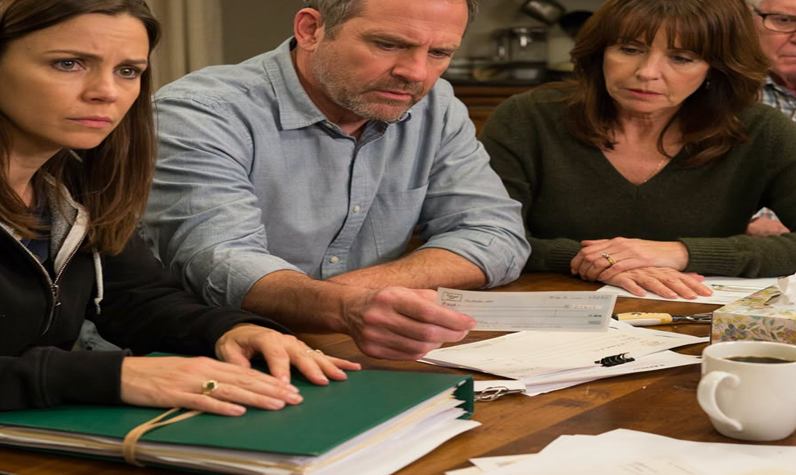
My brother Ransome stood in our mother’s kitchen three days after her funeral, slid Thorne a check for thirty four thousand dollars, slid me nothing, and said, “You kept a notebook, Oberlin. That’s a hobby, not a contribution.” I didn’t argue. I didn’t raise my voice. I said okay, picked up my coffee, and drove home to Trumbull and the kids with my hands steady on the wheel the whole way. Then I went into the back room, pulled the green binder off the shelf where it had sat for nineteen years, and started reading it front to back for the first time as something other than a chore.
I want to tell you plainly what that binder was, because it matters to everything that came after. It was not a diary. It was not sentimental. It was a three ring binder, army green, the plastic cracked soft at the spine from two decades of being opened at a kitchen table under a single bulb, and inside it were the actual books of my parents’ feed and hardware store on the county road outside Merribel, Indiana. Register tapes stapled to reconciliation sheets. Bank statements, folded in thirds, tucked behind the month they belonged to. Mileage logs for the delivery truck. Tax worksheets in my own handwriting going back to a year when gas was under two dollars a gallon. And, near the very back, in my mother’s shaking hand from the last winter of her life, four lines that I had not let myself read again until that night, because I already knew what they said and I was not ready to need them yet.
I am forty one years old. I have kept a set of books, one way or another, since I was nineteen. And for three days after we buried our mother, my own brother stood in the house I grew up in and told the room, in front of Thorne and Vernay and the lawyer’s paperwork spread across the table, that what I had done for this family for nineteen years did not count as work.I want you to understand why that was such a specific kind of cruel, and I want you to understand what was sitting in a binder on my shelf the whole time he was saying it.
Our father opened the store the year he turned twenty six, a cinderblock building on the county road with a gravel lot and a hand painted sign that said FEED AND HARDWARE and, underneath in smaller letters, MERRIBEL SINCE 1979. He ran it the way a lot of men around here ran things back then, mostly out of his head, invoices in a cigar box, a ledger he filled in some months and forgot in others, taxes done in a rush every March at the kitchen table with my mother reading numbers off to him while he squinted at the calculator. It worked, more or less, the way a lot of things around here worked more or less, until the year I was nineteen and the bank called about an overdraft on the business account that nobody could explain, and my father sat at that same table with his head in his hands and said he didn’t know where the money had gone, honestly could not tell you, because he had never once written it down in a way anyone could follow.
I was the one who sat down next to him. Not because anybody assigned it to me. Because I had always been the kid who liked columns to add up, who balanced my own checkbook to the penny at fifteen out of some stubborn private satisfaction nobody else in the family understood, who took bookkeeping as an elective my junior year of high school when everybody else took shop or home ec, and loved it, actually loved it, the way some people love a puzzle that has exactly one right answer if you’re patient enough to find it. I spent that whole spring going through two years of cigar box receipts with my father, matching them against bank statements, building him a real ledger by hand because we couldn’t afford software and honestly I didn’t trust software yet either. By June we had found the leak. It wasn’t theft. It was a supplier double billing him for fertilizer three months running and nobody catching it because nobody was looking. I found six hundred and forty dollars that quarter alone, and my father looked at me across that table like I had pulled a rabbit out of a hat, and he said, “Well I’ll be. You’ve got the head for it, Obie. Your mother never did, God love her, and I sure don’t.”
That was the beginning of nineteen years.
I did not become the family bookkeeper because anyone gave me the job. I became the family bookkeeper because I was good at it and because the alternative was watching my parents’ store bleed out slowly from a hundred small unwatched cuts, and I could not stand by and let that happen when I had the skill to stop it. I went on to build a career out of it too, an actual career, keeping books for a trucking outfit two towns over, the kind of job with a title and a desk and a W-2, and I want to say that clearly because Ransome liked to talk about my “little notebook hobby” as though I did it in my spare time with nothing else going on, as though I was some woman with too much time and not enough sense who liked fussing over numbers the way another woman might like fussing over a garden. I was not a hobbyist. I was the only person in that family who had ever been formally trained to do what I did for them for free, every month, for nineteen years, on top of a full time job and raising two kids with Trumbull out on the county line.
My father died of a heart attack behind the counter of that store on a Tuesday morning in October, seven years before the day Ransome handed Thorne a check and handed me a lecture. He was sixty three. My mother was behind on nothing when he died, because I had made sure of it, quietly, the way I made sure of everything, month after month, without anybody in the family particularly noticing that the store kept running clean the whole time grief was tearing the rest of us apart.
Ransome was living two hours away then, in a bigger town, selling used trucks off a lot he half managed for somebody else, and he came home for the funeral and stayed a week and told our mother, standing in that same kitchen, that he would “step up” and “look after things” now that Dad was gone. He meant it, I think, the way people mean things in the raw week after a funeral, with more feeling than follow through. He drove home a week later. The looking after things landed on me, same as it always had, except now there was no father at the register to catch what I missed and no father to catch what Ransome forgot to do either.
My mother kept the store open another eleven years after that, mostly out of pride and partly because she honestly did not know what else a person did with a Tuesday if not open the store, and I kept the books the whole time. I drove out every first Sunday of the month, sat at that kitchen table with the same green binder, went through the register tapes and the bills and the bank statement, and built the ledger by hand the way I’d learned to at nineteen, because my mother trusted my handwriting on a page more than she trusted a screen, and because doing it that way meant I caught things a spreadsheet would have let slide past unremarked.
Ransome visited more in those years, I’ll give him that. He came for holidays, he came for a week each summer, he made a show, when he came, of fixing whatever was visibly broken around the property, a gutter, a fence post, the kind of repair a neighbor could see from the road and comment on at church. He was good at being seen to help. I want to be fair about that, because fairness matters to me, it always has, it’s the whole reason I’m telling you this story instead of just being angry about it in private. Ransome was not lazy. He was strategic about which kinds of work got noticed and which didn’t, and bookkeeping, by its nature, is invisible work. Nobody drives past a farmhouse and says, would you look at those beautifully reconciled bank statements. Nobody at a Sunday potluck asks who’s been keeping the store’s tax filings current for two decades running. It is thankless in the most literal sense of that word: there is no ceremony built for thanking it. I knew that going in. I did it anyway, because it needed doing and because it was, in its own quiet way, how I loved my parents. Some people show love with casseroles. I showed it with a balanced ledger.
My mother’s decline started slow, the kind of slow where you keep telling yourself it’s just her age, and then it wasn’t slow anymore. Congestive heart failure, the same family weakness that took my father, except it took her over eleven months instead of one Tuesday morning, eleven months of hospital stays and home health aides and me driving the county road three and sometimes four times a week instead of once a month, because by then the books were the least of what she needed from me but I kept doing them anyway, at her bedside sometimes, the green binder open across my knees while a heart monitor beeped somewhere behind her shoulder.
It was in those last months that she started writing in the margins.
She’d never done that before. Nineteen years of ledgers and my mother had never once picked up the binder and added anything to it herself, it wasn’t her handwriting that lived in those pages, it was mine. But that last winter, in a hand that had gone shaky and small, she started leaving me notes. Nothing dramatic. A line here about a bill she wanted double checked. A line there thanking me, plainly, for “keeping this family honest all these years, Obie, you’re the only one who ever really has.” And then, on the second to last page, dated six weeks before she died, four lines I read once in that hospital room and did not let myself read again until the night Ransome told me my nineteen years didn’t count.
“I know what Ransome’s been doing with the store account. I haven’t had the strength to fight him on it. Don’t you let him make you small over this, Obie. You keep the true book. You always have.”
I didn’t understand what that meant, not fully, not that winter. I thought she meant the small things, a few unexplained withdrawals I’d noticed over the years and chalked up to cash for deliveries or a supplier paid outside the usual channel, the kind of thing that happens in a cash business run partly on trust. I did not yet understand the scale of what she was telling me to look for. I would understand it in full three days after her funeral, sitting at my own kitchen table with the binder open and a stack of old bank statements I had photocopied over the years without ever once cross referencing them the way I was about to.
She died on a Thursday in March, in her own bed, with Thorne holding one hand and me holding the other and Ransome in the hallway on a phone call about something he described afterward as “unavoidable.” Vernay came in from three states over and cried harder than any of us, which surprised nobody who knew him, because Vernay has always felt everything at full volume and organized nothing, the sweetest and least useful of the four of us in a crisis, a good man who simply cannot be counted on to read a document before he signs it.
The funeral was at Merribel Community Church, the same church my mother had brought casseroles to for forty years, and the fellowship hall afterward was full the way it is when someone has lived a long honest life in a small town, folding tables end to end with fried chicken and green bean casserole and three different kinds of pie, and half the county coming through the line to tell me what a fine woman my mother had been, and how proud she’d always been of “her Obie, the one with the head for numbers.” I heard that phrase more than once that afternoon, from people who had known our family thirty and forty years, and I want you to hold onto it, because three days later my own brother would stand in our mother’s kitchen and act as though it had never once been true.
The trouble started the way trouble in families like ours usually starts: with a walkthrough. Ransome called it that, “we’ll do a walkthrough of the house,” said it like a real estate term, brisk and procedural, and I understood even as he said it that he had already decided how this was going to go and the walkthrough was a formality he intended to move through quickly before anybody had the emotional footing to slow him down.
He arrived that Saturday with a folder of his own. Not a binder, a folder, thin and printed clean off somebody’s computer, and I remember thinking even then how telling that was, how a man who had never once sat down to do the actual work could still walk in with something that looked more official than what I’d built with my own hands over nineteen years, because printed always looks more official than handwritten to people who don’t know any better.
He sat us all down at the kitchen table, Thorne and Vernay and me, and he explained, in the calm patient voice of a man laying out something reasonable, that the store had been running at a loss for years, that he had been “covering shortfalls” out of his own pocket during his visits home, that this had never been formally documented because “that’s not how family works,” and that fairness, real fairness, meant the estate should reimburse him forty six thousand dollars off the top, before anything else got divided, for what he called his years of quiet sacrifice.
Nobody at that table had ever seen Ransome write a check to that store in his life. I want to be precise about that because precision is the whole point of this story. I had kept the books. I would have seen it.
Thorne, who has never in her life enjoyed conflict the way some of us can stomach it, looked at the folder and then looked at me, waiting, I think, for me to say something, and when I stayed quiet, gathering myself, Ransome took my silence for agreement and kept talking. He said the store itself should be sold quickly, before it lost more value, and the proceeds split after his reimbursement came off the top. He said the house should go to whoever wanted to buy the other two out fastest, which was code, we all understood, for him. And then he looked at me, specifically at me, and said the line I opened this story with, the line I will hear for the rest of my life whenever I open that binder: “You kept a notebook, Oberlin. That’s a hobby, not a contribution.”
He handed Thorne a check that afternoon, an advance, he called it, thirty four thousand dollars, drawn off an account I didn’t recognize, a goodwill gesture to smooth the process along while the estate cleared probate. He handed Vernay nothing yet but promised him “his share soon.” He handed me a look that said the conversation about my share was closed before it opened, because in his accounting, the one printed clean off a computer, I had not contributed anything that counted.
I said okay. I want you to understand that I meant it, in the moment, as something closer to I hear you than I agree with you, the particular okay a person says when they need time before they say anything else, when arguing at that table would only give him the reaction he was fishing for, proof that I was emotional, unreasonable, the sister who couldn’t handle a simple business conversation. I have spent nineteen years being underestimated in that specific way, mistaken for soft because I am quiet, and I have learned that the smartest thing a quiet person can do, when handed an insult dressed up as a decision, is not argue it in the room. It’s go home and check the math.
So I did.
I sat at my own kitchen table that night with Trumbull beside me, not saying much, just being there the way he’s been there for eighteen years of marriage, while I opened the green binder to the accounts and pulled out every bank statement I’d ever photocopied and set to work the way my father taught me at nineteen, the way I’d done for a fertilizer supplier’s double billing twenty two years ago, the way I do anything: methodically, without hurry, matching every column to its neighbor until the shape of the truth showed itself.
It took most of the night. What I found by two in the morning was this.
Over six years, starting the spring after my father died, a series of transfers had gone out of the store’s business account in amounts that never matched any invoice, any supplier, any payroll line I could account for. Five hundred here. Eleven hundred there. Once, in a single week the November Ransome’s divorce finalized, four thousand two hundred dollars in three separate withdrawals. They were not large enough, individually, to trip anything, and they were spread out enough, across six years, that my mother’s aging eyes going over a monthly statement would never have added them up into a single sum. But I was not looking at one month. I was looking at six years laid end to end on my own kitchen table, and when I added every unexplained transfer together, the total came to forty six thousand two hundred and eighty dollars.
Forty six thousand two hundred and eighty. The same man who had sat at that table three days earlier and demanded forty six thousand dollars off the top of the estate, for shortfalls he claimed to have personally covered, had in fact taken almost that exact amount out of the store over six years and never once put a dollar back in.
I sat with that number for a long time before I let myself feel anything about it. That’s the accountant in me, I think, the part of me that learned at nineteen that feelings are easier to hold once you know exactly what you’re feeling them about. And underneath the number, underneath everything, was my mother’s handwriting from six weeks before she died. I know what Ransome’s been doing with the store account. She had known. She had not had the strength left to fight him on it in the last winter of her life, and instead she had done the only thing left to a dying woman who trusted one child to finish what she couldn’t: she’d written it down, in the one place she knew I would eventually look, and told me to keep the true book.
I called Oakes the following Monday. Oakes had drawn up my mother’s will fifteen years earlier and had a small office off the courthouse square in Merribel, the kind of office that’s been in the same storefront so long the paint on the door has its own history, and Oakes had known our family since before I was born, had sat behind my father at church for three decades, had signed my own wedding license as a witness. If there was one person in this county who could look at nineteen years of my handwriting next to Ransome’s clean printed folder and know instantly which one told the truth, it was Oakes.
I brought the binder. All of it, the whole nineteen years, plus the photocopied bank statements I’d matched line by line the night before, plus a summary page I’d built that morning laying the six years of unexplained transfers out date by date next to the events they lined up with, because I had gone back and checked, and every single spike matched something in Ransome’s life. The divorce. A down payment on a truck lot he tried to open on his own two years later that folded within a year. A loan he’d needed cosigned and hadn’t been able to get cosigned any other way. Six years of my brother quietly treating our parents’ store like a line of credit nobody was watching, while our mother told the county he’d “stepped up” and our father, before he died, never knew at all.
Oakes went through the binder page by page at that desk for the better part of two hours while I sat across from a man old enough to have watched me grow up, in a room that smelled like old paper and coffee, watching his expression change the way a person’s expression changes when a suspicion becomes a certainty. When Oakes finally looked up, the first question wasn’t about Ransome. It was, “Does your mother know you kept records this careful?” And I said yes. I told Oakes about the margin notes. I opened the binder to the last page and let a man who had known my family for thirty years read, in my dying mother’s own shaking hand, that she had known, and that she had trusted me, specifically me, to be the one who kept it honest when she no longer could.
Oakes called a meeting for that Friday, all four of us, at the office off the square, and told Ransome only that there were “some figures to review before probate could move forward,” which was true and also, I imagine, exactly vague enough to make my brother walk in that Friday still believing he held the better hand.
He didn’t know I’d be bringing the binder until it was already open on the desk between us.
I will not pretend I didn’t enjoy watching his face change. I am not a naturally vengeful person, ask anyone who has ever met me, but there is a particular satisfaction, earned over nineteen years of being called a hobbyist, in watching a man’s clean printed folder lose an argument to a cracked green binder held together with rubber bands. Oakes walked through it slowly, date by date, the way I’d built it, forty six thousand two hundred and eighty dollars in unexplained transfers laid out next to a divorce and a failed truck lot and a loan he couldn’t get cosigned, and asked Ransome, in the same even voice Oakes uses for everything, whether he had an explanation.
He tried denial first. Said the withdrawals were legitimate business expenses I simply hadn’t been told about, cash paid to suppliers off the books, the kind of thing that happens in a business like ours. Oakes asked for a single invoice, a single receipt, anything at all to support that claim, and there was nothing, because there had never been anything, because Ransome had spent six years assuming nobody was looking closely enough to ask.
Then he tried the other thing, the thing men like my brother try when denial stops working, which is to make it about me instead of about him. He said I’d clearly built this whole file out of spite, that I’d always resented him for leaving town and making something of himself while I stayed and “played bookkeeper,” that a woman with a grudge could make any set of numbers say whatever she wanted them to say if she had nineteen years to arrange them just so.
I did not raise my voice. I have never once needed to raise my voice to win an argument built on real numbers, and I told him so, plainly, sitting in that office with our mother’s binder open between us. I said, “Every one of these figures is on your bank statement too, Ransome. You can go pull your own copies if you don’t trust mine. The numbers don’t care whose side you think I’m on.”
It was Thorne who finally spoke, and it surprised me, because Thorne had spent her whole life avoiding exactly this kind of room. She said she’d noticed some of it too, over the years, small withdrawals she couldn’t explain, and had told herself it wasn’t her business, had let Ransome’s confidence talk her out of her own instincts the same way it had always talked all of us out of ours, and she was sorry, she said, looking at me and not at him, that she’d taken his check before she’d asked me a single question about mine. She slid the thirty four thousand dollar check back across the table that afternoon and said she wasn’t cashing it until this was settled properly, for all three of us, the way our mother would have wanted.
Vernay mostly sat there with his hands folded, the way he does, absorbing it, and at the end he looked at Ransome and said, quietly, “You let me think Obie hadn’t done anything,” which might be the single most honest sentence I ever heard my youngest brother say.
Oakes’s ruling, once probate finished working through it, was not dramatic, because real justice in a small county courthouse rarely is. The forty six thousand two hundred and eighty dollars was treated as an advance against Ransome’s share of the estate, dollar for dollar, meaning it came out of his portion before anything else got divided, exactly the opposite of the outcome he’d walked into that kitchen three weeks earlier expecting. What remained, the house and the store and the modest savings my mother had kept, split three ways evenly between Thorne, Vernay, and me, the way her will had always said it should, the way it would have happened from the start if a folder and a raised eyebrow hadn’t nearly talked two of my siblings out of asking a single hard question.
Ransome did not apologize the way I might have written it if I were inventing this instead of living it. He is not a man built for that particular sentence. What he did, in the parking lot outside Oakes’s office, standing by his truck with the folder still under his arm, was say, “I didn’t think you’d actually go digging,” which is as close to an admission as I expect to ever get from him, and which told me everything I needed to know about how little he’d ever actually believed in the binder he’d spent nineteen years calling a hobby.
I did not need him to apologize properly for something in me to settle. That’s the part I want you to understand, because I think it’s the part that matters most. I did not walk into Oakes’s office looking for my brother’s contrition. I walked in with my mother’s handwriting in my hands, asking only to be believed, and by the time we walked out, I was.
Thorne and I bought the store from the estate together that spring, a fair price, split evenly, with Vernay glad to take his share in cash and no interest in running a feed store from three states away, which suited all of us fine. We kept the hand painted sign out front, MERRIBEL SINCE 1979, and added a line under it that our father never got to add himself, because for the first thirty odd years of that store’s life the person who actually kept it honest never had her name on anything, not the sign, not the deed, not so much as a business card. Thorne wanted to fix that. She’s the one who suggested it, actually, over coffee at that same kitchen table one Sunday that spring, and I sat with the idea a full week before I let myself say yes.
The sign now reads, underneath the original: BOOKS KEPT BY OBERLIN, and I know that probably sounds like a strange thing to be proud of, a line about accounting on a feed store sign in a town of four thousand people. But I think about my father at nineteen looking at me across a cigar box full of receipts and saying you’ve got the head for it, Obie, and I think about my mother in that hospital bed with a heart monitor beeping behind her, writing four lines in a margin because it was the only strength she had left to give me, and I think that line under the sign is not really about accounting at all. It’s about being seen, finally, for the exact thing I always was, in a family that spent nineteen years mistaking my quiet for something small.
I still keep a binder. A new one now, green like the old one, because some habits are worth keeping on purpose. Every first Sunday of the month I sit at the store’s back counter with the register tapes and the bank statement and build the ledger by hand, the way my father taught me, the way my mother trusted me to keep doing long after she couldn’t watch me do it anymore. Ransome comes through Merribel twice a year now, for Christmas and for the county fair, and he is civil, and I am civil back, and we do not speak of the folder or the forty six thousand two hundred and eighty dollars, because there is nothing left to say about it that the numbers didn’t already say better than either of us could.
Some Sundays, closing up, I’ll catch an old customer reading that line under the sign, BOOKS KEPT BY OBERLIN, and they’ll ask if that’s really me, and I’ll say yes, it’s really me, nineteen years and counting. And every time, without fail, I think of my mother’s handwriting, small and shaking on the second to last page of a green binder, telling me to keep the true book. I did. I still do. And for the first time in my life, my name is on it.
This story is a dramatization. Names, characters, and details are invented, and any resemblance to real people or events is coincidental.