I recognized Clara’s handwriting the second I picked up the envelope. Three days later, I stood outside our old high school, completely unprepared for who would find me there.
The house had been quiet for so long that I had stopped noticing the silence. The record player in the corner wore a thin film of dust, and the framed photo of my old high school sat on the mantel like a monument to a boy I no longer recognized in the mirror.
I was seventy-four, and I still slept on one side of the bed.
Fifty-five years of silence, and then this.
Three days ago, a white envelope appeared under my door. No stamp. No return address. Just my name in cursive I would have recognized in any lifetime.
Clara.
My hands shook so badly I had to sit down before I could open it. Inside was a single sheet, brief and gentle.
If you are reading this, my dear John, then I have finally managed what I could not manage in life. I’ve asked my granddaughter to see that it reaches you at the right time. Please meet me at our old school on Friday at 3:00 p.m.
Fifty-five years of silence, and then this.
I called Margaret, my neighbor from down the hall, because I did not trust myself to think alone.
“The girl from 1971?”
“John, you sound like a ghost. What’s happened?”
“She wrote to me.”
“Who did?”
“Clara.”
There was a long pause on the line.
“The girl from 1971?”
“The only Clara there ever was.”
Margaret exhaled slowly. “John, honey. It’s been over fifty years. Are you sure that letter is what you think it is?”
Be careful with your heart, John.
“I know her handwriting. I stared at her notes in the margins of every book we shared in that library. It’s older now, but it’s hers. She arranged for it to be delivered.”“And her family? That awful father?”
I closed my eyes. William. I could still see him glaring at me across the church aisle in the spring of 1970, a man who wore his disapproval like a starched collar. He had never spoken a word to me, and somehow that had been worse than shouting.
“William’s been gone a long time, I imagine,” I said quietly.
“Be careful with your heart, John. It’s not as young as it used to be.”
The schoolyard was empty.
“It never grew up, Margaret. That’s the problem.”
I hung up and read the letter again. And again. By Friday, I had memorized every loop of her pen.
The drive to the school felt longer than the fifty-five years themselves. When I pulled up to that weathered brick building, the ache in my chest was almost sweet. I expected to see her walking toward me, a woman my age with silver in her hair and that same gentle smile.
The schoolyard was empty.
I waited an hour in the cold, standing near the concrete steps where we used to trade notes between classes. The wind picked up. My eyes watered, and I told myself it was only the weather.
“She told me to give this to you.”
“You foolish old man,” I whispered. “Chasing ghosts.”
I turned to walk back to my car.
Then I heard the crunch of gravel behind me.
I spun around, ready to see her face at last. But it was not Clara standing at the bottom of the steps.
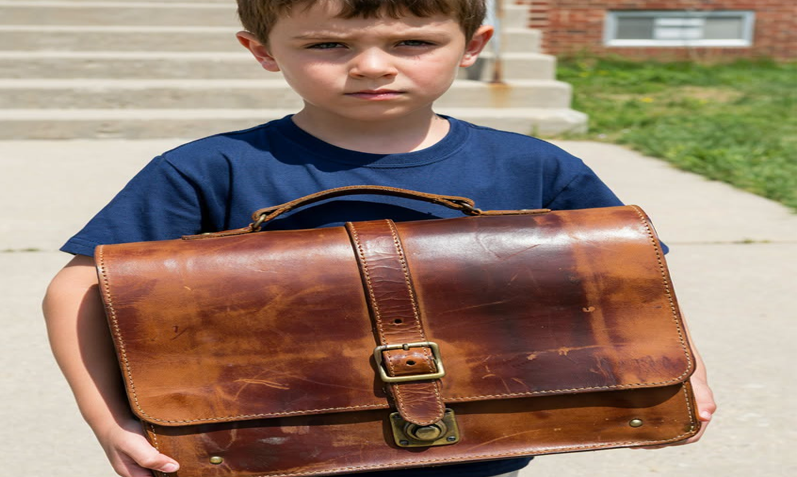
It was a little boy, no older than seven, alone, clutching a scuffed leather briefcase I would have known anywhere.
He took one small step forward and held it out to me.
“She told me to give this to you,” he whispered.
You’d know what to do with it.
Funny the things a person remembers after half a century. I could no longer picture every dress Clara had ever worn, but I would have recognized that old brown leather briefcase anywhere, its corners already scuffed by senior year.
I knelt down slowly, my knees protesting against the cold concrete. The briefcase looked enormous in the boy’s small hands, the leather scuffed at the corners in a way I remembered too well.
“What’s your name, son?” I asked.
“Brian,” he said. He held the case out again, more firmly this time. “Mommy said the kind lady told her you’d know what to do with it.”
The weight of it surprised me.
My throat tightened. I searched his face for any sign of Clara, and found her in the shape of his eyes.
“Where is she now?”
Brian pointed toward the blue sedan waiting at the curb.
“Mom said you might need a little time first.”
I managed a faint smile.
“Your mom was right.”
I eased myself down onto the concrete steps, one hand on the cold stone for balance. Brian sat beside me without being asked, swinging his sneakers just above the ground. He set the briefcase gently across my knees.
The weight of it surprised me. Whatever was inside felt heavier than paper had any right to feel.
Fifty-five years pressed down against my chest.
“Do you know what’s in here, Brian?”
“Letters,” he said. “Lots of them. And some papers Mommy told me not to touch.”
My thumb hovered over the tarnished brass latch. My hands were shaking, the way they had trembled three days ago when I first held that white envelope in my kitchen. Fifty-five years pressed down against my chest.
“Mister?” Brian’s small voice brought me back. “Are you okay?”
He had a smudge of what might have been chocolate on his chin, and his hair was cut a little crookedly over one ear, as though he had wriggled during his last haircut.
“I’m not sure yet, son,” I said honestly. “I think I’m about to find out.”
A birth certificate, dated October 1972.
“Mommy said the kind lady was your friend,” Brian offered.
“A very long time ago.”
I glanced back toward the car. Brian’s mother lifted her hand in a small, reassuring wave. She was simply there, an anchor to a story I hadn’t yet been told.
I pressed the latch. It clicked open. Clara’s perfume drifted up from the worn leather, and beneath it lay dozens of envelopes, every one addressed to me in her handwriting.
I reached for the first one with fingers that would not stop trembling.
The envelopes filled the case from edge to edge, each one addressed to me in Clara’s handwriting, none of them ever mailed.
He says you already found someone else.
At the very top lay a folded document. A birth certificate, dated October 1972.
My hands went cold.
“Mister? Are you okay?”
Brian stood a few feet away, scuffing his sneaker against the concrete. I could barely find my voice.
“I’m alright, son. Just give me a minute.”
I opened the first letter. Clara’s cursive was younger there, hurried, blotched in places where the ink had run.
The kind lady went to heaven a few months ago.
“My darling John, by the time you read this, I hope you will understand. My father took me across three states in one night. He says you already found someone else. He says you never even asked where I went.”
I pressed my knuckles to my mouth.
The second letter was angrier. The third was pleading. In the fourth, she wrote about a fluttering under her ribs, and a name she had chosen if it was a boy.
Fifty-five years of silence, and every page was another door William had bolted shut.
I looked up at the sky, blinking hard. That old man. That proud, unforgiving old man, sitting in his church pew, deciding my life without ever saying my name.
She had a picture of you in her purse.
“Brian,” I said, more gently than I felt. “The lady who gave you this. Where is she now?”
Brian’s small mouth twisted.
“The kind lady went to heaven a few months ago. She gave it to my mommy last summer. She said today was the day.”
Something inside my chest cracked open.
I had come here to see her face. I had rehearsed what I would say. And she was already gone, while I sat in my quiet apartment believing she had never wanted me at all.
“A few months,” I repeated. The words did not feel like mine.
I had convinced myself you had built a life without me.
“Mama says she was very nice,” Brian offered. “She had a picture of you in her purse. A young picture.”
That undid me. I had to look down at the letters just to keep from breaking apart in front of the child.
I read faster. Clara wrote of the town they moved to, the small window she stared out of, the way her father confiscated her mail. She wrote of praying I would somehow find her.
“By the time Father died, I had convinced myself you had built a life without me. I could not bear to be the woman who shattered it. So I kept writing, and I kept the letters here, for a day I wasn’t sure would come.”
William had won.
In the next letter she wrote:
“Looking back now, I almost pity him. Father truly believed he was protecting our family. I came to understand it was fear—fear of gossip, fear of shame, fear of losing control. By the time I saw the truth, he had already stolen a lifetime from both of us.”
I set the letter down and stared at the empty schoolyard. William had won.
“Mister?” Brian said. “There’s one more at the bottom. The kind lady told Mama that one was the most important.”
I looked down.
Our son died a few hours after birth.
Beneath the stack, pressed flat against the leather, lay a single sealed envelope. Thicker than the others. My name on the front in a shakier hand, the cursive of a woman in her seventies.
I picked it up. It weighed almost nothing, and it weighed everything.
Brian waited quietly beside me.
I opened the final envelope with trembling hands.
Inside was Clara’s last letter and a thick report from a private investigator she had hired in her seventies.
The first blow came halfway down the page.
William had staged the death to erase the shame.
“After a difficult labor, they told me our son died a few hours after birth. I only held him for seven minutes, John. I believed them for fifty years.”
The second blow was worse.
“When Father’s things were finally sorted after my sister passed, I found the adoption papers he had hidden away. I hired an investigator that same week.”
The report was clear. Our son had not died. William had staged the death to erase the shame, to keep Clara from ever returning to a boy he considered beneath her.
“He lived, John. He lived a full life. And he died three years ago, less than a hundred miles from your door.”
The cancer had already won.
I had missed his entire life… and now I had missed the chance to know him too.
“Please don’t think I stayed away because I didn’t want to see you. I spent decades believing you had moved on, married, and built the life my father insisted you wanted.”
I closed my eyes. She had loved me all those years, just as I had loved her.
“When I finally learned the truth — and discovered our son had survived — it was already too late. The cancer had already won. I couldn’t bear for your last memory of me to be a dying woman. But I couldn’t leave this world without making sure you finally knew the truth about our son.”
I lowered the pages onto my knees, so the wind could not steal them too.
I saw Clara.
Brian shifted on the step beside me, waiting. His mother had walked quietly up the path, her hand resting on his shoulder.
“Your son was my father,” she said softly. “Brian is your great-grandson. Clara asked me to let the letters speak first before I told you who we were. She found us last year. She told me everything.”
I stared at her, searching her face without meaning to. The curve of her smile. The way her eyes softened when she looked at Brian. For one impossible moment, I saw Clara at seventeen standing in the school library, smiling at me over the top of a book.
“What… what was his name?” I managed.
“Daniel,” she said gently.
He laughed exactly the way you do.
I whispered it once under my breath, tasting the name I should have spoken a lifetime ago.
“He was a good man. He became a history teacher, just like he’d always dreamed. He loved old records, spent weekends restoring antique radios, and treasured his family more than anything — perhaps because he had grown up believing he had none.”
She smiled through her tears.
“Everyone who knew him said he had the gentlest heart. Clara used to tell me he laughed exactly the way you do.”
I looked at Brian. Those eyes. Clara’s eyes, worn like an heirloom passed down through two generations I never knew existed.
Brian’s small hand slipped into mine.
“Would you —” I began, and my voice broke. I cleared it and tried again. “Would you let me know him? Both of you?”
She nodded, tears sliding down her cheeks,
“She hoped you would ask.”
I reached out, and Brian’s small hand slipped into mine.
That evening I drove home with the briefcase on the passenger seat and a crayon drawing Brian had pressed into my palm.
I carried the briefcase inside as carefully as though Clara were still holding the other handle. Before I did anything else, I placed Brian’s drawing on the refrigerator with an old magnet that had been sitting unused for years.
“See you next weekend?”
Then I laid Clara’s letters beside the framed photograph from our senior year. For the first time in decades, it no longer felt like a memorial. It felt like the beginning of something that had simply arrived late.
Just as I reached for the record player, my phone rang.
“Hi,” Brian’s small voice said. “Mom said I could call and say goodnight.”
I smiled before I realized I was smiling.
“Goodnight, Brian.”
“See you next weekend?”
My throat tightened.
“I wouldn’t miss it.”
I put on a record I had not played in forty years.
The chair across from me was still empty. But for the first time in fifty-five years, I wasn’t setting the table for a memory. I was setting it for a family I’d finally found.