“This house is ours now,” Marjorie said, pointing toward the open door. “Bradley is gone. Take your clothes and get out.”
They thought my husband had died without a will.
They had no idea what he had signed three days before his surgery or whose name was already recorded on the deed.
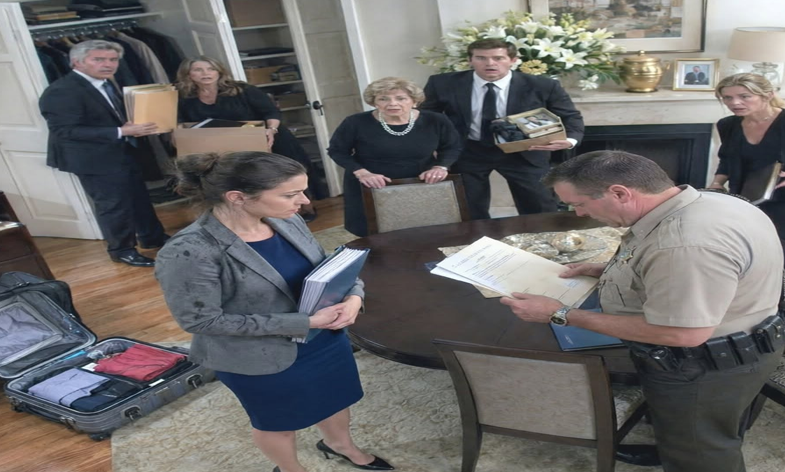
My black funeral dress was still damp against my skin when I stepped into the apartment. Suitcases blocked the hallway. Every closet stood open. Bradley’s jackets had been pulled from their hangers and divided into piles on the floor.
On our dining table, beside the flowers from the funeral, someone had written an inventory on the back of a sympathy card:
Electronics.
Jewelry.
Documents.
Declan, Bradley’s cousin, walked out of the bedroom carrying my husband’s laptop.
“Put that down,” I said.
He smiled as though I were a confused child. “Don’t make this uglier than it has to be, Avery.”
Marjorie stood beside Bradley’s urn with one hand resting on her leather handbag. She had changed out of her funeral clothes. The speed of it made something cold settle inside me.
“Who let you in?” I asked.
“I have a key,” she replied. “I’m his mother. I don’t need permission to collect my son’s property.”
Behind her, Aunt Fiona opened Bradley’s desk and began pulling out folders.
“Stop touching his papers.”
Fiona looked over her shoulder. “And who exactly are you now?”
Nobody answered her.
They did not have to.
“A widow,” she said. “That’s all.”
The room went quiet, but only for a second. Then drawers started opening again. Zippers closed. Someone unplugged the television. Someone else removed the framed photograph from our wedding and set it facedown.
They were not grieving Bradley.
They were erasing me.
Marjorie removed an envelope from her bag and placed it on the table.
“This is a notice to vacate,” she said. “You have until tomorrow evening. Declan has already spoken to a realtor.”
I looked at the paper but did not touch it.
“You listed my home for sale?”
“Our family’s home,” she corrected. “Bradley paid for it. Bradley owned it. And Bradley left no will.”
Declan lifted the laptop higher. “We checked.”
That was when I understood why Bradley’s desk had been disturbed before I arrived.
They had not come to mourn.
They had come searching.
“You went through his files while I was burying him,” I said.
Marjorie’s mouth tightened. “We protected what belongs to us.”
I stared at her for a moment.
Then I laughed.
It came out so suddenly that Declan stopped smiling. Fiona froze with a folder in her hands. Even the relative dragging our television toward the door set it down.
Marjorie stepped closer. “Have you lost your mind?”
“No,” I said, wiping a tear of disbelief from my cheek. “I finally understand.”
“Understand what?”
“You truly believe Bradley left nothing.”
“He left this apartment,” she snapped. “His accounts. His company benefits. His personal property.”
“You think he was an employee at Mercer Preservation.”
“He was a project manager,” Declan said. “We know exactly who he was.”
I looked at the laptop in his arms.
“No,” I said. “You knew the version of Bradley he allowed you to see.”
Marjorie’s expression changed for the first time. Not fear. Not yet.
Uncertainty.
I reached into my purse and removed my phone.
“Call whoever you want,” she said. “There is no will. We already asked the probate clerk.”
“I’m not calling probate.”
I pressed one saved contact and put the phone on speaker.
A woman answered immediately.
“Avery?”
“They’re inside,” I said. “Nine of them. They’re packing the apartment.”
The woman’s voice became precise and cold. “Has anyone removed property from the premises?”
Declan slowly lowered the laptop.
“Not yet,” I said.
Marjorie leaned toward the phone. “Who is this?”
“Lena Torres,” the woman replied. “Counsel for the Bradley Mercer Living Trust. Please instruct everyone to remain where they are.”
No one moved.
Marjorie gave a brittle laugh. “Bradley’s surname was Hale.”
“To his family,” Lena said. “Not to the corporation he founded.”
Declan’s face drained of color.
Marjorie grabbed the phone from the table and ended the call.
“This is a performance,” she said. “You married a sick man and manipulated him.”
I picked up the phone again.
“No,” I said. “I married a careful man who knew exactly what you would do once he could no longer stop you.”
Then I tapped the small camera icon Bradley had installed above the bookshelf.
A red light blinked.
Every drawer they had opened, every suitcase they had filled and every word they had said had been recorded.
For the first time, someone near the door whispered, “Marjorie, we should leave.”
She blocked the exit with her body.
“Nobody is leaving without Bradley’s things.”
A knock sounded from the hallway.
Three slow knocks.
Marjorie straightened her shoulders, expecting the realtor.
I opened the door.
Lena Torres stood outside with a sheriff’s deputy and a thick blue folder sealed by a silver clasp.
She walked to the dining table, moved the false eviction notice aside and placed the folder directly in front of Marjorie.
“This was recorded with St. Johns County three days before Bradley entered the hospital,” Lena said.
Marjorie’s eyes fixed on the county seal.
Lena opened the folder, turned to the first page and placed one finger beneath the name Bradley had added to the deed.
The deputy leaned forward to read it.
Then he looked directly at me.
Type DEED and I’ll continue.
(I know you’re curious about the next part, so please be patient and read on in the comments below. Thank you for your understanding of the inconvenience. please leave a ‘YES’ comment below and give us a “Like ” to get full story )