The morning of the third Saturday in June, the heat was already rising from the asphalt on Elmwood Avenue. I sat on our porch step, adjusting my silver watch strap. It was tight against my skin, so I slid it up my wrist an inch, then pulled it back down.
Across the street, Howard Vance stood on his lawn. He had his hand on the pull-cord of an old green lawnmower, his shoulders hunched forward like a rusted iron bracket. He gave the cord a short, weak yank, but the engine only coughed once and went quiet.
Noah was sitting on the wooden glider behind me, holding a plastic cup of water. He did not say anything, but I heard the ice rattle against the sides of the cup.
I stood up and went to the edge of the porch, looking at the wood railing where the old porch chair sat. One of the screws in the armrest was slightly loose, sticking up just enough to catch a sleeve. I tapped it down with my thumb, feeling the rough metal edge.
“He is eighty-two,” I said, mostly to myself. “He should not be out there in this.”
Howard tried the cord again. This time he did not even get a full pull out of it before his hand slipped, and he stood there with his arms flat against his sides, staring at the grass.
“I am going over,” Noah said.
He stood up, putting his cup on the small table. He was fourteen then, tall but thin, his joints still too big for the rest of him.
“Let him be, Noah,” I said, reaching out to touch his elbow. “Howard does not like people interfering. You know how he gets when the mailman leaves the rubber bands on his porch.”
Noah looked past me, his eyes locked on the old man across the street.
“He will just say no if I ask,” Noah said.
He did not wait for me to answer. He walked down the steps, his sneakers squeaking on the gray paint, and headed toward our garage.
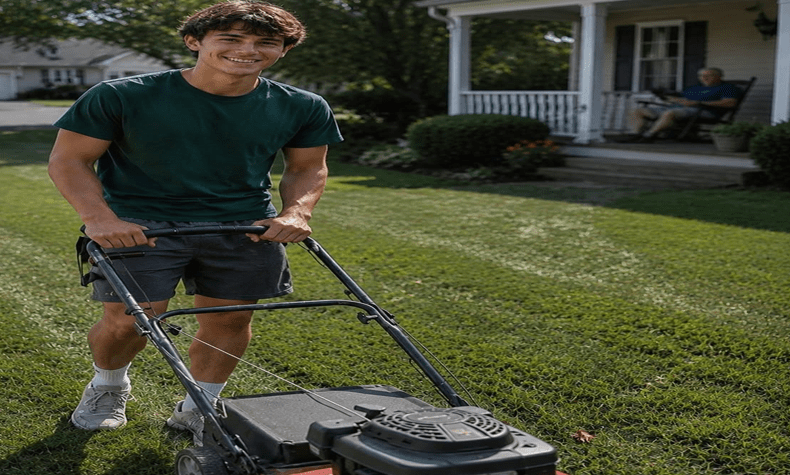
By the time I reached our sidewalk, Noah was already wheeling our own red mower across the street. The front wheel had a squeak we had been meaning to oil since May, and the sound carried clear across the hot asphalt.
Howard did not move. He sat down in the green wooden chair on his porch, his hands flat on his knees, his face completely still. He looked like he had been carved out of a block of hickory.
Noah did not look at him either. He pushed our mower onto Howard’s grass, lined it up with the curb, and reached for the starter cord.
He gave it one smooth pull. The engine caught instantly, filling the street with the sharp smell of regular gas and two-stroke oil. Noah did not ask for permission, and he did not wave. He just started walking, pushing the machine in a straight line toward the side yard.
I stood near Howard’s mailbox, my fingers working at my watch strap again. I expected Howard to stand up, to yell over the engine, or to wave Noah off his property.
Instead, the old man just sat there. His eyes followed the red mower as Noah made his first turn near the porch steps, leaving a neat, dark green stripe in the high grass.
Noah kept his head down, focusing on the line. When he finished the front half, he stopped the engine to empty the grass bag into one of our paper yard bags.
The silence came back fast, thick with the smell of damp cut grass.
Howard did not move his hands from his knees. “The oil is low,” he said. His voice was like dry leaves scraping on concrete.
Noah did not look up. “It is full,” he said.
He hooked the bag back on and started the engine again. I walked back across the street to our porch, feeling the heat rising through the soles of my shoes.
The kitchen was slightly cooler by five o’clock, but the air still felt heavy. Noah sat at the table, his forehead pink from the afternoon sun. He was sliding a yellowed paper receipt back and forth between his thumb and index finger.
“Did he say anything else to you?” I asked, setting a pitcher of water on the table.
“No,” Noah said.
“Did he offer to pay you?”
“No.”
“Noah, we cannot afford to run our own gas over there every week for free. That mower takes three dollars and ten cents a gallon now.”
Noah rubbed the back of his neck, his skin turning a deeper shade of red.
“He complained about the heat,” Noah said.
“That was all?”
“Yes.”
“He has children,” I said, pulling the curtain back to look across the street. “An estate like that, and he cannot hire a service? He has a daughter in Cleveland and a son somewhere near Columbus. They should be the ones handling this.”
Noah looked down at his water glass. “They do not come.”
“Still,” I said, letting the curtain fall. “You cannot do this every weekend. He will think it is a job.”
Noah stood up and walked toward the hallway, his steps heavy.
“It is just the yard,” he said.
I looked at the counter where our old wooden recipe card box sat. It was chipped at the corners, the green paint fading. I wondered if Howard had anything like that left in his big, quiet house, or if his children had already taken what they wanted years ago.
The four years went by in a succession of Saturdays. Every weekend, from May to October, Noah crossed the street with the mower. He never asked for money, and Howard never offered any. They rarely spoke more than five words to each other, but the grass was always cut.
Then came the Tuesday morning when the red mower stayed in the garage, and the black car from the funeral home arrived across the street.
We stood in the gravel parking lot of the Elmwood Methodist Church after the funeral service. The air was cool, the first real chill of October.
Aaron Vance, Howard’s son, walked toward us. He was thirty-eight, with the same sharp jawline his father had, though his shoulders were broader. He wore a dark grey suit that looked new, the fabric stiff.
“Sarah,” Aaron said. His voice had a sharp, defensive edge. “Noah.”
“We are very sorry for your loss, Aaron,” I said.
Beside him stood Claire, Howard’s daughter. She was thirty-six, her fingers constantly twirling her silver wedding band. Her face looked pale under the gray sky.
“Thank you,” Claire said, her voice quick and breathless. “We did not expect many people. Father did not keep many friends.”
“Noah took care of the yard,” I said, feeling a sudden need to explain why we were there. “For four years.”
Aaron clenched his jaw, looking at Noah. “We knew about that. Daniel, the estate attorney, has some papers for you. He wants to meet at the house on Saturday morning.”