My stomach dropped. Every awful possibility ran through my head at once—strangers, danger, the kinds of stories you hear on the news and pray never touch your own life. I tightened my grip on Zion’s hand.
“Find out what?” I said, and I heard my own voice come out harder than I meant it to.
The man crouched down slowly, close to Zion’s height, and I watched something pass between them—not fear, not the wariness a child shows around a stranger, but something closer to comfort, like he was bracing my son for what came next as much as he was bracing me.
“Zion, buddy,” he said gently, “go grab your backpack from the fence there. Give me a minute to talk to your mom, okay?”
Zion looked up at me, checking, and I nodded, though every instinct in me wanted to pull him closer instead of letting him walk ten feet away. He went, dragging his feet, glancing back twice.
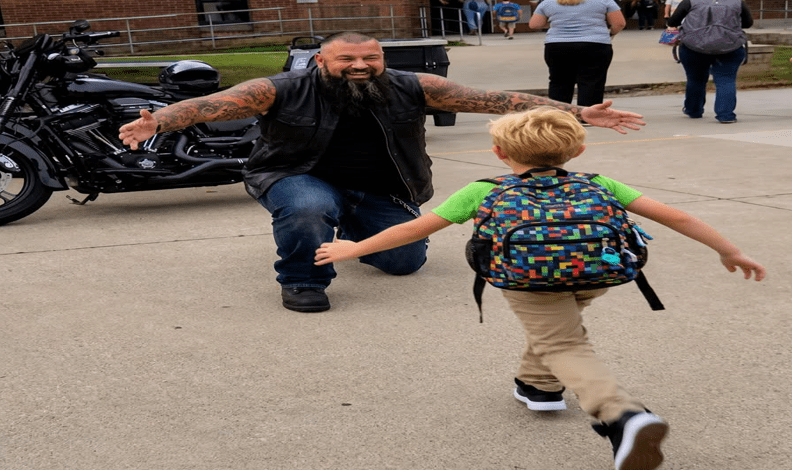
The man stood, and up close he was even bigger than he’d looked from across the schoolyard—six foot four at least, forearms covered in ink that had faded soft at the edges the way tattoos do after twenty years, a gray-streaked beard reaching halfway down his chest. He had kind eyes. I noticed that even through my panic, and hated myself a little for noticing it, because kind eyes didn’t explain anything.
“My name’s Walt,” he said. “Walt Merriwether. I used to work with your husband.”
“My husband’s been dead for three years,” I said. “He was in Afghanistan. He never worked with anyone named Walt.”
Walt’s face did something complicated then—a wince, a flinch, something that looked almost like grief crossing a stranger’s face over a man he claimed to have known.
“That’s the thing, ma’am,” he said quietly. “I don’t think I’m talking about the man you think I’m talking about.”
I need to back up, because none of what happened over the following weeks makes sense without understanding exactly what I believed about my husband before that afternoon outside Zion’s school.
My name is Delphine Okafor-Bryant, and my husband, Marcus Bryant, died in a helicopter accident during a training exercise at Fort Campbell three years ago, six months before he was supposed to deploy. That’s the story I told everyone. That’s the story on the folded flag I kept in a shadow box on our mantel. That’s the story I told Zion, over and over, in the careful, age-appropriate language grief counselors help you find—your daddy was a soldier, and soldiers do dangerous work, and sometimes even brave people don’t come home.
Marcus and I met when I was twenty-six, working as a pediatric occupational therapist in Nashville. He was funny and steady and good with kids in a way that made me fall for him faster than I meant to. We married eighteen months later. Zion came two years after that. Marcus was career Army, and I understood, marrying him, that his work meant deployments, meant silences he couldn’t fill in even when I asked, meant a version of my husband that existed somewhere I couldn’t follow. I accepted that. I loved him enough to accept it.
What I didn’t know—what I would learn, in pieces, over the following six weeks—was that most of what I understood about Marcus’s actual work had been a story too. Not a lie, exactly. Something more careful than a lie. A story built to protect me from things I was never supposed to need protecting from, because he wasn’t supposed to die.
Walt asked if we could sit somewhere and talk properly, away from the school pickup line where other parents were starting to notice a giant biker in earnest conversation with a visibly shaken mother. I didn’t want to go anywhere with him. Every reasonable instinct told me to take Zion and drive straight to the police station and let them sort out whatever this was.
But Zion had run to him. My cautious, shy son, who still hid behind my leg at birthday parties, had lit up like Christmas morning at the sight of this stranger and sprinted across a schoolyard into his arms.
That fact alone kept me standing there instead of walking away.
“There’s a coffee shop two blocks up,” I said. “We’ll meet you there. I’m driving myself and my son, and if you’re not exactly who you say you are, I’ve already got 911 dialed on my phone.”
He nodded like that was exactly the response he’d expect from someone in my position, which somehow made me trust him slightly more than his kind eyes had.
The coffee shop was nearly empty at three in the afternoon. Zion sat beside me in the booth, uncharacteristically quiet, drawing on a napkin with the crayons the waitress brought him, occasionally glancing up at Walt with an expression I couldn’t read—not fear, not quite the easy joy from the schoolyard either. Something more careful. Something that looked, unsettlingly, like a child keeping a secret.
“How does my son know you?” I asked, once we’d all settled and I’d made sure I was sitting between Walt and the door.
Walt wrapped both hands around his coffee mug, and for the first time since I’d met him, he looked uncertain—a big man visibly searching for the right way to say something he clearly didn’t want to say at all.
“I need you to understand something first,” he said. “I’m not here to hurt you or your boy. I’ve known Zion for about a year and a half. I run a shop—motorcycle repair, mostly custom builds—about six miles from here. He’s been coming by most Thursdays after school, sometimes Saturdays.”
“He what?” I said. My voice came out strangled. “Zion doesn’t go anywhere after school without me knowing. He goes to aftercare until I pick him up at five-thirty.”
Walt’s jaw tightened. “That’s what I figured he must be telling you. Ma’am, I think you need to ask him directly, but I also think—and I say this as gently as I know how—I think you should hear the rest of it from me first, so you’ve got some context before he tries to explain.”
I looked at Zion. He’d stopped drawing entirely and was staring at the napkin like it might offer him an escape route.
“Zion,” I said, “have you been leaving school without telling anyone?”
He nodded, very small, very fast, tears already gathering.
“With him?” I asked, gesturing at Walt, trying to keep the panic out of my voice for my son’s sake even as it climbed higher in my chest by the second.
Another small nod.
“How?”
“Aftercare doesn’t really check,” he whispered. “You just have to sign the sheet on your way out. I learned how to write like Mrs. Delacruz signs it.”
A seven-year-old, forging a signature on an attendance sheet, walking six miles to a motorcycle shop to see a man I’d never heard of. I felt the floor of my understanding tilt sideways.
“Why,” I said, and I had to stop and breathe before I could finish the sentence, “would you go anywhere with a stranger, Zion? We’ve talked about this. We’ve talked about this so many times.”
“He’s not a stranger,” Zion said, and his voice cracked with the particular outrage of a child who feels wrongly accused. “He’s Uncle Walt. Dad told me about him before he left.”
I sat with that sentence for a long moment before I could make myself respond to it.
“Your dad’s been gone three years, baby,” I said carefully. “Before he left for training, do you mean?”
Zion shook his head, and looked at Walt like he wanted permission to keep talking, and Walt gave him the smallest nod.
“No,” Zion said. “Before he left the last time. Before the phone call.”
“What phone call?”
Walt reached across the table then, not touching me, just closing some of the distance, his voice dropping low and careful. “Delphine—can I call you Delphine?—I think there’s something you don’t know about Marcus’s actual work. And I think, before we go any further, you need to ask yourself something. Did you ever actually see a body?”
The question landed like a physical blow. I had not. There’d been a closed casket. Full military honors, folded flag, a chaplain’s careful hands guiding me through a ceremony I remembered mostly as a wall of white noise. The Army had explained the closed casket as standard protocol given the nature of the accident, and I had never once questioned it, because why would a grieving widow question the machinery of grief the Army had clearly done a thousand times before, for a thousand other families.
“What are you saying to me right now,” I said, very quietly, because if I said it any louder I thought I might come apart entirely at a table in a coffee shop with my son watching.
“I’m saying,” Walt said, “that Marcus wasn’t doing what you were told he was doing. I worked with him for six years before I retired out. We weren’t Fort Campbell infantry, ma’am. We were something a little more specialized, and a little more careful about what gets told to families, for good reasons and for less good ones both. And about fourteen months ago, he showed up at my shop, out of uniform, and told me he needed somebody Zion could reach if things ever got complicated. He gave me your school’s pickup schedule. He gave me Zion’s photo. He made me memorize your address in case I ever needed it and couldn’t write it down.”
“He’s dead,” I said. “Marcus is dead. I buried him.”
“I know what you buried,” Walt said, and something in the careful, deliberate way he said it made the room go very still and very cold around me. “I’m not sure it’s what you think it was.”
I want to be honest about what happened in the days that followed, because I don’t think anyone who hasn’t lived through something like it can fully understand how a person continues functioning—making dinner, signing school forms, answering “how are you doing” from well-meaning friends—while an entire foundational fact of their life quietly comes apart underneath them.
Walt gave me a name that afternoon—a man named Colonel Renata Achebe-Whitfield, who he said had been Marcus’s commanding officer in whatever unit he’d actually served with, and who Walt said would talk to me if I called and used a specific phrase he made me repeat back twice to be sure I had it right. I called that number four times before someone answered. On the fifth try, a woman’s voice, clipped and careful, confirmed she was Colonel Achebe-Whitfield, and asked me, before I’d said more than my name, to hold while she moved to a secure line.
What she told me, over the following forty minutes, reshaped three years of my life into something I no longer fully recognized.
Marcus had transferred out of conventional infantry six years into our marriage, into a unit whose actual function she wasn’t able to describe to me in any real detail, not because she didn’t trust me but because there were things about it she genuinely wasn’t permitted to say to anyone without the appropriate clearance, spouse or not. What she could tell me was this: the helicopter training accident I’d been told about, the one that had supposedly killed him at Fort Campbell, had been a cover story, constructed to protect an operation that had gone wrong overseas roughly eighteen months earlier, in a location and under circumstances she wasn’t permitted to detail.
Marcus had been badly injured in that operation, she told me. Injured, not killed. The government’s official position, for reasons of operational security she said she genuinely believed were legitimate even as she understood how monstrous they must sound to me, had been to let his death be reported to protect the integrity of whatever mission he’d been part of, and to protect me and Zion from the kind of scrutiny and danger that came with the alternative truth.
“Is he alive,” I said, and I don’t think I’d ever heard my own voice sound like that before—thin, stretched, barely holding together.
There was a long pause on the line.
“I genuinely don’t know the current status,” she said. “What I can tell you is that fourteen months ago, when he made contact with Mr. Merriwether, he was alive, and he was trying, in whatever limited way was available to him, to make sure his son had someone to reach if things ever became complicated for your family. I haven’t had confirmed contact with him myself in approximately eight months.”
I didn’t sleep that night, or the one after. I sat at my kitchen table with Zion asleep down the hall and turned every memory of the previous three years over in my hands, looking for cracks I should have noticed and hadn’t.
The life insurance payout had come through unusually fast, I remembered now, faster than the benefits coordinator at the base had told me most families waited. There had been a man—I’d assumed he was some kind of grief counselor, though he’d never actually used that title—who visited twice in the first month, asking gentle, probing questions about how Zion was adjusting, how I was managing financially, whether I had family nearby who could help. I’d taken his interest as kindness. I understood now it might have been something closer to monitoring.
And there was the money. Eight months after the funeral, an anonymous scholarship trust had been established in Zion’s name, funded through a private foundation I’d never been able to get much information about when I called to thank whoever had set it up. The foundation’s representative had simply told me a “family friend” had wanted to help. I’d cried with gratitude at the time. I sat at my kitchen table now and wondered if I’d been crying gratitude toward my own dead-not-dead husband, quietly funding his son’s future from wherever he actually was.
I want to explain what Zion eventually told me, in pieces, over several difficult conversations, because I think it matters more than anything Walt or Colonel Achebe-Whitfield could tell me.
Marcus had come to see him once, roughly fourteen months earlier. Zion described a man who looked like his father but different—thinner, with a scar along one side of his jaw that hadn’t been there before, walking with a slight limp Zion had never seen in him. They’d met at a park, not our house, and Marcus had told him, in the careful, simplified language you’d use with a six-year-old, that he had to go away for a very long time to keep some important people safe, and that he wouldn’t be able to call or visit for a while, maybe a long while, but that he wanted Zion to have someone he could find if he ever felt scared or needed help that Mommy couldn’t give him alone.
“He said Uncle Walt would always know how to find him,” Zion told me, sitting cross-legged on his bed, working very hard not to cry. “He said not to tell you, because it would make you sad, and Daddy said you’d already been sad enough.”
I held my son while he cried, and I cried too, and I felt something considerably more complicated than the simple grief I’d carried for three years—something that had anger threaded all through it, anger at a system that had let me bury a man who wasn’t dead, anger at Marcus for choosing to protect me from a truth that was, in the end, mine to carry whether he thought I could handle it or not, and underneath all of it, something I was almost afraid to name: hope, thin and dangerous, that maybe I hadn’t actually lost him after all.
I hired an attorney within the week—a woman named Priscilla Vance-Whitcombe who specialized in military family law and had, it turned out, handled two other cases over her career involving families discovering that a reported death had been something considerably more complicated than the paperwork suggested. She was careful and unshockable in a way I found genuinely steadying during a period when very little else was.
“I want to be honest with you about what we’re up against,” she told me, during our first real meeting. “If your husband is alive and this was a covert operation cover story, we’re looking at a legal landscape most attorneys never touch in their entire careers. The government isn’t going to hand you answers just because you ask nicely, whatever the actual truth turns out to be.”
We filed formal inquiries through every channel Priscilla could identify—the Department of Defense, the Army’s Criminal Investigation Division, a formal records request that she said would likely take months and might come back so heavily redacted it would be nearly useless. Colonel Achebe-Whitfield, to her credit, continued taking my calls, though her answers grew increasingly careful, increasingly hedged with phrases like “I’m not in a position to confirm” and “that would require clearance I don’t currently have reason to grant you.”
Walt, meanwhile, became something I hadn’t expected—not just a source of information but a genuine presence in Zion’s life that I found myself grateful for, even amid everything else. He’d known Marcus for six years. He’d apparently watched Zion twice a month for over a year, teaching him to change a bike tire, letting him sit on the seat of a parked Harley making engine noises, giving him, without my knowledge, some version of the male presence he’d been missing since his father’s supposed death. I was angry that it had happened behind my back. I was also, in a complicated way I didn’t fully untangle for months, grateful someone had been quietly filling that gap while I was too consumed by grief to notice it existed.
“I should’ve told you the day he first showed up,” Walt admitted, sitting in my living room one evening about three weeks into all of it, Zion asleep upstairs. “Marcus asked me not to, and I understood why at the time, but watching you these past few weeks, I think I made the wrong call keeping it from you as long as I did. I’m sorry for that part, even if I’m not sorry I was there for your boy.”
“I don’t know how to feel about any of it,” I told him honestly. “I’ve been angry at you and grateful to you in the same hour more times than I can count.”
“That sounds about right,” he said.
Five months after that afternoon outside Zion’s school, I got a call from an unlisted number I almost didn’t answer, sitting in my car in a grocery store parking lot with the engine still running.
The voice on the other end was rough, unfamiliar in some ways and achingly familiar in others—the particular cadence of it, the way certain words landed, unmistakably the man I’d married even filtered through whatever had happened to change everything else about him.
“Delphine,” he said, and I had to grip the steering wheel to keep from dropping the phone.
I don’t remember most of what either of us said in that first call. I remember crying so hard I could barely form words. I remember him apologizing, over and over, in a voice that sounded genuinely broken by what he’d done, not performing remorse but drowning in it. I remember him telling me, in careful, halting pieces, some version of what had actually happened—an operation overseas that had gone catastrophically wrong, injuries severe enough that his recovery had taken the better part of two years, an intelligence situation so sensitive that the official position, made above his pay grade and without his full consent, had been that Marcus Bryant needed to remain officially dead for the protection of people whose names he still couldn’t tell me even now.
“I didn’t choose it, not really,” he told me. “By the time I was well enough to understand what they’d decided, it had already been done. The funeral had already happened. I spent a long time believing coming back into your life at all would put you and Zion in more danger than staying away would. I’m still not entirely sure I was wrong about that. But I couldn’t stand the thought of my son growing up with nobody to find if things ever got hard for him, so I did the one thing I could do without breaking every rule I was under, which was give him Walt.”
“You should have trusted me,” I said, and I meant it with my whole chest, all the anger I’d been carrying finally finding somewhere to land. “You should have let me decide what risk I was willing to carry for the truth, instead of deciding it for me.”
“I know,” he said. “I know that now. I didn’t know it then. I thought I was protecting you. I understand now that I was just protecting myself from having to watch you carry it.”
I want to be honest that this story doesn’t end with a simple, joyful reunion, because that isn’t what actually happened, and I think the truth matters more than the tidy version.
Marcus’s return to any kind of normal life took years, not months, and it’s still, even now, incomplete in ways that ache. There are things about those two years he still can’t tell me, classification restrictions that Priscilla confirmed were genuinely, legally binding rather than convenient excuses. He came home changed—physically, in the visible ways of the scar along his jaw and the limp that never fully resolved, and less visibly, in the careful, watchful way he moves through the world now, the way loud noises still sometimes stop him cold.
We didn’t simply resume our marriage the way it had been. We rebuilt something considerably more careful, considerably more honest, over the following two years—separate living arrangements at first, then slow, deliberate steps back toward each other, with a therapist who specialized in exactly this kind of impossible situation helping us find language for things neither of us had any framework for discussing. I forgave him, eventually, not because forgiveness came easily but because I watched him spend two years earning it, in the patient, unglamorous work of actually showing up, actually answering the hard questions instead of deflecting them, actually letting me be angry without flinching away from it.
Zion is nine now. He still sees Walt most Saturdays, though these days his father usually comes along too, the three of them in that motorcycle shop, Marcus teaching his son things a man who thought he might never see him again apparently decided were worth teaching properly. I watch them sometimes from the doorway, and I think about that afternoon outside the school—my careful, shy son running full speed into the arms of a stranger, because that stranger was the one thread his father had managed to leave him, connecting a life that had been declared over to the life still quietly, stubbornly continuing underneath it.
I think, often, about Walt’s face that first afternoon, the careful way he said I guess this is how you’ll find out, like he’d rehearsed a hundred better ways to tell me and none of them had ever felt adequate to the size of the thing he was telling. I understand now that there wasn’t a good way. Some truths are too large to arrive gently. They simply arrive, the way my son arrived running across a schoolyard, faster than I could reach him, faster than I could have possibly been ready.