At thirty-five thousand feet, the air inside a Boeing 777 first-class cabin smells of conditioned moisture, expensive leather, and old money.
For four hours between Seattle and Chicago, I had kept my gaze fixed on my laptop screen, calibrating environmental impact models for the Great Lakes wetland restoration project. I did not look across the aisle. I did not need to.
Even after five years of silence, I would recognize the rhythmic tapping of Julian Vance’s fountain pen against his legal pad in a crowded cathedral.
He hadn’t changed. At thirty-eight, my former husband still looked like the heir to a Midwestern industrial dynasty: angular cheekbones, thick charcoal hair brushed back with immaculate precision, and a tailored bespoke suit that masked the brutal intensity of a clean-energy titan who controlled three billion dollars in offshore wind patents.
Five years ago, in the marble penthouse on Lake Shore Drive, that same man had hurled an envelope across the breakfast table, striking my collarbone before the glossy thermal print fluttered onto the parquet.
“Don’t insult my intelligence, Evelyn,” his voice had snarled, stripped of all aristocratic restraint. “A fertility clinic text on your locked phone? A private obstetrician’s appointment in downtown Manhattan when you were supposed to be at a climate conference? Do you take me for a fool? I will not raise another man’s bastard in my father’s house.”
He hadn’t looked at the ultrasound. He hadn’t asked a single question. In his mind, an intercepted administrative text from a high-risk maternal-fetal specialist was conclusive proof of adultery.
I hadn’t begged. I had packed two canvas duffle bags, signed the mutual divorce waiver forfeiting every cent of the Vance trust, and caught a midnight train out of Union Station carrying a high-risk triplet pregnancy alone.
When the seatbelt sign chimed for our final approach into O’Hare International Airport, Julian finally closed his folio. He turned his head, his sharp amber eyes locking onto mine with the cool, condescending detachment he used when acquiring troubled utility companies.
“You haven’t changed your perfume, Evelyn,” he said, his voice a low, gravelly baritone. “Still cedar and rain.”
I shut my laptop with a quiet snap. “And you haven’t changed your arrogance, Julian. Still mistaking your assumptions for the laws of physics.”
He let out a short, mirthless chuckle. “I see life as an independent academic hasn’t softened your edges.”
“Independence has a way of clearing the air,” I replied, slipping my notebook into my leather satchel. “You should try it sometime, without your board of directors holding your hand.”
We deplaned in a tense, freezing silence, walking the long concourse toward the baggage carousel. Outside the high glass curtain walls, Chicago was buried beneath an early November sleet storm, tarmac lights smearing yellow across the slick asphalt.
As we cleared the domestic arrivals partition, a sudden, high-pitched chorus tore through the mechanical hum of the terminal.
“Mama! Mama!”
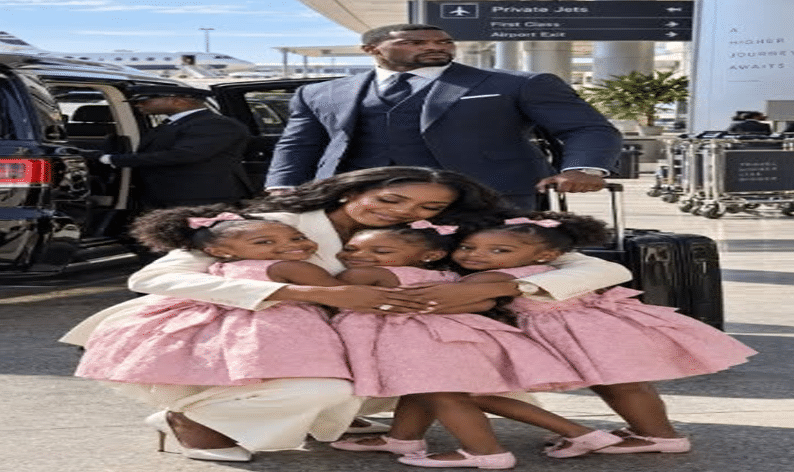
Three small figures wearing identical beige woolen duffle coats and red knit mittens breached the security stanchions, their sneakers squeaking frantically against the terrazzo floor.
Sophie arrived first, locking her arms around my thighs. Grace leaped into my hip, nearly knocking my shoulder bag loose, while Emma buried her face directly into the hem of my wool coat, giggling with the fierce, possessive joy of five-year-olds who had spent four days apart from their mother.
I dropped to my knees on the cold floor, wrapping my arms around all three of them, burying my face into their damp hair smelling of cinnamon and sweet laundry soap.
“My brave girls,” I whispered, laughing as Grace planted a wet, sticky kiss against my jaw. “Did you mind Grandma?”
“Grandma let us bake star cookies!” Emma announced loudly.
Behind me, the world stopped spinning.
The heavy thud of an Italian leather briefcase striking the floor broke through the children’s laughter.
Julian stood frozen six feet away. The blood had completely evacuated his face, leaving his skin the color of wet lime. His tall, athletic frame wavered slightly, as though an invisible shockwave had rippled through the concourse.
His amber eyes were blown wide, fixed in absolute, unadulterated terror upon the three small faces turned toward him.
They didn’t just resemble him. Genetics had executed an act of photographic duplication.
All three girls possessed his distinctive steel blue-gray eyes—a cold, luminous shade found only in the portrait gallery of the Vance estate. They had his high, aristocratic forehead, his sharp jawline, and, when Sophie scowled in confusion at the strange man staring at them, an identical, deep dimple appeared in the flesh of her left cheek.
“Evelyn…” Julian whispered, the word rattling dryly in his throat like gravel. “Whose… how old are they?”
I rose to my feet, keeping my hands resting firmly on Sophie and Grace’s shoulders. My voice was steady, flat, and absolute.
“They are five years old, Julian.”
Sophie tilted her head, studying his face with solemn, analytical curiosity. She reached into her rabbit-shaped backpack and pulled out an aged, creased envelope whose wax seal had been broken long ago.
“Mama,” Sophie said in her clear, piping voice. “Grandma said if we saw the man from the picture frame, we were supposed to give him this. She said it was the letter that explained why Daddy lived in the newspaper.”
Julian reached out with trembling fingers. The man who had negotiated fifty-million-dollar turbine contracts could barely keep his hands steady enough to unfold the yellowed stationery inside.
The letterhead belonged to Dr. Miriam Hale, Chief of Maternal-Fetal Medicine at Columbia University.
The handwriting was clinical, precise, and dated one week before our divorce decree was finalized:
“Dear Mr. Vance,
I am writing this confidential addendum directly to your private office because Evelyn refuses to breach your demands for silence. Her appointments with this clinic were not personal; they were emergency consultations for a monochorionic triplet gestation of extreme medical fragility. She is carrying three identical daughters conceived during your trip to Lake Geneva in February. Her silence was born of grief, not guilt. If you have a shred of honor remaining, you will cease your legal abandonment and accompany your wife to her twelve-week viability scan.”
Julian’s chest heaved once, twice, a ragged gasp catching behind his teeth. He dropped to one knee on the airport floor, his fingers clutching the paper so hard the corners shredded.
“Three…” he choked out, looking up at me with eyes that were suddenly swimming in tears. “Triplets. Evelyn… my God… what did I do?”
I looked down at him, my heart an iron vault that refused to yield.
“If you want to know why that letter took five years to reach your hands, Julian,” I said, pointing toward the sliding exit doors where my mother’s car was idling in the slush, “get your coat. We have an appointment in Evanston.”