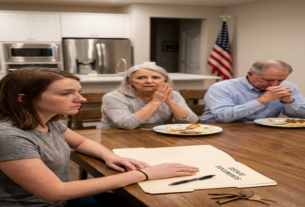
I came home exhausted from a night shift and found my father tagging me in the family group chat. “We’re using your lake house this weekend. Twenty people.”
Mom followed with:
“Stock the fridge and don’t make this difficult.”
I answered with one word.
“No.”
She sent laughing emojis.
“You really think you can stop us?”
I didn’t respond.
Then Friday morning came.
Dad called me screaming,
“What did you do to the house?”
At the time, I was already twelve hours into a double shift in the cardiac unit.
My phone buzzed beneath a pile of patient charts.
The notification had nothing to do with a medical emergency.
But it was about to expose a family problem I had been ignoring for years.
At 3:07 in the morning, my father tagged me in the main family group chat.
“We’re using Arden’s lake house this weekend. Twenty guests. Friday through Tuesday. Everyone bring towels. Arden, get everything ready.”
I stood behind the nurses’ station in Charlotte, North Carolina, with antiseptic clinging to my scrubs and stale coffee burning somewhere behind me.
A heart monitor flashed green through the glass wall of Room 12.
Farther down the hall, a ventilator released its steady mechanical sigh.
I read Dad’s message once.
Then twice.
Then a third time.
Exhaustion does strange things to your eyes.
After fourteen years as a registered nurse, I had learned never to trust the first version of anything at three in the morning.
But the message didn’t change.
My name is Arden Voss.
I was thirty-six.
Single.
Exhausted almost all the time.
And the sole owner of a small lake house on Lake Norman.
I had bought it after nine years of double shifts, packed lunches, discount scrubs, and driving the same dented silver Honda Civic my family loved to make jokes about.
That house belonged to me.
Not in some vague emotional sense.
Legally.
Financially.
Completely.
Every mortgage payment came from my account.
So did the property taxes.
Repairs.
Paint.
Mulch.
Broken screen doors.
Plumbing.
Everything.
I bought that house because I wanted one place in the world where nobody could walk through the door and tell me what I owed them.
Then Mom replied beneath Dad’s announcement.
“Fill the refrigerator, sweetheart. Aunt Liora likes fresh flowers in the main bedroom. And please don’t make this awkward.”
Within minutes, reactions started appearing.
Thumbs-up.
Hearts.
Laughing emojis.
My cousin Hollis wrote,
“Finally. That place needs some real family energy.”
My younger brother Keaton added,
“About time you shared something.”
Then someone asked,
“Is the Wi-Fi password still the same?”
That was the message that made me stop.
I had never given any of them my Wi-Fi password.
The unit around me was quiet.
Not peaceful quiet.
Hospital quiet.
The kind that feels like everyone is waiting for the next alarm.
A patient in Room 9 coughed twice.
My charge nurse walked by carrying a medication tray.
“You okay, Arden?”
“Yes.”
That was the first lie I told that morning.
I opened the family chat and started scrolling backward.
Slowly.
Carefully.
Nurses are trained to notice what is missing.
A dose that was skipped.
A symptom nobody mentioned.
A bruise hidden under a sleeve.
I found what I was looking for buried in old messages from Memorial Day.
Mom had written:
“We’re at Arden’s lake place. She doesn’t know, so don’t post anything yet.”
Forty-three people had seen the message.
Not one of them told me.
My hand went still.
I didn’t cry.
I didn’t gasp.
I didn’t throw my phone.
I just stood under the blue hospital lights and understood exactly what had happened.
While I was working long shifts taking care of strangers, my own family had been secretly using my house.
Mom had gotten access to a key I never gave her.
Dad had opened a door I never invited him through.
Relatives had slept in beds I had prepared for my own peace.
And now they were planning a five-day vacation there like I was some unpaid hotel manager who happened to share their last name.
I typed one word.
“No.”
No explanation.
No apology.
No smiley face.
No attempt to make the answer easier for them.
Just:
No.
Mom replied less than thirty seconds later.
“You really think you can stop us? Arden, we are your parents.”
Dad immediately added,
“Do not start drama at your age.”
I stared at the messages.
Then turned my phone facedown.
Because I still had patients.
And unlike my family, those people had actually asked for my help.
For the next several hours, I worked.
Checked vital signs.
Changed an IV.
Comforted a husband whose wife was being taken for an emergency procedure.
Held the hand of an elderly man waiting for cardiology.
Answered call buttons.
Updated charts.
Kept moving.
Sometimes the only way to survive something personal is to become incredibly professional.
But one thought stayed with me through the entire shift.
My family believed I couldn’t stop them.
They were about to learn otherwise.