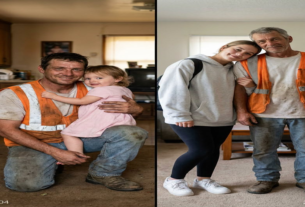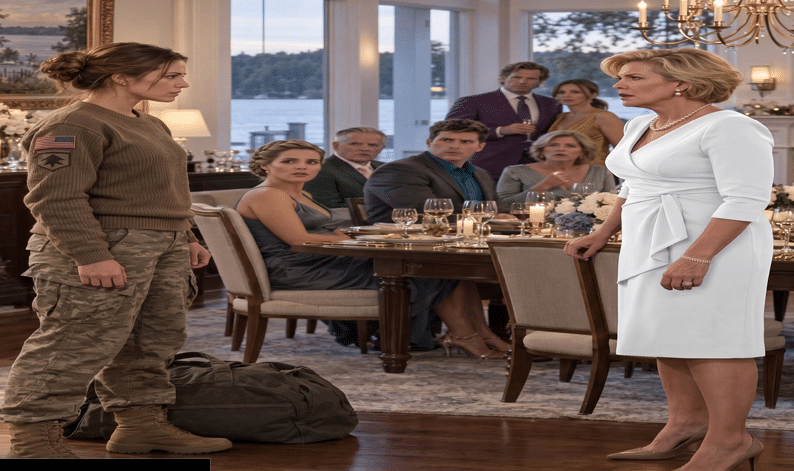
“My adoptive mom laughed to her wealthy guests at the $17 million lake house: “She’s just my husband’s charity project.” My sister added, “We don’t include her in family decisions.” Then their lawyer looked at me, froze, and said quietly: “Wait… she’s the owner?”
I heard my adoptive mother say it from the hallway of the lake house while I stood there holding one Army duffel bag, fresh off fourteen months in Kuwait and northern Iraq.
A few people laughed.
Then Diane continued.
“She’s not really family, so we don’t involve her in estate planning.”
I didn’t walk in immediately.
I simply stood there and listened.
Arthur had adopted me when I was four.
He had never treated me as anything less than his daughter.
Diane had spent most of my life finding quieter ways to remind me that she felt differently.
Different rules.
Different expectations.
Different standards.
When Chloe crashed her BMW at nineteen, it was a “learning experience.”
When I got a B+ in chemistry at sixteen, Diane wondered whether community college might be “more realistic for someone like me.”
Now she was explaining my place in the family to a table full of wealthy guests as though I were an uncomfortable financial footnote.
Then Marcus joined in.
“Elena is more comfortable blowing things up than managing assets.”
That drew an even louder laugh.
Two months earlier, I had supervised a $12.8 million military infrastructure operation without losing a single soldier or contractor.
But I didn’t defend myself.
I picked up my bag and walked into the dining room.
The laughter stopped.
Diane’s face slowly lost color.
Chloe looked annoyed, then nervous.
Marcus suddenly looked like he regretted speaking.
I gently set my duffel on the hardwood floor and looked directly at Diane.
She stood too quickly.
“Elena. We didn’t know you were already here.”
“I know.”
That was all I said.
The next morning, I discovered why they suddenly needed me to feel like “family.”
Diane called me into the kitchen.
Chloe pushed a thick folder across the marble island.
Marcus had what Diane called an “extraordinary opportunity.”
Chloe said the lender simply needed stronger collateral partners temporarily.
“It’s mostly procedural.”
I opened the folder.
It was a $4 million commercial loan guarantee through Ridgemont Capital Bank.
Then I kept reading.
Marcus wasn’t expanding anything.
There were missed payments.
Default warnings.
Personal guarantees.
Debt restructuring disclosures.
And buried deeper in the agreement was the part they hadn’t emphasized:
If the loan failed, my ownership share would absorb primary recovery exposure before Marcus’s company assets.
They weren’t asking me to help.
They were positioning me to absorb the damage.
Diane watched me read.
Then she said quietly,
“You owe this family, Elena.”
I looked up.
“For what?”
Her answer came immediately.
“For taking a stray in.”
Even Chloe went silent.
Diane continued, reminding me that they had fed me, educated me, and given me opportunities.
I nodded.
“Arthur did.”
Then I reached for the pen beside the contract.
All three of them relaxed.
I uncapped it, read the signature line one last time, and slid the entire agreement back across the counter.
“No.”
Chloe exploded.
Diane’s expression turned cold.
“If you refuse to help this family, then maybe it’s time we formally reconsider your place in it.”
She threatened to remove me from the family completely.
I placed my coffee mug in the sink.
“If you want to disown me, do it in writing.”
Then I left.
I sat in my truck in the rain for nearly ten minutes before remembering something Arthur had given me six days before he died.
An envelope.
I had never opened it.
At the hospital, he had told me only one thing about it:
“Open this if Diane ever asks you for money.”
Inside was a short handwritten note.
Go see Victor.
Don’t tell Diane first.
And don’t sign anything.
Forty minutes later, I was climbing the stairs to Victor Vance’s small law office.
Arthur had called him the last honest lawyer in Virginia.
Victor opened a safe behind his bookshelf and brought several thick folders, certified legal binders, and a cedar box to his desk.
Then he looked directly at me.
“Your father knew exactly what Diane was.”
He showed me bank statements, rental agreements, internal emails, signatures, and records Arthur had quietly collected for years.
Then Victor removed one sealed document from a certified binder.
He stopped talking.
Placed it directly in front of me.
And said:
“Arthur amended the trust before he died.””