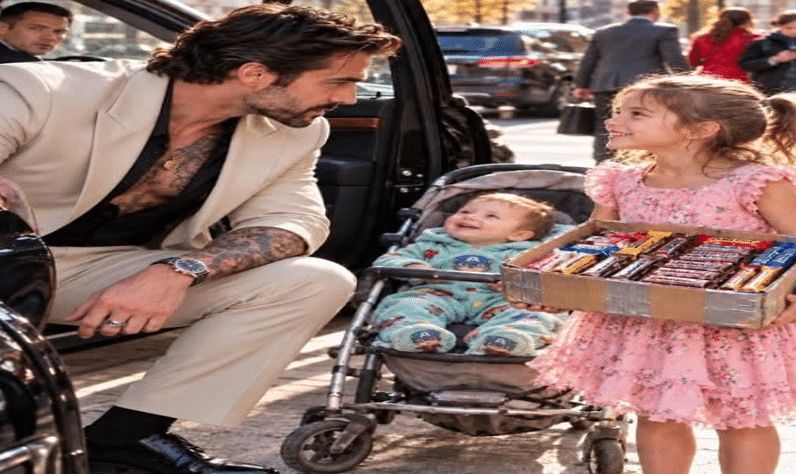
For one suspended second, I thought the girl was pointing at me.
Then I followed her gaze to the stroller.
A corner of white paper had slipped from beneath the baby’s blanket. It was folded around a plastic hospital bracelet, and printed across the paper in black ink was a name I knew better than my own.
Evan Bell.
My chief financial officer.
The man who had sat across from me every Monday morning for eleven years, reviewing payroll, freight contracts, charitable donations, and every dollar that passed through Moretti Maritime.
The man who knew where I kept my spare keys, which restaurants I hated, and how long I could go without sleep before my temper became dangerous.
The man I had trusted to sign checks when I was out of the country.
I looked at the girl.
“Where did you get this?”
She pulled the stroller closer to herself. “Mr. Bell gave it to my mama.”
“What did he give her?”
“The card. And the money for the medicine.” Her eyes flicked toward the hospital bracelet. “But then he stopped coming.”
Frank had come around the front of the car. He stood a few feet behind me, one hand tucked inside his coat, his attention moving between the traffic and the child.
“Boss,” he said quietly, “we should get them somewhere warm.”
The baby coughed again.
This time, the sound was weaker.
I crouched beside the stroller, keeping my hands visible. The girl watched me with the guarded concentration of someone who had learned not to trust sudden kindness.
“What’s your name?” I asked.
“Mia.”
“And your brother?”
“Jonah.”
“How old is Jonah?”
“Six months.”
The answer came instantly. She had probably been asked before.
“Where’s your mother?”
Mia’s mouth tightened.
“She’s resting.”
“Where?”
“In our room.”
“What room?”
She looked past me toward the street.
For the first time, I noticed the cardboard box had been placed beside a rusted metal post. Behind the post was the narrow entrance to an alley, and beyond it, the back wall of an abandoned printing shop. A staircase led up to a second-floor apartment with dark windows.
Frank saw it too.
“Nicholas,” he said, his voice lower now, “call someone.”
I took out my phone.
“Who?”
“An ambulance.”
Mia’s face changed.
“No,” she said quickly. “Please don’t.”
“Your brother needs a doctor.”
“He just has a cold.”
“He’s having trouble breathing.”
“He’ll be okay.” She wrapped both arms around the stroller handle. “Mama said not to let anyone take him.”
There was fear in her voice, but not of me.
Fear of being separated.
I softened my tone. “No one is taking him away. A doctor will help him, and you can go with him.”
“You promise?”
“I promise.”
It was a word I had used too carelessly in my life. Usually to close a negotiation or reassure someone until I could arrange a more useful answer.
This time, it felt like a contract.
Mia stared at me for a long moment.
Then she nodded.
Frank called emergency services while I took off my coat and wrapped it around the baby’s blanket. Jonah’s cheeks were flushed, and his breathing sounded tight, but he did not cry. He seemed exhausted beyond crying.
Mia touched his forehead.
“Did you give him anything?” I asked.
“Warm water.”
“Medicine?”
“Not yet.”
“Why not?”
“We needed money.”
Her answer was so matter-of-fact that it hurt more than tears would have.
I glanced at the box. Forty-three candy bars. At a dollar each, even if she sold every one, it would barely cover a bottle of infant medicine and a meal.
“Who gave you the candy?”
“Mama found it in the pantry.”
“Did she send you out here?”
Mia lowered her eyes.
“She said we had to try.”
There was no accusation in the way she said it. Only the dull acceptance of a child who had begun treating adult problems as ordinary weather.
The ambulance arrived four minutes later.
Mia climbed inside without protest, but she kept one hand wrapped around the stroller until the paramedic assured her Jonah would remain beside her. I followed them to the hospital in the town car, with Frank driving and the candy box on the seat between us.
No one spoke for the first several blocks.
Then Frank said, “Evan Bell has a daughter?”
“I don’t know.”
“You’ve known him eleven years.”
“I said I don’t know.”
He glanced at me in the rearview mirror. “You know everything else about him.”
That was the problem.
I knew Evan’s tax filings, his mortgage, his divorce settlement, his mother’s nursing-home expenses, and the exact amount he had invested in a vineyard in Oregon. I knew the names of his three dogs and the password to the company’s emergency banking system.
But I had never asked him what kept him awake.
At St. Vincent’s, a nurse took Jonah into an examination room while another led Mia to a chair in the pediatric waiting area. She sat stiffly, her blue jacket still zipped to her chin.
I handed the candy box to Frank.
“Keep this safe.”
He looked at the box, then at me. “That’s your priority?”
“It’s hers.”
He nodded and carried it to the corner.
A social worker named Mrs. Alvarez approached with a clipboard. She was a calm woman in her fifties with silver hair and a knitted green scarf.
“I’m going to ask you a few questions,” she told Mia. “Your brother is being looked after. You are safe here.”
Mia glanced at me.
“He’s staying?”
“I am,” I said.
Mrs. Alvarez looked between us but didn’t challenge it. “What is your mother’s name?”
“Lily.”
“Lily what?”
Mia hesitated.
“Lily Moretti.”
The waiting room seemed to tilt.
I heard the distant squeak of a cart rolling over linoleum. A television played silently above the reception desk. Somewhere behind the doors, a child laughed.
But all I could hear was that name.
Lily.
My daughter.
My only child.
The girl I had not seen in nine years.
I had spent years telling myself Lily had left because she hated the life I had built. That she had been ashamed of me, or frightened of the people around me, or simply determined to become someone who didn’t carry my name like a burden.
The last time I saw her, she had stood in the doorway of my office with a duffel bag over one shoulder.
“You don’t protect people, Dad,” she had said. “You collect them. You make them dependent on you, and then you call it love.”
I had told her she was young.
She had told me that was what men said when they didn’t want to listen.
Three days later, she left Boston.
I sent people to look for her.
They found nothing.
Or so I had believed.
I turned toward Mia.
“Your mother’s full name is Lily Moretti?”
“Yes.”
“How old is she?”
“Twenty-eight.”
That was Lily’s age.
“Does she know where you are?”
Mia’s eyes filled with alarm. “She told me to stay by the corner.”
“Why?”
“She was sick.”
“What kind of sick?”
“She couldn’t stand up. She said she would come back.”
“When?”
“After she got help.”
“From whom?”
Mia looked at the hospital doors.
“Mr. Bell.”
A coldness moved through me.
“Evan Bell?”
She nodded.
“What does he look like?”
She reached into the pocket of her jacket and pulled out a small photograph, bent down the middle. The image showed a younger Evan standing beside Lily in front of a lakeside cabin. Lily was holding a newborn baby. Evan had one hand resting lightly on her shoulder.
I recognized the cabin.
It belonged to me.
I had bought it for Lily when she was seventeen, back when I still believed expensive gifts could substitute for time. She had used it once, then returned the keys.
I stared at the picture.
“When was this taken?”
“I don’t know.”
“Where did you get it?”
“Mama keeps it in her purse.”
“Where’s her purse?”
“In the room.”
“What room?”
Mia looked at Mrs. Alvarez.
The social worker spoke gently. “Mia, we need to know where your mother is so we can make sure she is safe.”
“She’s in the apartment upstairs.”
Mrs. Alvarez rose at once.
I stood with her.
“You can’t go alone,” I said.
She gave me a careful look. “You’re family?”
“I’m Lily’s father.”
The words felt strange in my mouth. Not because they were untrue, but because they were the first time I had spoken them in years.
Mrs. Alvarez nodded. “Then you can come with us. But we do this carefully.”
Frank stepped forward. “I’ll drive.”
“No,” I said. “Stay here with Mia.”
He frowned. “Nicholas—”
“Stay with her.”
Frank looked as if he wanted to argue, then saw something in my face and stopped.
The apartment was above the abandoned printing shop, reached by a staircase that smelled of dust and damp plaster. The door at the top was unlocked.
Mrs. Alvarez knocked anyway.
“Lily? My name is Elena Alvarez. I’m with St. Vincent’s. We’re here to help.”
No answer.
Mia had said her mother was resting, but the silence behind the door did not sound like sleep. It sounded abandoned.
Mrs. Alvarez pushed it open.
The apartment contained one narrow bedroom, a small kitchen, and a living room with a mattress on the floor. A folding table held a kettle, two mugs, and a stack of unopened envelopes.
There was no sign of Lily.
I moved through the room slowly, looking for evidence of her in every object. A red scarf over the back of a chair. A jar of hair ties beside the sink. A photograph taped to the wall.
Lily at twenty years old, thinner than I remembered, smiling at someone outside the frame.
I touched the photograph with the tip of my finger.
“She was here,” Mrs. Alvarez said.
On the mattress lay a coat, an empty bottle of water, and a prescription container. The label read Lillian Moretti.
I picked it up.
The medication was for anemia.
There was also a receipt from a pharmacy dated three days earlier.
At the bottom of the receipt, written in blue ink, was a phone number.
I recognized the area code, but not the number.
Mrs. Alvarez opened the kitchen cabinet. There were two cans of soup, a bag of rice, and a small bottle of children’s fever reducer.
“She may have gone to get help,” she said.
“She wouldn’t leave the children alone.”
“Unless she thought she had no choice.”
The sentence landed harder than it should have.
On the folding table, beneath the envelopes, I found a brown paper packet sealed with clear tape. My name was written across the front.
Not Nicholas.
N. Moretti.
The handwriting was Lily’s.
For several seconds, I couldn’t bring myself to open it.
Mrs. Alvarez noticed.
“You don’t have to read it here.”
“I do.”
Inside was a single sheet of paper.
Dad,
I don’t know if this will reach you. I’m not asking for money. I’m not asking you to fix anything. I only need you to know that I tried to keep the children away from your world.
Evan said you would help if you understood the truth.
I don’t know if he was right.
The rest of the page was blank.
No explanation. No address. No apology.
Just a sentence that seemed to accuse both of us.
I read it twice.
Then I noticed something beneath the letter: a sealed envelope bearing the logo of Moretti Maritime.
I tore it open.
Inside was a printed account statement.
For the past eleven months, more than two hundred thousand dollars had been transferred from a company account into a series of small payments. Medical clinics. Grocery stores. Temporary housing. School fees. Pharmacies.
The transfers had been approved by Evan Bell.
The account was one I had never seen.
At the bottom of the statement, under a column marked BENEFICIARY, appeared a name.
Lillian Moretti and dependents.
My first reaction was anger.
Not the hot, reckless anger that made men say things they could not take back. This was colder. More deliberate.
Evan had used company money without telling me.
He had concealed Lily from me.
He had allowed me to believe she wanted nothing to do with me while quietly supporting her children.
For eleven years, I had treated Evan’s judgment as an extension of my own. If he had lied, then every decision we had made together became uncertain.
I folded the papers.
“Did you know about this?” Mrs. Alvarez asked.
“No.”
“Do you know where Lily might have gone?”
“No.”
She studied my face. “You should call the police and report her missing.”
I took out my phone.
The screen showed twelve missed calls from a number I did not recognize.
I played the voicemail.
A man’s voice came through, strained and hurried.
“Nicholas, it’s Evan. Don’t contact the police yet. I know how this looks, but you have to listen to me. Lily left the apartment because she thought someone had found her. I’m trying to locate her now. Keep Mia at the hospital. Do not let anyone from the company speak to her until I get there.”
The message ended.
I played it again.
Mrs. Alvarez’s expression sharpened. “Who was that?”
“My CFO.”
“Why would he tell you not to contact the police?”
“I don’t know.”
“That is not a good answer.”
“No,” I said. “It isn’t.”
A sound came from the hall.
Footsteps.
Mrs. Alvarez stepped toward the door, but I raised my hand.
A man appeared at the top of the stairs.
He was in his late fifties, wearing a dark overcoat and carrying a leather briefcase. His gray hair was damp from the rain, and his face looked older than it had that morning.
Evan Bell stopped when he saw me.
For a moment, neither of us spoke.
Then his gaze fell to the papers in my hand.
“You found the account.”
“You knew I would.”
“I hoped you would.”
“You knew Lily was alive.”
His face tightened.
“Yes.”
“How long?”
“Since the day she left.”
The answer struck with such force that I had to grip the edge of the table.
“You knew where she was all this time?”
“Not always.”
“But you knew she had children.”
“Yes.”
“And you never told me.”
“She begged me not to.”
“You made that decision for me?”
“No. I made it for her.”
“You used my company’s money.”
“I used money I had authority to access.”
“You hid an account from me.”
“I created a separate account because the payments needed to remain private.”
“Private from me.”
Evan took a breath. “You’re not hearing what I’m saying.”
“I’m hearing perfectly.”
“No, you’re hearing the part that gives you the right to be angry.”
The words were so unlike him that they silenced me.
Evan placed the briefcase on the floor.
“Lily did not leave because she hated you,” he said. “She left because she was afraid of what would happen if you found out she was pregnant.”
“Pregnant with whom?”
He looked away.
“Evan.”
“With Daniel.”
The name was familiar.
Daniel Bell.
Evan’s youngest son.
Daniel had worked briefly in the company’s shipping division before leaving Boston. I remembered him as a quiet young man with a gift for mechanical systems and an unfortunate tendency to avoid every difficult conversation.
“He and Lily were together?” I asked.
“They were in love.”
I laughed once, without humor. “You expect me to believe my daughter disappeared with your son, had two children, and neither of you thought I deserved to know?”
“Daniel died before Jonah was born.”
The room became very still.
“How?”
“An accident at the docks.”
I knew there had been an accident three years earlier. A subcontractor’s employee had fallen from a loading platform during an overnight shift. I had read the report, authorized compensation, and moved on to the next crisis.
I had never seen the name.
Evan’s voice lowered. “Lily blamed herself. She believed if she had told you about the pregnancy, you would have forced Daniel into working for you, or sent him away, or made the decision for both of them. She was young and frightened.”
“She was my daughter.”
“She knew exactly who you were.”
The words were not cruel.
That made them worse.
Evan continued. “After Daniel died, Lily refused to come back. She said she didn’t want the children raised around the company. I helped when I could. The transfers were not stolen money. They were from my retirement account and a small trust Daniel had left.”
I looked at the statement again.
“Then why use a Moretti Maritime account?”
“Because my bank flagged the transfers. I needed a clean way to pay the clinics. I reimbursed the company account every month.”
I stared at him.
“Every month?”
“Yes.”
“Why didn’t you tell me?”
“Because Lily asked me not to.”
“That answer is wearing thin.”
“I know.”
He reached into his coat and pulled out a small envelope.
“I came here because she left this for you.”
I did not take it immediately.
“What happened to her?”
“She received a message this morning. Someone told her they knew where she and the children were living. She thought it was connected to Daniel’s death.”
“Connected how?”
Evan’s eyes moved toward the window.
“Daniel had discovered something at the docks before the accident.”
“What?”