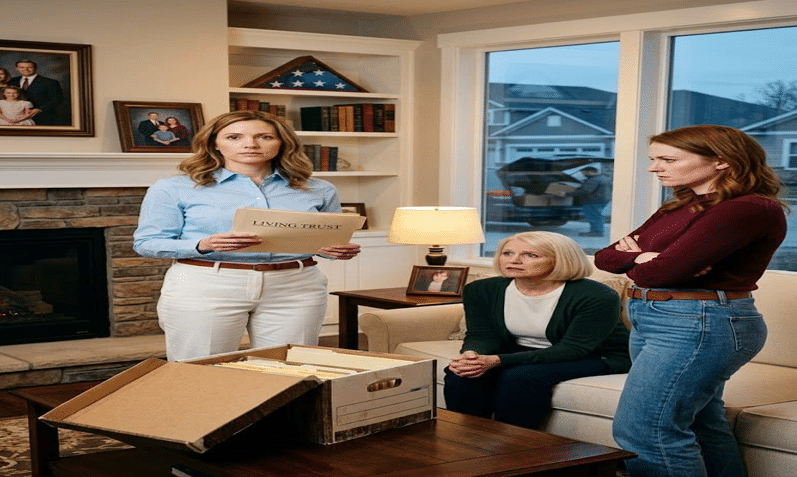
My sister looked me in the face and said, “Why don’t you just go away?” blaming me for ruining her life. My parents didn’t stop her—they agreed with every word. I didn’t argue, and I didn’t defend myself. I just walked out quietly. Then this morning, my phone lit up so fast I knew something had gone very wrong.
So I did.
I left the way people leave a room when they finally realize they were only welcome as long as they kept everything running. I passed the kitchen island with the wilted Costco veggie tray from Sunday, the stack of paper plates near the sink, and the family calendar on the fridge with Alyssa’s fundraiser brunch circled in red. Then I walked straight out of my parents’ brick house without giving anybody the scene they were clearly prepared for.
Outside, the cul-de-sac was settling into evening. Porch lights were coming on one by one. Somewhere across the street, a garage door groaned shut. A neighbor rolled a trash bin back up the driveway like it was any other night in any other quiet subdivision. That almost made it worse. The whole street looked so normal while my family sat inside deciding I was the problem they could finally remove.
Alyssa had been pacing near the dining room, flushed and breathless, saying I had ruined everything again. My mother used that soft, church-lady calm she reaches for when she wants cruelty to sound like good manners. My father stayed in his chair with his reading glasses low on his nose and acted like he was being fair. But people do not have to raise their voices to choose a side. Sometimes all they have to do is let the cruelest person in the room keep talking.
And she did.
I didn’t remind them who had spent the last eight months handling the calls nobody wanted to make, or who kept showing up every time another bill, another form, another “small family favor” landed on the table. I didn’t point to the cream folder sitting in the middle of the placemats, the one they had nudged toward me twice already without quite saying why my signature mattered so much tonight. I didn’t mention Grandma, or the promise I made her, or why Alyssa had suddenly become very interested in “moving forward” before certain paperwork was finalized.
I just took my keys from the mudroom hook and left.
By the time I reached my apartment downtown, the lobby smelled faintly of floor cleaner and takeout. The elevator chimed on the sixth floor. A man in a navy quarter-zip stepped out, office badge still clipped to his belt, barely looking up from his phone. I got inside, set my bag on the counter, and sat in the dark long enough to hear Alyssa’s last sentence replay in my head.
Why don’t you just go away?
People only say that when they think your silence is going to make something easier.
At 6:12 this morning, my phone started vibrating so hard it skidded across the nightstand.
Mom. Dad. Alyssa. Then Mom again. Three voicemails. Nine missed calls. One text from my father that said, Call me right now. Another from Alyssa with no punctuation, just panic.
I made coffee before I listened to any of it.
When I finally did, nobody sounded angry anymore. My mother sounded breathless. My father sounded older than he had the night before. In the background, Alyssa kept saying no in that sharp, thin voice people use when something has slipped out of their hands.
Then Dad sent me a photo.
It was the front of the house, taken from the porch. Our wreath was still on the door. The welcome mat was crooked. And taped neatly beside the frame was a white notice with a county seal at the top.
I knew what it was before I even zoomed in.
NOTICE OF TAX FORECLOSURE PROCEEDINGS.
I set my coffee down.
Carefully.
The amount listed beneath it was $38,417.62.
Property taxes.
Penalties.
Interest.
Legal fees.
And a deadline.
Ten business days.
My father called again.
This time, I answered.
“Rachel.”
He didn’t say hello.
He didn’t ask whether I had slept.
His voice was tight.
“What did you do?”
I looked through the window of my apartment at Cincinnati waking beneath a pale gray sky.
“I left.”
“You know what I mean.”
“No, Dad. I don’t.”
“The notice.”
“What about it?”
“A county officer put this on the house this morning.”
“I can see that.”
“How?”
I almost laughed.
Not because anything was funny.
Because eight months of explanations had somehow disappeared overnight.
“Unpaid property taxes generally lead to notices.”
“Don’t talk to me like I’m stupid.”
“I’ve never thought you were stupid.”
“Then explain why this happened.”
I closed my eyes.
“Because the taxes weren’t paid.”
Silence.
Then Alyssa’s voice exploded somewhere behind him.
“Ask her why she canceled it!”
I opened my eyes.
“Canceled what?”
My father covered the phone.
I heard muffled voices.
My mother.
Alyssa.
Then Dad returned.
“The payment arrangement.”
I leaned back against the kitchen counter.
“What payment arrangement?”
Another silence.
Longer this time.
That was when I understood.
They thought I had been paying it.
Not helping.
Not organizing.
Paying.
“Dad.”
My voice became very calm.
“Whose name is on that house?”
“Mine and your mother’s.”
“And whose property taxes are they?”
“That isn’t the point.”
“It is exactly the point.”
His breathing changed.
For eight months, I had been trying to explain this.
After Grandma died, everything became complicated.
She had lived in the small bungalow behind my parents’ property for seventeen years.
Technically, the bungalow and my parents’ house sat on the same parcel.
Years earlier, Grandma had contributed money toward a major addition and renovation.
In exchange, my parents had signed an agreement giving her a recorded financial interest in the property.
Nobody thought much about it at the time.
Then Grandma died.
And the paperwork mattered.
Her interest passed into her estate.
And because Grandma had named me executor, every family conversation suddenly became my responsibility.
At first, Alyssa didn’t care.
Then she learned what Grandma’s estate might be worth.
That was when everything changed.
The cream folder from the night before contained a proposed family settlement.
My parents wanted Grandma’s estate to release its claim against the property.
Alyssa wanted the same thing.
They called it “cleaning up the title.”
What they didn’t emphasize was what happened afterward.
My parents planned to refinance the house.
Alyssa needed money.
A lot of it.
Her event-planning business had been struggling for nearly a year.
She owed vendors.
She had credit-card debt.
And the fundraiser brunch circled on the refrigerator wasn’t simply a charity event.
Her company was producing it.
If it failed, she stood to lose one of her last major clients.
The refinance would have given her breathing room.
But there was a problem.
Grandma’s estate.
Me.
My signature.
“You told us you were handling the taxes,” Dad said.
“No.”
“Yes, you did.”
“I told you I had contacted the county to stop the process from advancing while we sorted out Grandma’s estate.”
“That’s the same thing.”
“No, Dad.”
I stared at my coffee.
“It isn’t.”
My mother came onto the phone.
“Rachel, please.”
Her voice was already trembling.
“This is our home.”
“I know.”
“We could lose it.”
“I know.”
“Then why would you let this happen?”
That question hurt.
Not because I felt guilty.
Because I had heard versions of it my entire life.
Why would you let Alyssa fail algebra?
Why would you let your father forget his cardiology appointment?
Why would you let the insurance lapse?
Why would you let Grandma’s prescriptions run out?
Why would you let Christmas become stressful?
Somewhere along the way, helping had turned into responsibility.
And responsibility had turned into blame.
“I didn’t let anything happen.”
My mother started crying.
“You knew about this.”
“Yes.”
“Then why didn’t you fix it?”
There it was.
I looked at the clock.
6:31.
Less than twelve hours earlier, she had sat at the dining table and told me Alyssa had a point.
Maybe I did make everything harder.
Maybe I did always have to control things.
Maybe the family would be calmer if I stopped interfering.
So I had.
“Mom.”
“Yes?”
“Last night, you told me to stop controlling everything.”
“I was upset.”
“You agreed when Alyssa told me to go away.”
“We didn’t mean literally.”
I almost smiled.
“What part wasn’t literal?”
Silence.
Then Alyssa grabbed the phone.
“You knew this was going to happen.”
Her voice was furious.
“I knew it could happen.”
“And you didn’t warn us?”
“I warned you in August.”
“You said there were tax issues.”
“I gave Dad the notice.”
“You never said they could take the house.”
“I did.”
“When?”
“September 3rd. At this same kitchen table.”
“That was months ago.”
“Yes.”
“And you expect us to remember every little thing you say?”
There are sentences that explain entire families.
That was one of them.
Every little thing.
$38,417.62 in unpaid taxes.
A recorded estate interest.
A refinance they couldn’t close.
My grandmother’s final wishes.
Little things.
I took a sip of coffee.
“What do you want from me, Alyssa?”
“Fix it.”
“No.”
The word came out so quietly she missed it.
“What?”
“No.”
Silence.
Then:
“You have to.”
“I don’t.”
“You’re the executor.”
“Of Grandma’s estate.”
“And the estate is causing this.”
“No. Unpaid taxes are causing this.”
“You know what I mean.”
“Yes.”
For the first time, I realized that was the problem.
I always knew what they meant.
So they never had to say it honestly.
They didn’t want me to handle the estate.
They wanted me to surrender it.
They didn’t want help with the taxes.
They wanted my money.
They didn’t want my advice.
They wanted my signature.
And they didn’t want me in the family unless I arrived carrying one of those things.
“Alyssa.”
“What?”
“Why was my signature so important last night?”
She stopped.
Behind her, I heard my father say something.
“Rachel—”
“No.”
I stood straighter.
“I want Alyssa to answer.”
She exhaled.
“For the refinance.”
“I know that.”
“Then why are you asking?”
“Because the settlement in that folder didn’t just release Grandma’s interest.”
Silence.
“It also authorized a distribution.”
My father’s voice became confused.
“What distribution?”
Interesting.
Alyssa said nothing.
My mother whispered:
“What is she talking about?”
I opened the PDF on my laptop.
I had photographed every page of the cream folder before leaving their house.
Page eleven.
Section seven.
Distribution upon refinancing.
I read the number again.
$125,000.
Payable directly to Alyssa Morgan Consulting LLC.
My father spoke first.
“One hundred twenty-five thousand?”
Alyssa finally answered.
“It was temporary.”
My mother gasped.
“What?”
“It was a loan.”
“From our house?”
“I was going to pay it back.”
Dad’s voice changed.
“You told me the refinance was for the roof and the tax balance.”
“It was.”
“Then what is Rachel talking about?”
Alyssa began speaking rapidly.
Cash flow.
Vendor obligations.
Contracts.
Temporary liquidity.
A spring booking season.
I listened.
It was almost impressive.
She had a professional phrase for every form of desperation.
Then my father asked:
“Did you put that in the papers?”
Alyssa didn’t answer.
“Alyssa.”
“Dad, if Rachel would stop making everything into a federal case—”
“Did you put it in the papers?”
“Yes.”
The silence afterward was different.
For the first time, I wasn’t the problem sitting between them.
Facts were.
My mother whispered:
“You wanted us to borrow $125,000 against the house?”
“I was going to repay it.”
“When?”
“Mom.”
“When?”
“I don’t know.”
Dad swore.
I couldn’t remember the last time I’d heard him do that.
Then he asked the question that should have been asked before anyone pushed a cream folder toward me.
“Who prepared those documents?”
Alyssa hesitated.
“My attorney.”
Not our attorney.
Not the estate attorney.
Hers.
I closed my laptop.
“That’s why I wouldn’t sign.”
My father went quiet.
“You knew?”
“I read the documents.”
“Why didn’t you tell me?”
“I tried.”
“No, you didn’t.”
“Yes, Dad.”
I felt tired suddenly.
“Last night, I said the settlement contained terms we needed to discuss before anyone signed.”
I could hear the memory arriving.
My mother had said:
Not tonight, Rachel.
Dad had sighed.
Alyssa had rolled her eyes.
Then she accused me of sabotaging her future.
Twenty minutes later:
Why don’t you just go away?
Dad’s voice became smaller.
“I thought you were stalling.”
“I know.”
Another long silence.
Then my mother asked:
“What happens now?”
That was the first useful question anyone had asked me.
“You call the county.”
“We did.”
“And?”
“They said the balance has to be resolved.”
“Then resolve it.”
“With what?”
I closed my eyes.
There it was again.
“With your money.”
“We don’t have forty thousand dollars sitting around.”
“You have retirement savings.”
Dad immediately said:
“We can’t touch that.”
I almost laughed.
My $31,000 emergency fund apparently had fewer protections.
Because that had been the unspoken plan.
I had learned about the tax balance months earlier.
I had offered to help negotiate a payment plan.
Not pay it.
Help.
But every delay became my problem.
Every phone call became mine.
Eventually, the county representative knew my voice.
My parents stopped opening half the envelopes because:
Rachel’s handling it.
Except I wasn’t.
I couldn’t.
I didn’t own the house.
And after the estate dispute became part of the title problem, my attorney specifically warned me not to use estate funds to satisfy my parents’ personal tax obligations without proper authority.
I explained all of that.
Again.
This time, they listened.
Amazing what a white notice taped to a front door can do for attention.
At 8:04, my father called the county.
At 8:36, my mother called their financial adviser.
At 9:10, Alyssa called me privately.
I almost didn’t answer.
Then I did.
“What?”
Her voice was quiet.
“You embarrassed me.”
I stared at the phone.
“I wasn’t there.”
“You knew Dad didn’t know about the $125,000.”
“No.”
“You had to know.”
“I assumed he had read the document he wanted me to sign.”
“You could have warned me.”
I laughed.
Just once.
“You told me to go away.”
“I was angry.”
“And I went away.”
“You always do this.”
“What?”
“Act calm so everyone else looks crazy.”
I sat down.
There are arguments you can win only by refusing to enter them.
So I asked:
“Did Grandma know your business was in trouble?”
Silence.
“Alyssa?”
“She knew I had some debt.”
“How much did she give you?”
Another silence.
That answer mattered.
“How much?”
“Twenty thousand.”
My chest tightened.
“When?”
“Last year.”
Grandma had been ninety.
Living on Social Security, a pension, and savings she guarded carefully.
“What did you tell her it was for?”
“Business.”
“What business?”
“Why does it matter?”
Because Grandma had called me six weeks before she died.
She had been upset.
She said someone in the family kept asking her for money.
She wouldn’t tell me who.
She made me promise something.
Rachel, when I’m gone, don’t let anyone hurry you.
At the time, I thought she meant grief.
Now I understood.
“Alyssa.”
“What?”
“Did Grandma give you the money willingly?”
“Yes.”
Immediately.
Too immediately.
“Then why didn’t you tell us?”
“Because you’d judge me.”
“No.”
I looked at the photograph of Grandma on my bookshelf.
“I would have documented it.”
Alyssa went quiet.
There was the difference between us.
She thought paperwork was suspicion.
Grandma thought paperwork was protection.
That afternoon, I called the estate attorney, Miriam Klein.
I told her everything.
The proposed settlement.
The $125,000 distribution.
The $20,000 Grandma had apparently given Alyssa.
The foreclosure notice.
Miriam listened without interrupting.
Then she said:
“Do not sign anything.”
“I wasn’t going to.”
“And Rachel?”
“Yes?”
“We need to review your grandmother’s bank statements.”
My stomach tightened.
“Why?”
“Because if Alyssa received $20,000 near the end of your grandmother’s life, we need to determine whether it was a gift, a loan, or something else.”
“I don’t want to accuse her of anything.”
“We’re not accusing anyone.”
Miriam’s voice stayed calm.
“We’re accounting.”
That word steadied me.
Accounting.
Not revenge.
Not punishment.
Facts.
Three days later, we found the first check.
$5,000.
Memo:
ALYSSA BUSINESS LOAN.
Then another.
$5,000.
Then $10,000.
Same memo.
Loan.
Not gift.
Miriam requested Grandma’s handwritten financial ledger.
Grandma had kept one for thirty-seven years.
Every birthday check.
Every charitable donation.
Every plumber.
Every prescription.
Every dollar.
Beside Alyssa’s name were three entries.
$5,000.
$5,000.
$10,000.
And beside the final one:
Promised repayment by June.
June had passed six months before Grandma died.
No repayment appeared.
Miriam leaned back in her chair.
“That changes the estate accounting.”
I knew what she meant.
Alyssa’s inheritance would be reduced by the unpaid loan.
Not because I decided it.
Because Grandma had documented it.
When Alyssa found out, she called me screaming.
“You’re stealing my inheritance!”
I held the phone away from my ear.
“No.”
“You went digging through Grandma’s private things.”
“I’m her executor.”
“You’re obsessed with paperwork.”
“She wrote down the loan herself.”
“She told me I didn’t have to repay it.”
“Then we’ll need evidence of that.”
“You’re unbelievable.”
Maybe.
But I had spent eight months being told that accuracy was cruelty whenever accuracy became inconvenient.
I wasn’t doing that anymore.
My parents eventually resolved the tax balance.
They withdrew part of a retirement account, arranged the remaining amount, and stopped the foreclosure process before the deadline.
It cost them penalties.
It cost them interest.
It cost them an uncomfortable meeting with a financial adviser who apparently asked several questions they should have been asked years earlier.
They kept the house.
The refinance did not happen.
Alyssa did not receive $125,000.
And I did not return to managing their bills.
That was the part they struggled with most.
Two weeks later, Mom called.
“The insurance renewal came.”
“Okay.”
“Don’t you need the policy number?”
“No.”
Silence.
“Rachel.”
“Yes?”
“Your father doesn’t understand the online portal.”
“Then he can call the number on the statement.”
Another silence.
“You’ve always handled these things.”
“I know.”
“So you’re just going to stop helping us?”
“No.”
I looked around my apartment.
“I’ve stopped doing things you can do yourselves.”
She didn’t like that answer.
But she learned.
Dad learned too.
Slowly.
Painfully.
He started opening his own mail.
He created a folder for property taxes.
He even made a spreadsheet.
It was terrible.
I told him so.
For the first time in months, he laughed.
Alyssa and I didn’t speak for nearly five months.
Her fundraiser brunch happened without me.
Her business survived, although barely.
She sold her luxury SUV.
Moved into a smaller office.
Negotiated with vendors.
Took consulting work she previously considered beneath her.
In other words, she did what the rest of us had been doing for years.
She adjusted.
Grandma’s estate took almost another year to settle.
When it did, the house issue was resolved cleanly.
The estate released its recorded interest in exchange for an agreed amount based on Grandma’s original contribution and the terms of the old agreement.
My parents remained in their home.
The estate distributed what remained according to Grandma’s will.
Alyssa’s share was reduced by the documented $20,000 loan.
Mine wasn’t larger because of it.
That mattered to me.
The unpaid amount went back into the estate and was divided according to Grandma’s instructions.
Nobody got a victory prize.
That was never the point.
On the day I closed the estate account, Miriam handed me Grandma’s ledger.
“You can keep this.”
I ran my fingers over the worn green cover.
Near the back, between utility totals and Christmas gifts, Grandma had written something I had never seen.
Rachel worries too much, but she reads everything.
I laughed.
Then I cried.
Because suddenly I could hear her voice.
Don’t let anyone hurry you.
Six months after the estate closed, Alyssa appeared at my apartment.
No warning.
I almost didn’t open the door.
Then I saw what she was holding.
The cream folder.
The same one from the dining table.
She had kept it.
“I found this while moving offices.”
I stepped aside.
She entered.
We sat at my kitchen table.
For a while, neither of us spoke.
Then she placed the folder between us.
“I read it.”
I looked at her.
“All of it?”
She gave a small, embarrassed smile.
“Apparently that’s something people should do before demanding signatures.”
I said nothing.
She looked down.
“I was desperate.”
“I know.”
“That doesn’t excuse it.”
“No.”
“I really thought if I could get the money, I could fix everything.”
“I know.”
“And when you wouldn’t sign, I decided you were the reason I couldn’t.”
I waited.
Her eyes filled.
“I told Mom and Dad you wanted control.”
“Yes.”
“I said Grandma made you executor because you manipulated her.”
“Yes.”
“I told them you enjoyed watching me fail.”
That one I hadn’t known.
She saw it on my face.
“I’m sorry.”
I looked toward the window.
Five months earlier, I would have imagined that apology feeling like justice.
It didn’t.
It felt like grief finally learning how to speak.
“Why did you come here?”
She swallowed.
“Because I keep hearing what I said.”
Why don’t you just go away?
Her voice broke.
“And you did.”
I looked at her.
“Yes.”
“I didn’t think you actually would.”
That sentence almost made me smile.
“That’s part of the problem, Alyssa.”
She nodded.
“I know.”
Then she said something I hadn’t expected.
“Thank you for not signing.”
I stared at her.
“If you’d signed those papers, I would have taken the money.”
I didn’t answer.
“I would have told myself I’d repay it.”
She wiped her face.
“But I don’t know if I could have.”
That was the first completely honest thing she had said about it.
“I was drowning.”
“I know.”
“And instead of admitting it, I kept looking for somebody else’s life jacket.”
I reached across the table.
Not all the way.
Just far enough to touch the edge of the folder.
“Are you still drowning?”
She shook her head.
“No.”
“Good.”
“I’m not doing great.”
“Those are different things.”
She laughed through her tears.
“Grandma used to say that.”
“I know.”
We talked for two hours.
Nothing was magically repaired.
She didn’t become a different person because she apologized.
I didn’t forget the dining room.
My parents didn’t suddenly understand every way they had made me responsible for keeping the family functional.
But things changed.
Mostly because I changed.
The following Christmas, Mom asked whether I could come early and organize dinner.
“No.”
She blinked.
Then I smiled.
“But I’ll bring pie at five.”
Dad laughed.
Mom didn’t.
She eventually did.
Alyssa arrived carrying mashed potatoes.
Store-bought.
Nobody died.
The meal happened.
The dishes got washed.
Dad forgot the rolls in the oven.
For once, that became a funny story instead of an emergency I was expected to prevent.
After dinner, I stood near the mudroom.
My keys were hanging from the same hook.
Alyssa came beside me.
For a second, both of us looked toward the dining room.
Same table.
Same chairs.
Different year.
She whispered:
“I’m glad you came back.”
I picked up my keys.
“I came to dinner.”
She looked at me.
Then smiled.
She understood.
Coming back for dinner wasn’t the same as returning to the role I’d left.
That role was gone.
I had spent years believing being needed was proof of being loved.
It wasn’t.
Sometimes being needed simply means everyone has learned that you’ll carry what they put down.
Bills.
Appointments.
Forms.
Secrets.
Debt.
Resentment.
Responsibility.
And eventually, when your arms are full, somebody complains that you’re controlling everything.
The night Alyssa told me to go away, I thought I was walking out because my family had rejected me.
I understand it differently now.
I was walking out of a job nobody had hired me for but everyone expected me to perform forever.
The next morning, that county notice terrified them because the person they had blamed for interfering was no longer standing between them and the consequences.
They called me because they thought I was the solution.
For years, I would have rushed back.
I would have paid something.
Signed something.
Made six phone calls.
Calmed my mother.
Protected my father.
Rescued Alyssa.
Then resented all of them afterward.
This time, I did something harder.
I let them handle what belonged to them.
And I handled what belonged to me.
Grandma’s estate.
My signature.
My peace.
There is still a photograph of that county notice on my phone.
I don’t keep it because I’m proud my parents almost lost their house.
I’m not.
I keep it because whenever I start confusing guilt with responsibility, I look at it.
A white sheet of paper.
A county seal.
A crooked welcome mat.
Proof that the world did not end when I stopped fixing everything.
My family figured it out.
My parents kept their house.
My sister faced her debt.
Grandma’s wishes were honored.
And me?
I finally went away.
Not from my family.
From the version of myself they had learned to depend on.
It turned out that was the only person I had needed to leave behind.