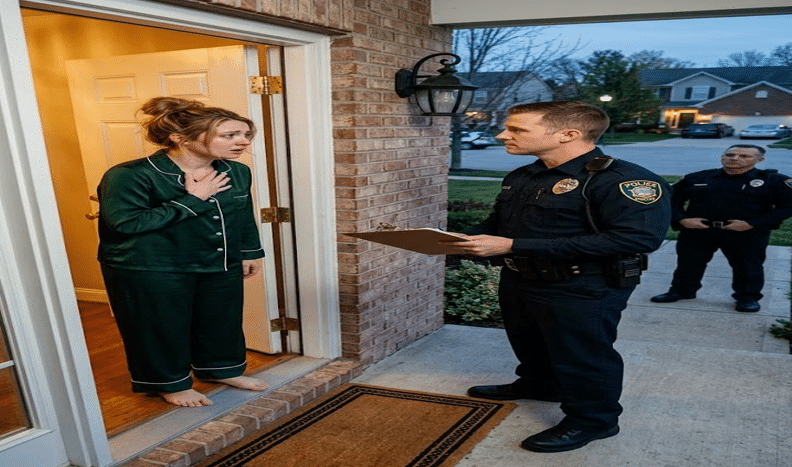
My parents called at 1 A.M. screaming, “Wire $20,000—your brother’s in the ER!” I asked one question… and they dodged it. So I said, “Call your favorite daughter,” hung up, and went back to sleep. The next morning… police were at my door.
It wasn’t a polite knock. It wasn’t the soft tap of a neighbor or the impatient thud of a delivery driver. It was hard, official, and steady—the kind of knock that makes your body lock up before your mind even catches up. I opened the door in old sweatpants and the wrinkled T-shirt I’d slept in, my hair twisted into a messy knot, and the cold air that spilled into the entryway made my stomach drop like I’d missed a stair in the dark.
Two officers stood on my porch. One was tall and square-shouldered, holding a small notebook. The other stayed half a step behind him, watchful, hands near his belt, the expression of someone who had started his morning in someone else’s disaster.
“Ma’am,” the taller one said, calm but firm, “are you Olivia Wilson?”
I nodded.
“Did you receive a phone call last night around one in the morning demanding that you wire twenty thousand dollars?”
The word demanding hit me harder than anything else. Not asking. Not informing. Demanding.
Every detail of the call snapped back into place. My phone buzzing against the nightstand at exactly 1:00 a.m. My husband, Matt, dead asleep beside me. My own pulse already racing before I even answered, because when your family calls in the middle of the night, your body learns to expect damage.
I had answered on instinct. “Mom?”
Her voice came through ragged and high, like panic wrapped in static. “Olivia—oh my God—honey—”
I sat straight up so fast the sheet tangled around my legs. “What’s wrong?”
“Twenty thousand,” she sobbed. “We need twenty thousand right now.”
“For what?”
“Mark.” She sucked in a shaky breath. “Your brother’s in the ER. They won’t do what he needs until—”
“What hospital?” I cut in.
There was a pause. Tiny. But wrong. Wrong the way a cracked stair feels wrong beneath your foot even before it gives way.
Then my father came on the line, sharp and irritated, not frightened at all. “Stop asking questions and send it.”
I remember staring into the dark bedroom, every nerve suddenly awake. “Dad, what hospital is he in?”
“Why does that matter?” my mother cried in the background. “He’s your brother!”
That line used to work on me. It used to pull me into motion before I had time to think. Because in my family, a crisis was never just a crisis. It was a test. A measure of how quickly I would empty my wallet, cancel my plans, swallow my anger, and prove I was still the reliable one.
Mark has been forty-two for six years and twelve years old for most of them. He is still described as “sensitive” after screaming at waitresses, “misunderstood” after getting fired, and “down on his luck” after maxing out cards, wrecking cars, borrowing money, and turning every bad choice into a storm somebody else is expected to stand in. My parents don’t just forgive him. They rearrange reality around him.
And then there’s Emily, my younger sister, the family’s soft place to land. Emily gets pet names, sympathy, patience, and rescue with a smile attached. Emily gets, “Don’t worry, sweetheart, we’ll figure it out.” I get midnight calls and instructions.
So when my mother wailed, “Please, honey, just wire it,” something in me didn’t break. It cleared.
I said the one sentence I should have said years earlier.
“Call your favorite daughter.”
Then I hung up.
My hand shook afterward, but not from guilt. From adrenaline. I sat there for a full minute staring at the black screen of my phone, waiting for it to ring again. It didn’t. Matt woke just enough to mumble, “Everything okay?” and I said, “No. But I think I finally am.” Then I put the phone facedown and went back to sleep.
Now, standing in my doorway with two police officers looking at me like I was a missing piece in something ugly, I felt that same cold clarity return.
“Yes,” I said. “They called me. My parents. They said my brother was in the ER and they needed twenty thousand dollars immediately.”
The taller officer glanced at his partner, then back at me. “May we come in?”
We sat at my kitchen table. Morning light came through the blinds in thin gray stripes. My coffee maker clicked uselessly on the counter because I’d turned it on and forgotten to put a mug under it. The taller officer opened his notebook.
“Ms. Wilson, your brother was not in any emergency room last night.”
I actually laughed once, a small breath of sound with no humor in it at all. “I knew it.”
“There was a disturbance at your parents’ house around one-forty this morning,” he continued. “Officers responded after a neighbor reported yelling and something breaking. Your brother was there. So were your parents. And your sister.”
My chest tightened. “Emily?”
He nodded. “She wired money before she drove over.”
The room seemed to tilt a little. Not because I was shocked she helped. Emily always helped. Emily had been trained to think helping was love. What knocked the air out of me was the picture that instantly formed in my mind: my mother crying into the phone, my father barking orders, Emily scrambling half-asleep with trembling hands because she still believed emergencies in our family were real.
The officer kept talking. “When your sister arrived, she discovered your brother was sitting in the kitchen. He had a cut on his hand, likely from punching a cabinet door. No ambulance. No hospital bracelet. No admission papers. No doctor. Just a broken lamp, an empty whiskey glass, and a stack of documents on the table.”
I went still.
“What documents?”
Instead of answering, he reached into a manila folder he had brought inside with him and slid one page halfway across the table.
I didn’t touch it at first. I didn’t need to. I knew my own life on sight.
A photocopy of my driver’s license.
The first page of last year’s tax return.
An old voided check from a joint account Matt and I had closed three years ago.
And on top of them, a yellow sticky note in my mother’s handwriting.
Cry first. Don’t let Olivia talk too much. If she asks the hospital, say County General.
For one dizzy second, the whole kitchen blurred.
“Where did you get this?”
“This was recovered from the table at your parents’ residence,” he said. “Along with a partially completed emergency loan application.”
He slid the next page over.
My name was typed neatly across the top. Olivia Marie Wilson. Loan amount requested: $20,000.
I felt all the blood leave my face.
The signature line had already been filled in.
Not with my signature exactly. Not well enough to fool me. But close enough to terrify me.
The officer’s partner finally spoke. “We need to know whether you ever authorized anyone in your family to apply for credit, transfer funds, or use your personal information.”
“No.” The word came out so fast it almost cracked. “Never.”
The tall officer nodded once, like he had expected that answer. “Your sister told responding officers she believed she was signing hospital payment paperwork when she arrived. She said your father folded the pages over and kept telling her there was no time.”
I stared at him.
“Signing what?”
He looked down at the form, then back up at me, and something in his face shifted. Not sympathy exactly. More like the moment a professional lets himself acknowledge that what he’s about to say is worse than the part you already know.
“Ms. Wilson,” he said quietly, “there’s a co-applicant section on this loan.”
The room went silent except for the soft drip of coffee hitting the counter because I still hadn’t put a mug under the machine.
I swallowed. “Who signed it?”
He slid the paper the rest of the way across the table, tapped the line with one finger, and said, “Before I answer that, I need you to sit down all the way, because the name on that line isn’t your brother’s. It’s your sister’s, and according to her statement, there was one more document underneath this application that suggests they weren’t just trying to pressure you for money last night. They were already preparing to—
“—use your identity to secure a much larger loan against property you own.”
My fingers went numb.
“What property?”
The officer looked down at his notes.
“A rental house on Willow Creek Road.”
I stopped breathing.
Willow Creek Road.
The little two-bedroom house my grandmother had left me when she died.
The house I had spent six years renovating.
The house I rented to a retired schoolteacher named Mrs. Patterson, who sent me handwritten Christmas cards and never missed a payment.
My parents knew about it.
Of course they did.
They knew everything about the house.
They knew when I inherited it.
They knew how much I spent replacing the roof.
They knew the mortgage had been paid off.
And apparently, they knew exactly how much money someone might be willing to lend against it.
I looked at the officer.
“How much?”
He hesitated.
“One hundred and eighty thousand dollars.”
The coffee maker clicked off.
I stared at him.
“That’s impossible.”
He turned another page.
“The documents appear to identify you as the borrower and your sister as a co-applicant on a separate credit application. We’re still establishing which applications were actually submitted and whether any funds were released.”
I pressed my palms against the table.
“My sister doesn’t own that house.”
“We understand.”
“She doesn’t even have a key.”
The officer nodded.
“That’s why we need to determine how these documents were prepared.”
I looked at the signature.
My name.
My grandmother’s house.
My sister’s name beside mine.
Then I whispered, “What did Emily say?”
The officer’s expression softened.
“She said she didn’t know what she was signing. When she realized your brother wasn’t hospitalized, she demanded an explanation.”
I swallowed.
“And?”
“Your father told her to stop making things difficult. Your brother became angry. That’s when the neighbor called.”
I closed my eyes.
I could picture it.
Emily standing in our parents’ kitchen.
Still wearing pajamas beneath her coat.
Trying to understand why the emergency had disappeared.
Why Mark was drinking whiskey instead of lying in a hospital bed.
Why our father had papers ready for her signature.
And why everyone was suddenly angry at her for asking questions.
The officer continued.
“Your sister has already contacted her bank about the transfer she made. She’s also cooperating with the investigation.”
I looked up.
“How much did she send?”
“Twenty thousand dollars.”
My stomach dropped.
Emily worked as an elementary school counselor.
She didn’t have twenty thousand dollars lying around.
She had spent years saving for a down payment on a small condominium.
I knew because she had shown me listings last Thanksgiving.
She had been so excited.
And now that money was gone.
I looked at the officer.
“Can I call her?”
He nodded.
“Of course. We’d also recommend that you contact your financial institutions, review your credit reports, and consider placing fraud alerts or security freezes on your credit files.”
I barely heard the rest.
Because my mind had returned to something my mother said three weeks earlier.
She had called to ask whether I still owned Grandma’s house.
I told her yes.
She asked whether it was worth much now.
I laughed.
“Why?”
She said she was just curious.
Then she asked whether Matt and I had ever considered borrowing against it.
I told her no.
She changed the subject.
At the time, I thought nothing of it.
Now I understood.
That wasn’t curiosity.
It was research.
After the officers left, I stood alone in the kitchen.
The papers lay spread across the table.
The coffee had dried into a brown stain on the counter.
I stared at the forged signature.
Then I heard footsteps.
Matt appeared in the doorway.
He had been upstairs getting dressed for work.
He stopped when he saw my face.
“Liv?”
I looked at him.
“My parents tried to use Grandma’s house for a loan.”
His expression changed.
“What?”
I handed him the papers.
He read them.
Then read them again.
His jaw tightened.
“Olivia.”
I looked down.
“They used Emily too.”
Matt placed the documents on the table.
Then pulled out a chair.
“Sit with me.”
I shook my head.
“I can’t.”
He stood beside me.
“Okay.”
I looked at him.
“I don’t know what to do.”
He took my hand.
“We start with what we can prove.”
I began crying.
Not loudly.
Just a slow, exhausted collapse of everything I had been holding together.
Matt wrapped his arms around me.
And for the first time that morning, I let myself feel the full weight of it.
My parents hadn’t simply asked for money.
They had prepared to take it.
They had planned the lie.
They had copied my documents.
They had practiced what to say.
And when I refused, they had moved to the next daughter.
Emily.
The one they always called their favorite.
The one they always praised for being sweet.
The one who had apparently discovered that being favored in our family meant being easier to use.
I called her at eleven.
She answered on the first ring.
“Olivia?”
Her voice broke.
I closed my eyes.
“Em.”
She began crying.
“I’m so sorry.”
I swallowed.
“For what?”
“I should have called you.”
I sat down.
“Emily, you thought Mark was dying.”
She sobbed.
“Mom said he was bleeding internally.”
My chest tightened.
“She told me he needed surgery. Dad said the hospital needed a deposit before they could transfer him.”
I looked at Matt.
He shook his head.
Emily continued.
“I sent the money because I thought he was going to die.”
I pressed a hand over my mouth.
Then whispered, “I know.”
She cried harder.
“When I got there, he was sitting at the table eating pizza.”
I stared at the wall.
“Pizza?”
“Yes.”
Her voice cracked.
“He was eating pizza, Olivia.”
For a moment, neither of us spoke.
Then Emily said something that made my heart break.
“I asked Mom why she lied.”
I waited.
“She said I was being dramatic.”
My eyes filled.
“And Dad told me that if I loved my brother, I wouldn’t care what the money was for.”
I closed my eyes.
There it was.
The same trap.
The same sentence.
Love measured in dollars.
Loyalty measured in obedience.
I swallowed.
“What happened with the papers?”
Emily took a shaky breath.
“Dad said they needed my signature to release some money for Mark’s treatment.”
I stared at the loan application.
“He folded the pages?”
“Yes.”
Her voice trembled.
“He kept his hand over the top. I saw my name and a place to sign. I thought it was hospital paperwork.”
I looked at Matt.
His face was grim.
“Then I saw your name.”
I went still.
Emily continued.
“I asked why you were on it.”
“What did he say?”
“He said you’d already agreed to help.”
My throat tightened.
“And then?”
“I looked at the other page.”
She began crying again.
“It had Grandma’s address.”
I stared at the table.
“I knew something was wrong.”
She swallowed.
“I asked why they needed your house.”
I waited.
“Mark started yelling.”
Her voice shook.
“He said I was ruining everything. He hit the cabinet. Mom started crying. Dad told me to shut up.”
I closed my eyes.
Then Emily whispered, “I called the police.”
I sat up.
“You?”
“Yes.”
I stared.
“The neighbor heard the noise, but I called too. I went outside and called because I was scared.”
My eyes filled.
Emily had spent her whole life avoiding conflict.
She apologized when strangers bumped into her.
She cried if someone raised their voice.
And in the middle of our parents’ kitchen, surrounded by lies and shouting, she had called the police.
I whispered, “I’m proud of you.”
She began sobbing.
“No one’s ever said that to me for standing up to them.”
My throat closed.
I looked toward the window.
Then said, “Come over.”
She hesitated.
“Are you sure?”
“Yes.”
“Olivia—”
“Emily, come home.”
She cried quietly.
Then whispered, “Okay.”
Forty minutes later, she stood on my porch.
Her eyes were swollen.
Her hair was pulled into a messy ponytail.
She wore an oversized sweatshirt and carried a small overnight bag.
When I opened the door, she looked at me.
Then dropped the bag.
I pulled her into my arms.
We stood there holding each other.
Two grown women.
Two daughters.
Both finally understanding that the family we had spent our lives trying to please had been willing to destroy us.
Matt picked up her bag.
“Come inside, Em.”
She wiped her eyes.
“Thanks.”
He smiled gently.
“Coffee?”
She nodded.
“Please.”
We sat at the kitchen table.
The papers were still there.
Emily looked at them.
Her face went pale.
“That’s my signature.”
I nodded.
She touched the page.
Then looked at me.
“I didn’t know.”
I took her hand.
“I believe you.”
Her face crumpled.
Those three words seemed to break something open inside her.
She cried again.
And this time, I didn’t try to stop her.
We sat together until the coffee went cold.
Then I called an attorney.
Her name was Nora Ellison.
She specialized in financial fraud and civil litigation.
Matt knew her through a colleague.
She agreed to meet us that afternoon.
We brought everything.
The police report information.
The loan application.
The forged signature.
The sticky note.
The call history.
Emily’s transfer confirmation.
The messages from our parents.
Nora listened carefully.
Then she leaned back.
“First, I want both of you to understand something.”
We looked at her.
“You are not responsible for protecting people from the consequences of their own fraud.”
Emily lowered her eyes.
Nora continued.
“Second, we need to distinguish between documents they prepared, applications they submitted, and money they actually received. Those are different things legally, and the evidence matters.”
I nodded.
She looked at me.
“Olivia, do you have the original documents for your rental property?”
“Yes.”
“Good. We’ll review the property records and contact the relevant institutions.”
Then she turned toward Emily.
“Have you disputed the wire with your bank?”
Emily nodded.
“They said they’d investigate, but they couldn’t guarantee recovery.”
Nora nodded.
“That’s realistic. We should act quickly and preserve all communications.”
I looked at her.
“Can they still get a loan against my house?”
“Not lawfully without the necessary authority and documentation. But attempted identity fraud can create serious problems, so we’re going to take preventive steps.”
I swallowed.
“Okay.”
Nora opened a notebook.
“Now tell me about your brother.”
I almost laughed.
Where would I begin?
The wrecked cars?
The unpaid loans?
The jobs he quit because supervisors were unfair?
The rent my parents covered?
The Christmas he borrowed five thousand dollars from me and bought a motorcycle two weeks later?
I looked at Emily.
She gave a tired smile.
“Start with the fact that Mark has never had an emergency he couldn’t make someone else’s problem.”
Nora raised an eyebrow.
Then began writing.
Over the next several days, the investigation widened.
The lender confirmed that an application using my information had been started but had not been funded.
My credit files were secured.
Nora helped me challenge the unauthorized activity and preserve records relating to the property.
Emily’s bank traced her transfer to an account controlled by Mark.
The money had not gone to a hospital.
It had gone to him.
And within hours, a portion had been used to pay overdue debts.
The rest was moved into another account.
When Emily learned that, she sat very still.
Then whispered, “He spent my house money.”
I looked at her.
She shook her head.
“I saved for six years.”
Her voice broke.
“Six years, Olivia.”
I put my arm around her.
She stared at the floor.
“I skipped vacations. I worked summer programs. I brought lunch from home.”
Tears slipped down her cheeks.
“And Mom told me I was saving too much.”
I swallowed.
Emily looked at me.
“She said I should enjoy life.”
I closed my eyes.
Then she whispered, “But she knew.”
I looked at her.
“What?”
Emily reached into her purse.
She pulled out her phone.
“There was a message.”
She opened it.
A text from our mother.
Sent two weeks before the midnight call.
Don’t mention your condo savings to Mark. He’s feeling sensitive about money.
I stared.
Emily scrolled.
Another message.
Your father and I are trying to help him get back on his feet. Please don’t make him feel worse.
Then another.
Family means helping without keeping score.
Emily looked at me.
“She knew exactly how much I had.”
My stomach tightened.
Then she said something that changed everything.
“Olivia, I think they planned to take my money even if you paid.”
I stared at her.
“What?”
She opened another message.
This one was from Mark.
Sent three days before the supposed emergency.
Hey Em, random question. Your bank still lets you wire large amounts same day, right?
I felt a chill move through me.
Emily swallowed.
“I thought he was asking because he was starting a business.”
I looked at the screen.
Then at her.
“He was checking whether you could send it.”
She nodded.
Her eyes filled.
“They weren’t choosing between us.”
I stared at the messages.
“They were planning to use both of us.”
That afternoon, Nora received the screenshots.
She read them.
Then called us.
“Come to my office tomorrow.”
Her voice was serious.
“There’s something else you need to see.”
The next morning, we sat across from her.
Nora placed a folder on the table.
“Your parents have been communicating with a private lending broker.”
I stared.
“How do you know?”
“The broker’s compliance department responded to our fraud notice and preserved records. Some of those records have been provided to investigators, and we’ve obtained copies of certain communications through authorized channels.”
She opened the folder.
There was an email.
From my father.
To the broker.
Subject: Family Property Financing.
I read the first paragraph.
Then stopped.
My father had described my grandmother’s house as an asset that could be used to support Mark’s business obligations.
He wrote that I was “cooperative but sometimes emotional about paperwork.”
I stared.
Then continued.
He said my signature could be obtained.
That my sister would help.
That the family needed to move quickly.
My hands began shaking.
Then I saw the final sentence.
If Olivia resists, we have a medical emergency strategy that usually works.
I looked up.
Nora watched me.
Emily covered her mouth.
For several seconds, nobody spoke.
Then I whispered, “Usually?”
Nora nodded.
“That word matters.”
I stared at the email.
Usually.
How many emergencies had I funded?
How many times had Mom called crying?
How many times had Dad said there was no time to ask questions?
How many times had Mark needed money for something urgent?
I thought about the car accident that never produced a police report.
The landlord who supposedly threatened eviction but never contacted me.
The dental surgery that somehow became a weekend in Las Vegas.
My stomach turned.
Nora leaned forward.
“Olivia, I think you should review your previous transfers.”
I nodded slowly.
Then I looked at Emily.
She was staring at the email.
Her face was pale.
I reached for her hand.
And we both understood.
This hadn’t started last night.
Last night was simply the first time the plan had failed.
Over the following week, Matt helped me gather bank statements going back several years.
We made a spreadsheet.
Date.
Amount.
Reason given.
Recipient.
Supporting evidence.
The numbers were horrifying.
Three thousand dollars for a supposed emergency car repair.
Five thousand for rent.
Seven thousand for a medical bill.
Four thousand for a business deposit.
Two thousand for legal fees.
Again.
And again.
And again.
By the time we finished, I had transferred more than sixty thousand dollars to Mark or my parents over seven years.
Emily had sent nearly forty thousand.
Not including the twenty thousand from the midnight call.
I stared at the totals.
One hundred thousand dollars.
And now they had tried to take another two hundred thousand.
I looked at Matt.
He was sitting beside me.
Quiet.
Angry.
But not surprised.
“Why didn’t you tell me?” I whispered.
He looked at me.
“Tell you what?”
“That it was this bad.”
He took my hand.
“Liv, I tried.”
I looked down.
I remembered.
The arguments.
The times he asked whether Mark had paid back the last loan.
The way I told him family was complicated.
The way I insisted my parents would never intentionally hurt me.
I began crying.
Matt squeezed my hand.
“I wasn’t going to force you to see something you weren’t ready to see.”
I looked at him.
“I’m sorry.”
He shook his head.
“You don’t owe me an apology for trusting your family.”
I leaned against him.
Then whispered, “But I owe myself one for ignoring what they kept showing me.”
He kissed my forehead.
We sat quietly.
And for the first time, I stopped trying to find a version of the story in which my parents had simply made a mistake.
They hadn’t.
They had built a system.
And we had been paying for it.
The criminal investigation continued.
The lender supplied additional records.
The banks preserved transaction histories.
Investigators reviewed the documents recovered from my parents’ kitchen.
The handwriting on the sticky note.
The forged signature.
The messages.
The financial transfers.
The email describing the medical emergency strategy.
Eventually, charges were filed relating to the attempted identity fraud and the money obtained through the false emergency.
The exact allegations differed among my father, mother, and Mark according to the evidence of their individual actions.
I didn’t celebrate when Nora called with the news.
I sat at my kitchen table and cried.
Because there was something terrible about hearing that your own parents might have to answer in court for trying to steal from you.
Even when you knew they deserved accountability.
Even when you knew doing nothing would leave you vulnerable.
Emily sat beside me.
She was crying too.
Then she said something I will never forget.
“Olivia, I think this is the first time anyone has ever told them no and meant it.”
I looked at her.
She was right.
For years, our parents had treated boundaries like insults.
Questions like disloyalty.
Refusal like betrayal.
But now the people asking questions weren’t their daughters.
They were investigators.
Attorneys.
And eventually, a judge.
The first major court hearing took place on a gray Tuesday morning.
I wore a navy dress.
Emily wore a pale blue blouse.
Matt sat beside us.
Our parents entered through the opposite side of the courtroom.
Mom looked smaller than I remembered.
Dad wore the same dark suit he used for weddings and funerals.
Mark looked angry.
Not ashamed.
Angry.
He stared at me as though I had personally ruined his life.
I looked away.
The proceedings were formal.
Careful.
Not the dramatic shouting match I had imagined.
Attorneys addressed the judge.
Documents were identified.
Evidence was discussed.
The court considered the allegations and the status of the case.
Later, as the matter moved through the legal process, additional records and testimony established the extent of the scheme.
I learned things I had never wanted to know.
That my father had helped prepare the false loan application.
That Mark had supplied financial information and discussed how quickly funds could be moved.
That my mother had written the instructions for the emergency call.
And that Emily had been targeted because our parents knew she would respond quickly to a family crisis.
I sat through the testimony with my hands folded.
Then the prosecutor read the sticky note aloud.
“Cry first. Don’t let Olivia talk too much. If she asks the hospital, say County General.”
My mother lowered her head.
My father stared straight ahead.
Mark shifted in his chair.
I felt my throat tighten.
Because hearing those words in a courtroom was different from seeing them on paper.
They were no longer a private family secret.
They were evidence.
Then came the email.
The one describing the medical emergency strategy.
The prosecutor read the final sentence.
“If Olivia resists, we have a medical emergency strategy that usually works.”
The room was silent.
Emily squeezed my hand.
I looked at my parents.
Neither looked toward me.
For the first time, I wondered whether they were ashamed.
Or merely frightened.
I didn’t know.
And I realized I no longer needed to.
When Emily testified, her voice shook.
She described the call.
The panic.
The wire transfer.
The drive to our parents’ house.
The shock of finding Mark sitting at the kitchen table.
Then she described the folded documents.
The signatures.
The yelling.
And the moment she realized the emergency had been invented.
The prosecutor asked why she sent the money.
Emily looked toward our parents.
Then answered.
“Because I thought my brother was dying.”
Her voice cracked.
“And because my parents told me he was.”
The courtroom became very still.
Then the prosecutor asked whether she would have sent the money if she had known the truth.
Emily shook her head.
“No.”
She wiped her cheeks.
“I was saving to buy my first home.”
I looked at her.
She continued.
“I trusted them.”
Those three words seemed to settle over the room.
I trusted them.
So simple.
So devastating.
When my turn came, I walked to the witness stand.
My legs trembled.
But my voice was steady.
I described the midnight call.
The question about the hospital.
The refusal to answer.
The police visit.
The forged signature.
The property documents.
The years of financial demands.
Then the prosecutor asked why I had hung up.
I looked toward my parents.
For a moment, I saw my childhood.
Mom brushing my hair before school.
Dad teaching me to ride a bicycle.
Mark running through the backyard.
Emily laughing in the kitchen.
All the memories that had made it so difficult to believe what was happening.
Then I looked at the judge.
“Because I finally understood that an emergency which cannot survive one reasonable question may not be an emergency at all.”
The courtroom was silent.
I swallowed.
“And because I was tired of being told that loving my family meant never asking where my money went.”
The prosecutor nodded.
“Thank you.”
I stepped down.
Matt stood when I returned to my seat.
He took my hand.
And I sat beside him feeling exhausted.
But lighter.
The case did not end that day.
There were further proceedings.
Negotiations.
Restitution discussions.
And difficult decisions.
Some charges were resolved through pleas.
Others required additional hearings.
My parents and Mark faced consequences based on their respective roles in the scheme.
Emily recovered part of her money through restitution arrangements and other lawful recovery efforts, though it took time.
The attempted loan against my property never funded.
My credit was protected.
And the records relating to my identity were corrected.
But the biggest change wasn’t financial.
It was the silence.
For the first time in my adult life, my phone stopped ringing with invented emergencies.
No midnight demands.
No guilt-filled messages.
No urgent requests for money.
No reminders that family came first whenever someone wanted something from me.
At first, the silence frightened me.
I kept checking my phone.
Waiting.
Expecting.
Then slowly, I began to enjoy it.
One Saturday morning, Matt and I sat on the back porch drinking coffee.
The air smelled like rain.
A robin hopped across the grass.
Matt looked at me.
“You’re smiling.”
I raised an eyebrow.
“Am I not allowed?”
He laughed.
“Of course.”
I looked toward the garden.
“I was just thinking.”
“About what?”
“How quiet it is.”
He nodded.
I smiled.
“I think I like it.”
He reached across the table and took my hand.
“Me too.”
A few weeks later, Emily called.
But this time, her voice was different.
Bright.
Excited.
Almost breathless.
“Olivia!”
I sat up.
“What happened?”
“I found a condo.”
I smiled.
“Really?”
“Yes!”
She laughed.
“It’s small. Two bedrooms. A little balcony. The kitchen is outdated, and the bathroom tile is ugly.”
I laughed.
“Sounds perfect.”
She laughed harder.
“It is.”
I felt tears fill my eyes.
After everything, she was still moving forward.
Still building something for herself.
Still believing she deserved a life that didn’t revolve around rescuing Mark.
“When do you close?”
“Next month, if everything goes through.”
I smiled.
“I’m proud of you.”
She went quiet.
Then whispered, “Thank you.”
I looked out the window.
“Em?”
“Yes?”
“You know you don’t have to earn that, right?”
Silence.
Then I heard her begin to cry.
“I think I’m learning.”
I smiled through tears.
“Me too.”
The day Emily got her keys, Matt and I drove over with pizza.
The condo smelled like fresh paint.
Boxes were stacked everywhere.
The living room was empty except for a folding chair and a lamp.
Emily stood in the doorway holding a brass key.
She looked at me.
“I did it.”
I smiled.
“You did.”
She began crying.
Then laughed at herself.
“I’m sorry.”
I shook my head.
“Don’t apologize.”
I hugged her.
And for a long moment, we stood in the doorway.
Two sisters.
No longer competing for scraps of approval.
No longer trying to prove which one was more loyal.
Just happy.
For each other.
That evening, we ate pizza on the floor.
Matt told terrible jokes.
Emily laughed so hard she nearly spilled her soda.
And I realized something.
For years, I had believed Emily was the favorite.
The one our parents loved more.
But now I understood that favoritism had been another kind of control.
They praised her because she obeyed.
They pressured me because I resisted.
And they used both of us.
In different ways.
For the same purpose.
Money.
Control.
Obedience.
The realization hurt.
But it also freed us.
We didn’t have to compete anymore.
We could simply be sisters.
Months later, I received a letter from my mother.
It arrived in a plain white envelope.
No perfume.
No decorative stationery.
Just my name.
Olivia.
I stared at it for a long time before opening it.
Inside was a handwritten apology.
She admitted that the emergency had been fabricated.
That she had written the sticky note.
That she had helped pressure Emily.
That she had allowed Mark’s problems to become excuses for harming her daughters.
She wrote that she had spent years telling herself she was keeping the family together.
Then she added:
I see now that I was asking you and Emily to sacrifice yourselves so I wouldn’t have to face what Mark had become.
I read that sentence twice.
Then placed the letter on the table.
I didn’t cry.
I didn’t call her.
I didn’t write back immediately.
Because I had learned that an apology could be sincere without creating an obligation to return.
I could acknowledge her words.
And still protect my peace.
That evening, Matt found me sitting beside the window.
He looked at the letter.
“From your mom?”
I nodded.
He sat beside me.
“How do you feel?”
I thought about it.
Then answered.
“Sad.”
He nodded.
“And?”
I looked at him.
“Relieved.”
He smiled gently.
“That’s allowed.”
I leaned against his shoulder.
For a while, we watched the evening light fade.
Then I whispered, “I used to think being a good daughter meant never disappointing them.”
Matt kissed my forehead.
“And now?”
I smiled faintly.
“Now I think being a good person means not betraying myself to keep someone else comfortable.”
He squeezed my hand.
“Sounds right to me.”
The following Christmas, Emily hosted dinner at her new condo.
There were only four of us.
Me.
Matt.
Emily.
And her best friend, Lauren.
No elaborate decorations.
No expensive gifts.
No dramatic speeches.
Just a small Christmas tree beside the window.
A roast chicken.
Mashed potatoes.
Green beans.
And a chocolate cake from the grocery store.
Emily had placed handwritten name cards beside each plate.
Mine said:
Olivia — Best Sister.
I laughed when I saw it.
“That’s a pretty competitive category.”
Emily grinned.
“Not really.”
We laughed.
Then sat down.
Halfway through dinner, Emily stood.
“I want to say something.”
I looked at her.
She held her glass with both hands.
Her voice trembled.
“Last year, I thought my life was falling apart.”
I felt my throat tighten.
She continued.
“I lost money. I lost trust. I lost the family I thought I had.”
She looked at me.
“But I gained something too.”
I swallowed.
Emily smiled through tears.
“My sister.”
I covered my mouth.
She continued.
“Not the sister I called only when Mom told me to.”
Her voice broke.
“Not the sister I secretly compared myself to.”
She looked directly at me.
“The sister who believed me when I said I didn’t know what I was signing.”
Tears slipped down my cheeks.
Emily raised her glass.
“To asking questions.”
Matt laughed softly.
Lauren smiled.
I raised mine.
“To telling the truth.”
We touched glasses.
And for the first time in years, Christmas felt peaceful.
After dinner, Emily asked me to help with the dishes.
I stood beside her at the sink.
She washed.
I dried.
The kitchen was small.
The dishwasher made a strange rattling sound.
A string of Christmas lights blinked above the window.
Emily handed me a plate.
Then looked at me.
“Olivia?”
“Yes?”
“Do you ever wish you’d just sent the money?”
I stopped drying.
I thought about the question.
About the police.
The forged documents.
The courtroom.
The tears.
The months of fear.
Then I looked at my sister.
“No.”
She nodded.
“Me neither.”
I smiled.
Then she said something that made me laugh.
“Although next time Mom calls at one in the morning, I’m letting it go to voicemail.”
I laughed so hard I had to put the plate down.
Emily laughed too.
And for a moment, we were children again.
Not frightened children.
Not children trying to earn love.
Just sisters laughing in a warm kitchen.
When Matt and I left, Emily walked us to the door.
Snow was falling softly outside.
She hugged me.
“Drive safe.”
I smiled.
“You too.”
She laughed.
“I’m not driving anywhere.”
I grinned.
“Old habits.”
She hugged me again.
Then whispered, “I love you.”
I held her tightly.
“I love you too.”
We drove home through quiet streets.
Christmas lights glowed in windows.
Families gathered around tables.
A little boy ran across a front yard carrying a wrapped present.
I watched the houses pass.
Then looked at Matt.
“Do you know what I finally understand?”
He smiled.
“What?”
“That night wasn’t the night I lost my family.”
He glanced at me.
I continued.
“It was the night I stopped confusing being used with being loved.”
Matt reached across the console.
I took his hand.
“And the next morning, when the police came to my door, I thought my life was falling apart.”
I looked out at the snow.
“But really, the truth was finally arriving.”
He squeezed my hand.
We drove the rest of the way in comfortable silence.
At home, I hung my coat beside the door.
Matt went to turn on the Christmas tree lights.
I stood in the hallway for a moment.
The house was warm.
Quiet.
Safe.
My phone lay on the entryway table.
For years, that little screen had controlled my peace.
One call.
One message.
One invented emergency.
And I would abandon everything to rescue people who never asked whether I needed rescuing.
Now the phone was silent.
And I was grateful.
I picked it up.
Opened my messages.
Found Emily’s name.
Then typed:
Thank you for tonight. I love you.
Her reply came almost immediately.
Love you too. Merry Christmas, Liv.
I smiled.
Then placed the phone facedown.
Not because I was afraid of what might come next.
But because, for once, nothing needed my immediate attention.
No crisis.
No demand.
No test.
Just a quiet Christmas evening with the man I loved.
I walked into the living room.
Matt stood beside the tree.
The lights reflected in the window.
He smiled.
“Everything okay?”
I looked around.
At our home.
At the little gifts beneath the tree.
At the photographs on the mantel.
Then I smiled back.
“Yes.”
And this time, I meant it.
Because the greatest thing I learned from that one-in-the-morning phone call wasn’t how to say no.
It was that I had been allowed to say no all along.
I just needed to believe my own life was worth protecting.
And when I finally did, the people who truly loved me didn’t disappear.
They stayed.
They listened.
They stood beside me.
And they never once asked me to prove my love with twenty thousand dollars.


