The first thing I saw was my grandmother’s quilt hanging over the edge of a dumpster.
It was the blue and yellow double wedding ring quilt she stitched by hand the year I was born. It used to lie across the foot of my bed at the lake house. Now one corner of it was flapping in the hot Texas wind, half buried under broken drywall and a splintered piece of my kitchen countertop.
I stopped my SUV in the middle of the gravel driveway and just stared at it.
It was a little past noon on a Friday in early June. The sun was baking the limestone ridges around the water. I had driven an hour and a half from Austin with the windows down and the radio off, because all I wanted was quiet. Three days of it. Nothing else.
For six months, I had lived on four hours of sleep and cold coffee. I’d been working the Henderson deal, a commercial park acquisition on the north side of Austin, the biggest deal of my career. It had closed on Wednesday. My commission was $212,000. When I saw the wire hit my account at Frost Bank, I sat in my car in the parking garage and cried. Then I packed a bag and promised myself a weekend at the lake.
This house was mine. I bought it five years ago with money I saved one paycheck at a time. I refinished the oak floors myself, on my knees, wearing a dust mask from the hardware store. I painted every wall a soft sea glass blue. I drove all the way to a salvage yard in San Antonio for an old farmhouse sink because I had wanted one since I was a little girl in my grandmother’s kitchen.
It wasn’t just property. It was proof that I could build something on my own.
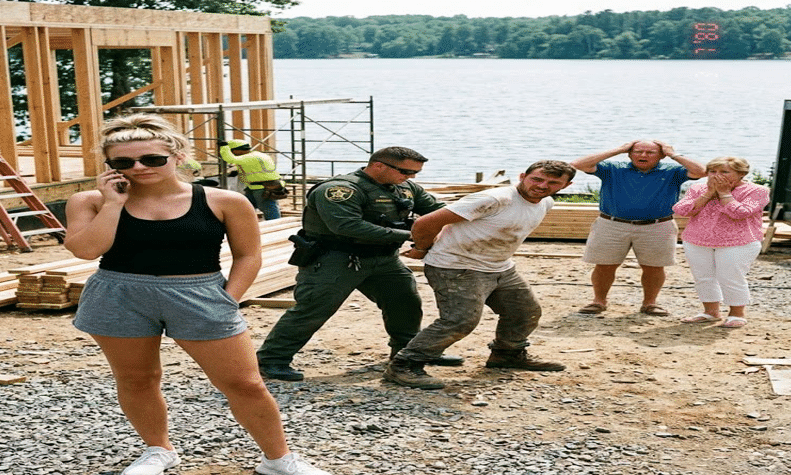
And now there was a huge moving truck parked across my front lawn, its tires sunk deep into the hydrangeas I planted in March. Next to it sat a heavy-duty construction dumpster. And over the side of that dumpster hung my grandmother’s quilt.
I turned off the engine.
The quiet of the lake didn’t come. Instead I heard the scream of a power saw coming from inside my house.
I ran up the porch steps so fast I almost tripped. My hands were shaking so badly I could barely grab the doorknob. Then I saw I didn’t need to. The front door was propped wide open with a brick.
The moment I stepped inside, a cloud of white dust hit my face. I coughed. My eyes watered. When they cleared, I couldn’t understand what I was looking at.
My living room was gone.
The cream linen sofas. The old black and white photographs of the lake from the 1940s that I’d hunted down at estate sales. The rug. All of it, gone. The walls had been torn down to the wooden studs. Wires hung out of the ceiling. My kitchen cabinets, the custom white oak ones I saved three years to afford, had been ripped right off the walls. There were jagged holes where the screws used to be.
My farmhouse sink was nowhere.
“Hey! Watch the corner with that!”
I knew that voice.
I stepped deeper into the dust. My heart was banging against my ribs.
There, in the middle of what used to be my kitchen, stood my sister-in-law, Victoria.
She was wearing a spotless white sundress and a wide straw sun hat. She had an iced coffee in one hand. With the other hand, she was dropping things into a big black trash bag. Casually. Like she was cleaning out a junk drawer.
I looked closer. My ears started to ring.
She wasn’t throwing away construction trash. She was throwing away my things.
My leather journals, the ones I’d kept since college. The framed photograph of my late grandfather standing on his fishing boat. The handmade ceramic mugs I bought on a trip to Santa Fe. And my grandmother’s wooden recipe box, the one with her handwriting on every card, the one she left me when she died.
“What the hell are you doing?” I screamed.
My voice was so loud that the two men swinging sledgehammers at my kitchen island froze in place.
Victoria spun around. Her perfectly manicured hand flew to her chest.
“Bella! Oh my God, you scared me half to death. We didn’t think you’d be out here this weekend.”
“You didn’t think I’d be here,” I said. My voice dropped low. It was shaking. “This is my house, Victoria. What are you doing? Why is there a moving truck on my lawn? Why is my grandmother’s recipe box in a garbage bag?”
She opened her mouth. Before she could say anything, the screen door banged open behind me.
“Bella, sweetheart! You’re here early!”
I turned around.
My mother, Eleanor, stepped through the door with a bright smile on her face, like she’d just arrived at a garden party. She wore crisp linen pants and a coral blouse. Her silver hair was in its usual neat bob. Behind her came my father, Arthur, in cargo shorts and a polo shirt. He was carrying a cardboard box. Written on the side in black marker were the words Jacob’s Home Office.
“Mom,” I said. My voice cracked. I pointed at the bare beams, at the smashed marble countertops on the floor. “What happened to my house? Who told these people they could do this?”
My mother waved her hand like she was shooing a fly. She stepped carefully over a pile of broken baseboards.
“Oh, don’t be dramatic about the mess, darling. The contractor, Patricia, promised us they’ll have the expansion done by the end of the month. It’s going to look absolutely stunning. We’re opening up the floor plan to bring in more natural light.”
“Opening up the floor plan?”
The room started to spin. The smell of the drywall dust was making me sick.
“Mom, this is my property. I own it. You can’t hire people to tear down my walls.”
“Well, we had to do something, honey.”
She used the soft, patient voice she always used when I was being difficult. The voice she’d used since I was seven.
“Your brother and Victoria are going to need the space. You hardly come out here more than twice a month. It just sits here empty. Jacob’s marketing firm is expanding, and he wants to run a satellite office from the lake. It makes perfect sense for them to move in full time.”
The words hit me like a fist to the chest.
“Move in?” I said. “Move in? Mom, I pay the mortgage on this house. Every single month. Twenty-four hundred dollars to Texas Capital Bank. I pay the property taxes. I pay the insurance. You and Dad gave me a fifteen thousand dollar check for my thirtieth birthday, and I was grateful for that. But the rest of the down payment, the closing costs, the repairs, the upkeep, that was all me. My name is the only name on the deed.”
My father cleared his throat. He wouldn’t look at me.
“Now, Bella, let’s not start keeping score about who paid for what. We’re a family. Jacob needs a break right now. You’re always so busy with your career in the city. You don’t need a whole house just sitting empty.”
Victoria stepped forward with a sweet, sticky smile.
“We’re honestly doing you a favor, Bella. We’ll take care of all the maintenance. And once the new master suite is finished, you can absolutely come visit. You can stay in the guest room whenever you want.”
The guest room. In my own house.
Something cold and hard settled in my chest.
It was the same story I’d lived my whole life. Jacob was the golden child. The son. The one who could do no wrong. When Jacob wrecked his car at seventeen, Dad bought him a new one. When Jacob dropped out of his MBA program, Mom told everyone he was “following his entrepreneurial spirit.” When I graduated top of my class at the University of Texas, Mom spent my graduation dinner talking about Jacob’s new business cards.
I was never really their daughter. I was Jacob’s backup plan. Everything I had, my money, my time, my house, was just sitting there waiting for Jacob to need it.
“Get out,” I said quietly.
“Bella, don’t be unreasonable,” my mother started.
“Get out!”
It tore out of my throat so loud that one of the contractors dropped his crowbar. It clanged on the floor.
“Get out of my house right now, or I swear to God I’m calling the sheriff and having every one of you arrested for breaking and entering and criminal mischief.”
My mother’s face changed. The sweet smile vanished. Underneath it was something cold and angry that I’d seen only a few times in my life.
“You are being incredibly selfish,” she said. “We are doing this for the family.”
“I don’t care. Get out.”
I stood there shaking while my father steered a furious Victoria and my mother out the front door. Victoria dropped the trash bag on the floor as she went. Through the window, I watched the moving truck start up. It backed slowly down my driveway, leaving two deep muddy ruts across the lawn.
I turned to the woman in charge of the crew. She was in her forties, wearing a white hard hat and a reflective vest. She was staring at me with wide eyes.
“Pack up your tools,” I said. “All of you. You’re trespassing.”
She held up both hands.
“Ma’am, I don’t want any trouble. Truly. But we were hired legally. We have a signed contract with your parents. I’m Patricia Hollis, Hollis Renovation Group. We’re licensed and insured.”
“They don’t own this house,” I snapped. “They have no right to sign a contract for my property.”
Patricia frowned. She flipped through the papers on her clipboard.
“That’s not what our paperwork says, ma’am. They showed us a copy of the deed. And they gave us a notarized power of attorney. It gives them full authority over renovations on the property.”
The air left my lungs.
“A what?” I whispered.
“A power of attorney,” Patricia said again. She pulled a photocopy off her clipboard and held it out. “Our office requires one any time the client isn’t the owner of record. It’s company policy.”
I snatched it out of her hand.
It was two pages long. It said that I, Isabella Prescott, granted my parents, Arthur and Eleanor Prescott, full and complete authority to modify, renovate, demolish, or alter the property at my lake address. It said they could sign contracts on my behalf. It said they could make financial decisions related to the property.
At the bottom of the second page was a signature that looked something like mine. Close. Not quite.
But that wasn’t what made my blood go cold.
Next to the signature was a round blue ink stamp. The official seal of a Texas Notary Public.
My seal.
My name. My commission number. My expiration date.
I’ve been a commissioned notary for six years. In commercial real estate, you need one constantly. Closings, affidavits, lease amendments. I keep my stamp and my notary journal in a zippered pouch inside my work tote. That tote goes everywhere with me.
I had never seen this document in my life. I had never signed it. And I had certainly never notarized my own signature. No notary in Texas is allowed to do that.
I stared at my own seal, and a memory hit me so hard I had to grab the edge of the doorframe.
Three weeks earlier. Sunday dinner at my parents’ house in Westlake. Mom had made pot roast. Jacob and Victoria were there. Halfway through dinner, Mom reached across the table for the bread basket and knocked her whole glass of red wine into my lap. It soaked my white silk blouse.
“Oh, honey, I’m so sorry! Go run it under cold water right now before it sets.”
I was in the upstairs bathroom for almost fifteen minutes, scrubbing at the stain. My work tote was hanging on the back of my dining room chair the whole time.
When I came back down, everyone was smiling.
They hadn’t just broken into my house. They had committed a felony to do it.
“Ma’am?” Patricia said quietly. “Are you all right?”
“No,” I said. “Can I keep this copy?”
She looked at the paper, then at my face, then at the ruins of my kitchen. Something in her expression shifted.
“Keep it,” she said. “I’ll pull my crew off right now. And I’m going to call my own lawyer.”
I didn’t stay at the lake house. I couldn’t. Every time I looked at the bare beams, I felt like I was looking at my own ribs.
Before I left, I climbed into the dumpster. I’m not proud of how it looked. A grown woman in work clothes, kneeling in broken drywall, digging with her bare hands. But I pulled out my grandmother’s quilt. I found my grandfather’s photograph, the glass cracked right across his face. I picked up the black trash bag Victoria had dropped and carried the recipe box out to my car like it was a baby.
Then I drove ten miles into town and checked into a little bed and breakfast called the Bluebonnet Inn. The woman at the desk took one look at me, covered in white dust, and didn’t ask a single question.
The moment the door of my room clicked shut, the adrenaline drained out of me all at once. I sat down on the edge of the flowered bedspread and shook.
I sat there a long time holding that photocopy. My own notary seal stared back up at me, a perfect blue circle of betrayal.
In Texas, misusing a notary seal isn’t a family argument. It’s a crime. And for someone like me, a licensed real estate professional, it could end everything. If the Texas Real Estate Commission or the Secretary of State thought I was stamping fake documents for my own family’s property deals, I would lose my license. I would lose my commission. I’d lose my career.
My hands were trembling when I called the only person I trusted completely.
“Bella!” Jessica’s voice was warm and bright. “I thought you were going off the grid this weekend. Shouldn’t you be floating on a raft with a margarita?”
“Jess,” I said, and that was all I got out before I started crying.
For the next twenty minutes, I told her everything. The truck. The dumpster. The quilt. Victoria in her sundress. My mother’s speech about natural light. The power of attorney. The stamp. The red wine.
Jessica and I have been best friends since seventh grade. She is usually a hurricane of opinions. But she didn’t say one word until I was finished. Then she was quiet for so long I checked to see if the call had dropped.
“Bella,” she said finally. All the humor was gone from her voice. “Your family has always put Jacob first. Everyone who’s ever met them knows that. But this is something else. They stole your professional equipment to forge a legal document so they could take your house. Do you understand what that means?”
“I know,” I whispered. I wiped my face on my sleeve. “If this gets out, my career is over. If anybody thinks I’m illegally notarizing documents for my own family, I lose my license. Everything I’ve worked for.”
“Then call Gregory,” she said. “Right now. Do not wait until Monday.”
Gregory Lin was my attorney. He was a sharp, no-nonsense litigator who had helped me fight through a nightmare of zoning disputes on two of my commercial deals. I’d never needed him for anything personal.
I texted him. Emergency. Family. Forgery. Please call.
He called back in five minutes.
I emailed him photographs of the destruction and a scan of the power of attorney while we were still on the phone. I heard him go quiet. Then I heard him let out a long, sharp breath.
“Bella, this is very serious,” he said. The calm, professional tone he always used had slipped. “Your parents didn’t just trespass. Based on what I’m looking at, we’re talking about forgery, fraudulent misrepresentation to a contractor, and major property damage. From these photos, I’d estimate the damage alone is approaching a hundred thousand dollars. But the misuse of your notary seal is the part that worries me. That turns this from a civil lawsuit into something prosecutors will want to look at.”
“I know,” I said. I pressed my fingers against my temples. A headache was blooming behind my eyes. “They took my stamp out of my bag at Sunday dinner. I remember leaving the bag alone.”
“All right,” Gregory said. His voice turned focused and tactical. “Here’s the plan. Tonight, I draft a cease and desist letter. It goes out by certified mail and email to your parents, your brother, Victoria, and Hollis Renovation Group. Monday morning, I’m asking the court for an emergency protective order to keep all of them away from that property. I’m also sending a letter to the county clerk’s office to flag your deed, so if anyone tries to record anything against that house using that power of attorney, we’ll know.”
“Okay.”
“And Bella?”
“Yes?”
“Do not talk to them. No texts. No calls. Nothing. They’re going to figure out very soon that their plan just ran into a brick wall. And people who are used to getting everything they want do very dangerous things when they’re cornered.”
I spent Saturday and Sunday at the Bluebonnet Inn, working like a person in a trance.
I hired a private security company out of Marble Falls to post a guard at the end of my driveway, twenty-four hours a day. It cost $1,100 a week. I paid it without blinking. I called three restoration companies and asked them to come out on Monday for estimates. I called my homeowner’s insurance company. The claims adjuster, a tired-sounding man named Ron, listened to the whole story and then told me, as gently as he could, that intentional damage by family members using a power of attorney was “going to be a complicated claim.”
My phone went crazy.
My mother called twenty-two times. Twenty-two. I counted.
My father left four voicemails. In the first one, he sounded disappointed. In the second, he sounded hurt. In the third, he was begging. In the fourth, he was shouting.
Jacob sent a flood of texts. He called me vindictive. He called me jealous. He said I had always resented him. He said I was trying to destroy his life “over a few stupid walls.”
I muted all of them. Every message, every voicemail, I forwarded straight to Gregory without reading the rest.
By Sunday night, I felt a strange, empty sort of calm. The legal machinery was moving. I had drawn the line.
But Gregory had been right. Cornered people do dangerous things.
Monday morning, I was back in Austin. I put on my sharpest navy suit. I put a second coat of concealer under my eyes to hide the dark circles. I had a ten o’clock meeting to give the final debrief on the Henderson deal to the partners.
I drove into the underground parking garage under our building on Congress Avenue. Just as I pulled into my spot, my phone rang.
Sarah Wilkins. Managing partner of the brokerage. My boss.
I put on my best cheerful voice. “Good morning, Sarah! I’ve got the Henderson files ready for ten.”
“Bella, where are you right now?”
Her voice was tight. Sarah never sounded tight. Sarah once negotiated a twelve-million-dollar lease while her assistant was having a panic attack in the next room.
“I just pulled into the garage. Why? What’s wrong?”
“Do not come up through the main lobby,” she said. “Take the freight elevator straight to the executive floor. Come directly to my office. Do not stop to talk to anyone.”
A cold sweat broke out on the back of my neck.
“Sarah, what’s going on?”
She lowered her voice.
“Your parents and your brother are in our main lobby. They’re screaming at the receptionist. And Bella, they’ve just filed a complaint with the Texas Real Estate Commission. They’re claiming you’ve been embezzling family money and using your notary seal to commit real estate fraud.”
My breath caught in my throat. The concrete walls of the parking garage seemed to tilt sideways.
They weren’t just trying to take my house anymore.
They were trying to destroy my whole life.
The ride up in the freight elevator felt like riding to my own execution. I watched myself in the steel doors. I looked pale and scared. But I also looked like someone I didn’t quite recognize. Harder. Colder.
The sadness I’d felt at the lake was gone. It had burned away. What was left was anger. Clean, white, steady anger.
I walked straight past the glass walls of the bullpen and into Sarah’s corner office. She was pacing behind her big mahogany desk with a thick folder in her hands.
“Close the door, Bella,” she said without looking up.
I closed it. The heavy door sealed us in silence.
“Sarah, I can explain everything.”
“Your mother is downstairs right now crying to our head of HR,” Sarah said. She tapped the folder against the desk. “She’s telling her you bought your lake house with money you stole from your brother’s business accounts. Your brother is waving around printouts of emails that supposedly prove you’ve been forging property documents for years. And an hour ago, I got a notice that a complaint has been filed against your license, and the Commission is reviewing it.”
My legs gave out. I sank down into one of the leather chairs in front of her desk.
“It’s a lie,” I said. “Every word of it. They’re doing this because I caught them stealing my house.”
Sarah finally stopped pacing. She looked at me, her sharp blue eyes cutting right through my panic.
“I know.”
I blinked. “You know?”
She sighed and leaned against the edge of the desk.
“Bella, you just closed the Henderson deal. You practically lived in this office for six months. I’ve personally audited your escrow accounts. Every single one. You are careful to the point of being annoying. And frankly, your brother’s evidence is a joke. Those emails are obvious fakes. He typed them in Microsoft Word. The font changes in the middle of a sentence.”
I almost laughed. Almost.
“But,” she said, “the state takes notary fraud complaints seriously. Even when they’re garbage. That’s going to mean a review.”
A wave of gratitude rushed over me. Then right behind it came the dread.
“So what happens now? Do you have to suspend me?”
A slow smile spread across Sarah’s face. It wasn’t a friendly smile. It was the smile she wears right before she wins a negotiation.
“Suspending you right now would be exactly what they want. Your family thought they could walk into my brokerage, throw a tantrum in my lobby, and scare me into firing my top producer so you’d fold.”
She picked up her desk phone and pressed a button.
“Security? Sarah Wilkins. There are three people in the main lobby. An older couple and a man in his thirties. They’re harassing our staff. Escort them out of the building. Now. If they refuse, call Austin Police and have them formally trespassed from the property.”
She hung up and looked at me.
“You are not suspended, Bella. In fact, after watching how you handled Henderson, I’m moving your promotion up. As of today, you’re a Senior Broker. You’ll get your own junior team and a bigger split on your commissions.”
I stared at her. I couldn’t speak.
“But listen to me,” she said, leaning forward. “You need to shut this family drama down. Legally. Permanently. Because if that review finds even one shred of truth in their story, my hands will be tied.”
I sat up straight. The fire came back into my blood.
“I’m already on it. My attorney is filing today.”
“Good,” Sarah said. “Bury them.”
I spent the rest of the day locked in a conference room on the phone with Gregory. I sent him the complaint notice the minute I got it.
“This is textbook retaliation,” he said. I could hear him typing. “They realized the power of attorney is a huge liability for them. So they’re trying to discredit you first. It’s a preemptive strike. If they paint you as a fraud now, then later, when you accuse them of stealing your stamp, it looks like a desperate lie from a crooked broker.”
“Can we stop the investigation?”
“I’m preparing a sworn affidavit from you. I’m attaching the forged document, a statement from Patricia Hollis about how it was presented to her, and copies of our pending civil filing. I’m also attaching your notary journal. If that stamp was used on a document, there should be an entry. There won’t be. That shows the stamp was used without you. Let’s give the Commission a reason to look at who filed the complaint instead.”
That afternoon, Gregory filed the lawsuit in Travis County District Court. Prescott versus Prescott. Me against my own mother and father. And my brother.
I read the caption on the filing five times. It didn’t feel real.
For the next few weeks, I ran on autopilot.
The restoration estimates came back. The best one was from a company in Fredericksburg that specialized in older Hill Country homes. Their total to rebuild the walls, replace the cabinets, rewire the kitchen, restore the floors, and track down another salvage farmhouse sink was $87,400.
My insurance company still hadn’t made a decision. Ron kept saying the claim was “under review.”
So I paid it myself. I wired $87,400 from my savings account to the restoration company. It took most of my Henderson commission after taxes. I sat at my kitchen table in my Austin apartment and watched the number in my savings account drop to almost nothing. Six months of no sleep. Gone. To undo what my own parents did.
I ignored the messages from aunts, uncles, and cousins. My mother had gotten to them first. In her version of the story, I was the cold, greedy daughter who was suing her elderly parents over a little home improvement project. My Aunt Carol sent me a Bible verse about honoring your father and mother. My cousin Derek told me I should be ashamed of myself.
I didn’t answer any of them.
But something kept bothering me.
The pieces didn’t fit. Not quite.
My parents were arrogant. They were spoiled. They worshipped Jacob, absolutely. But my mother was a retired school principal. My father was a retired insurance claims manager who still ironed his socks. They were people who returned library books early. Would they really commit a felony and risk prison just to give Jacob a nice office with a view of the water?
It was too reckless. Even for them.
There was something in this picture I wasn’t seeing.
Three weeks later, I was sitting on the floor of my apartment with the restoration blueprints spread across the carpet when my phone rang. Gregory.
“Bella, are you sitting down?”
“I’m on the floor. Does that count?”
“It counts. Stay there.”
“What’s going on? Did we get a trial date?”
“We did. Early next year. But that’s not why I’m calling.”
He paused. Gregory doesn’t pause.
“During discovery, I hired a forensic financial investigator to look at Jacob’s finances. I wanted to establish motive. Why he needed to physically occupy your house.”
“And?”
He let out a long, heavy breath.
“Bella, Jacob’s marketing firm isn’t expanding. It hasn’t made a profit in three years. He’s carrying about eight hundred thousand dollars in debt. Business credit lines. A second mortgage on his own house in Round Rock. Credit cards maxed out at four different banks. His personal credit score is under five hundred.”
I gripped the phone.
“There’s more,” Gregory said. “He’s the subject of a federal investigation. Quiet, so far. He’s suspected of embezzling money from two of his biggest clients. Funds they gave his firm for advertising buys that were never placed.”
The phone nearly slipped out of my hand.
“Embezzling? Jacob?”
“And here’s the part that makes everything fit,” Gregory said. “My investigator found a loan application. A home equity line of credit through a private lender in Dallas. Half a million dollars. The collateral listed is your lake house. The application was submitted using that power of attorney. The lender had already ordered an appraisal of the property. It was scheduled for two weeks after the day you walked in.”
I closed my eyes.
The demolition. The “expansion.” The moving truck. It wasn’t about an office at all. They needed people living in the house when the appraiser came. They needed the whole thing to look like it was under their control. They wanted my house’s equity, and they were going to pull it out in my name.
“Your parents didn’t take your house to give him an office,” Gregory said quietly. “They took it so Jacob could borrow against your equity and pay back the stolen money before the federal government indicts him. They were trying to keep your brother out of prison.”
I sat on my apartment floor surrounded by blueprints of my rebuilt kitchen, and for a long time I couldn’t say anything at all.
Then I said the only thing I could think of.
“With my money. With my house. With my name.”
“Yes,” Gregory said.
“And if it had all gone wrong, if Jacob couldn’t pay the loan back, the lender would have come after the house. My house. And the paperwork had my seal on it.”
“Yes,” Gregory said again. “Your name. Your stamp. Your liability.”
I thought of my mother knocking over her wine glass at Sunday dinner. The way she said, “Oh, honey, I’m so sorry.”
She had known exactly what she was doing.
The Travis County Courthouse is a huge building of limestone and glass. Cold. Serious. The kind of place that makes you lower your voice without being told.
Eight months had passed since the day I walked into the dust at my lake house. Eight months of depositions, motions, hearings, and phone calls with Gregory at midnight. Eight months of a family tearing itself to pieces.
I sat at the plaintiff’s table next to Gregory. I wore a tailored gray suit. My back was straight as a board. In my lap, under the table where nobody could see, I held a recipe card from my grandmother’s box. Peach cobbler. Her handwriting. I don’t know why I brought it. I just needed something of hers in my hand.
Across the aisle sat my parents and Jacob.
My mother looked ten years older than she had eight months earlier. Her silver hair had thinned. Her shoulders curled inward like she was cold. My father wouldn’t look at me. He stared at the polished wood of the defense table like it held some answer.
Jacob looked terrible. All the golden-boy swagger was gone. He was pale and sweaty. His tie was crooked. His leg bounced under the table the entire time.
Victoria wasn’t there. She had filed for divorce three months earlier, once she found out about the debt and the second mortgage on their house that she had never known about.
Their attorney was a slick, expensive litigator named Vance Dalton. He wore cufflinks and smiled too much. For the first two days of the trial, he tried to tell the jury a story about a loving family torn apart by a simple misunderstanding.
He put up old vacation photos on a big screen. Me and Jacob as kids at Galveston Beach, building sandcastles. My parents at my college graduation. He called my Aunt Carol to testify about how my parents had always supported me and loved me. He tried to call the forged power of attorney “a clerical misunderstanding by elderly parents who didn’t fully grasp the limits of their authority.”
Elderly. My father still plays eighteen holes of golf every Saturday.
But Gregory was a surgeon in that courtroom.
He called Patricia Hollis to the stand. She told the jury, under oath, that my parents had told her directly that they were the legal owners of the house. When her office said they needed a power of attorney because the deed showed a different owner, my mother produced one two days later. Already notarized.
“Did Mrs. Prescott say who notarized the document?” Gregory asked.
“She said her daughter did it,” Patricia said. “She said her daughter was a notary and had taken care of it.”
Then Gregory brought in a forensic document examiner, a quiet man with wire-rimmed glasses named Dr. Harold Fisk. He testified that the signature on the power of attorney had been traced. He showed the jury enlarged images. The pen had stopped and started in places where a natural signature flows. He testified that my notary journal had no entry for that document, on that day or any other. Gregory then showed my calendar and a dated text from my mother inviting me to dinner. The date on the power of attorney was the same Sunday. The same night my bag hung on a dining room chair while I scrubbed red wine out of my blouse upstairs.
Vance objected to almost everything. The judge overruled almost everything.
But the real collapse came on the afternoon of the third day, when Gregory called Jacob to the witness stand.\
Jacob walked up the aisle with his eyes darting all over the room. He put his hand on the Bible and swore to tell the truth. He sat down and fixed his tie with shaking fingers.
Gregory stood up and buttoned his jacket. He walked slowly to the podium. He didn’t start with the house.
“Mr. Prescott,” he said, calm and clear. “You testified earlier that you planned to use the lake house as an expansion office for your very successful marketing firm. Is that correct?”
“Yes,” Jacob said. His voice cracked on the word. “That was the plan.”
Gregory picked up a thick white binder from our table and carried it to the witness stand.
“Mr. Prescott, I’m handing you a copy of your personal and business financial disclosures, obtained by subpoena during discovery. Would you please turn to page four and read the total outstanding debt to the jury?”
Vance shot to his feet. “Objection, Your Honor. Relevance.”
“Your Honor,” Gregory said smoothly, “this goes straight to motive. We intend to show that this was never a misunderstanding about a renovation. It was a deliberate, desperate plan to commit real estate fraud.”
The judge was a stern woman in her sixties named Margaret Holloway. In three days, she had shown absolutely no patience for Vance’s theatrics.
“Overruled. The witness will answer the question.”
Jacob looked down at the page. A drop of sweat ran down his temple. He swallowed hard.
“It says eight hundred and forty-two thousand dollars.”
A murmur went through the people sitting in the gallery. My mother closed her eyes. A single tear slid down her cheek.
“And isn’t it true, Mr. Prescott,” Gregory said, stepping closer, “that you are currently under federal investigation for taking money from your clients to cover that debt?”
“Objection!” Vance shouted.
“Overruled,” the judge snapped. “Answer the question, Mr. Prescott.”
Jacob looked at Vance, terrified. Vance couldn’t help him.
“There’s been an inquiry,” Jacob said. “Yes. But no charges have been filed.”
“Not yet,” Gregory said.
He let that sit in the air for a second.
“Mr. Prescott, I have here text messages recovered from your phone during discovery. A message sent to your mother two weeks before the lake house was demolished. I’ll read it exactly. ‘If I don’t get a half million dollar collateral loan by next month, they are going to audit the accounts. I’m going to jail, Mom.’”
Gregory looked up.
“Did you send that message?”
The courtroom went completely silent. You could hear the air conditioning hum. You could hear someone in the back row shift in their seat.
All the vacation photos, all the sandcastles and graduation smiles, everything Vance had built for two days, just fell away. What was left was the truth, ugly and plain under the fluorescent lights.
“Yes,” Jacob whispered.
“So the renovation was a lie,” Gregory said. His voice rang through the room. “Your parents didn’t forge your sister’s notary seal to give you a nice view of the water. They forged a legal document so they could borrow half a million dollars against her property, take her equity, and bail you out of your own crimes.”
That’s when Jacob broke.
“It wasn’t my idea!”
He grabbed the microphone with both hands and leaned into it. His whole face fell apart.
“I didn’t forge anything! I just told them I was in trouble! My mom’s the one who took Bella’s stamp! My dad traced the signature at the kitchen table! I wasn’t even there! I was at home!”
The entire courtroom sucked in its breath at once.
My mother let out a sound I will never forget for the rest of my life. A choked, broken gasp, like someone had stabbed her. My father lifted his head and stared at his son. He looked at Jacob like he had never seen him before in his life.
Jacob. The golden child. The son they had risked everything for. The son they had committed a felony to protect. He had just confirmed the motive on the public record. And in his panic, he was throwing them both off a cliff to save himself.
And he wasn’t done.
“I have proof!” he babbled. Tears were running down his face now. He turned toward the judge. “I have a recording on my phone. My mom called me the night they took the stamp. She told me everything. She told me how she spilled the wine on purpose. I recorded it. I kept it just in case. I’ll give it to you. I’ll give you all of it. Just please, please, I need immunity. I can’t go to jail. I can’t go to jail.”
Judge Holloway brought her gavel down so hard it cracked like a gunshot.
“This court is in recess. Counsel, in my chambers. Now.”
People started talking all at once. The bailiff moved toward the witness stand. Vance had his hand over his face.
I didn’t move. I sat there holding my grandmother’s recipe card under the table.
I looked across the aisle at my mother. She was staring at Jacob as the bailiff led him down from the stand. Her mouth was open. Her hands were flat on the table like she was trying to keep it from floating away.
Just in case. He’d said he kept the recording just in case.
He’d been planning to betray them from the very first night.
Gregory leaned toward me and whispered.
“Bella. You understand what just happened?”
“Yes.”
“Are you all right?”
I thought about it.
“I don’t know,” I said honestly.
The damage was total, and every bit of it was self-inflicted. In his desperate, selfish rush to save himself, Jacob had just handed the state a recorded confession of his own mother committing felony forgery. He didn’t care that his parents had wrecked their lives to rescue him. When the fire got too close, he pushed them into it to keep himself from getting burned.
The trial never resumed.
It didn’t have to.
The next morning, Vance called Gregory before eight. He knew the recording would guarantee a criminal case against my mother. He knew the jury had watched Jacob confess. He begged for an immediate settlement.
That afternoon, I sat in a small, windowless conference room on the fourth floor of the courthouse. Fluorescent lights. A fake plant in the corner. A box of tissues nobody touched.
Across the table sat my parents.
They were broken. There’s no other word for it. The arrogance that had carried them through my entire childhood was gone. Their own son had hollowed them out in front of a room full of strangers.
“We agree to all terms,” Vance said quietly. He slid a thick stack of papers across the table.
I read every page. I always read every page.
They agreed to repay the full $87,400 for the restoration of the lake house. They agreed to pay all of my attorney’s fees, $64,000. They agreed to cover my security costs and the money I’d lost on furniture and belongings, another $23,000. They signed a permanent injunction giving up any claim, now or ever, to my property. And most important of all, they signed a sworn admission that they had forged my signature, used my notary seal without my knowledge, and filed a false complaint against me with the Real Estate Commission.
That last page was the one that saved my career. Gregory would send it to the Commission that same day.
My father’s hand shook as he signed the final page. The pen skipped twice.
My mother didn’t look at me once. She stared at the blank wall over my shoulder. She looked like a woman at a funeral, mourning a son who had never really existed.
“It’s done,” Gregory said. He packed the signed documents carefully into his leather briefcase.
I stood up and buttoned my jacket.
I looked at the two people who raised me. The woman who sewed my Halloween costumes. The man who taught me to ride a bike on our cul-de-sac. The same two people who had been willing to sacrifice my career, my home, and my future to cover for a man who stole from his own clients.
“Bella,” my father whispered. His voice broke on my name. “Please.”
I didn’t know what he was asking for. Forgiveness? Understanding? Mercy? Maybe he didn’t know either.
“You made your choices,” I said quietly. The words felt heavy, but they needed to be said. “And Jacob made his. You’ll all live with whatever comes next.”
I turned and walked out of the room.
I didn’t look back.
In the parking garage, I sat in my car for a long time with the engine off. I took my grandmother’s recipe card out of my pocket and looked at it. Peach cobbler. Two cups of sliced peaches. One stick of butter. Her handwriting slanted to the left, just like mine.
At the bottom, in faded blue ink, she’d written a little note to herself. Don’t rush it.
I laughed. Then I cried. Then I drove home.
One year later, the Texas autumn brought a cool breeze down over the limestone hills.
I stood on the newly rebuilt wooden deck of my lake house with a mug of dark coffee in my hands. The morning mist was slowly burning off the water. A heron stood on one leg near the dock, perfectly still.
Behind me, the house was whole again.
The walls were back up and painted that same soft sea glass blue. The white oak cabinets had been rebuilt by a carpenter in Fredericksburg who matched them almost perfectly. The restoration company found another farmhouse sink at a salvage yard in Waco. It has a chip in one corner. I love it more than the first one. The oak floors had been sanded and refinished, and they gleamed in the morning light.
My grandmother’s quilt lay across the foot of my bed again. I had it professionally cleaned by a woman in New Braunfels who repairs antique textiles. She fixed the torn corner by hand with thread she dyed to match. It took her six weeks. When I picked it up, she told me my grandmother’s stitches were the finest she had ever seen.
My grandfather’s photograph sat on the mantel in a new frame. I kept the cracked glass in a drawer. I don’t know why. Maybe so I’d remember.
A lot changed in twelve months.
Sarah kept her word. My promotion to Senior Broker came through, and my junior team closed nine deals in our first year. My income nearly doubled. The sworn admission Gregory secured cleared my name completely with the Real Estate Commission. The review was closed. My notary commission was renewed without a single mark on my record.
My insurance company eventually paid part of my claim, too. Ron called me himself to tell me. He said he’d been rooting for me the whole time.
My family, though, burned to the ground.
The settlement they paid me, on top of their own legal fees, was more than my parents had. They drained their savings. They cashed out my father’s 401(k) early and took the penalty. It still wasn’t enough. They filed for bankruptcy in the spring. The house in Westlake where I grew up, the one with the dining room where my mother spilled her wine, was sold in a foreclosure auction in June. They moved into a small rental apartment on the edge of Pflugerville.
That was only the civil side.
Because of Jacob’s recording, the Travis County District Attorney charged my mother with forgery and fraudulent use of identifying information. Because of her age and her clean record, she didn’t go to prison. But she was sentenced to five years of strict probation and four hundred hours of community service. My father was charged as well, and he took a plea deal. Two years of probation.
The story spread through my extended family and through their church and their country club like wildfire. Aunt Carol stopped sending Bible verses. Cousin Derek sent me a two-line text that just said, I’m sorry. I didn’t know.
My parents are alone now. I hear things, sometimes, from people who still talk to them. I don’t ask.
And Jacob?
His betrayal got him almost nothing.
The recording kept him from being charged in the forgery. But it did nothing to stop the federal investigation. His clients filed civil suits. His firm collapsed in a matter of weeks. Victoria finalized the divorce and walked away with the little that was still clean. Two months ago, a federal grand jury indicted Jacob on six counts of wire fraud. He’s waiting for trial now. Buried in debt. Living alone. Not speaking to the parents he destroyed.
The golden child had finally lost his shine.
I took a slow breath of the cool lake air.
For a long time, I carried a heavy guilt about fighting back. It sat on my chest at night. It followed me into meetings. It whispered to me every time I saw a mother and daughter laughing together in a restaurant.
I was raised to believe that keeping the peace meant quietly carrying whatever pain my family decided to hand me. That a good daughter doesn’t make a scene. That a good daughter doesn’t call a lawyer. That a good daughter gives up her guest room, her house, her name, if her brother needs it.
Jessica came out to the lake last month. We sat on this same deck with a bottle of wine and watched the sunset turn the water gold.
“Do you ever feel bad?” she asked. “About how it all ended?”
I thought about it for a long time.
“I feel bad that it happened,” I said. “I feel bad that my parents are old and alone. I feel bad that Jacob is going to prison. But I don’t feel bad that I fought back. Those aren’t the same thing.”
She clinked her glass against mine.
“No,” she said. “They’re not.”
Looking out at the water now, feeling the solid wood of my own deck under my bare feet, I know I did the right thing.
I didn’t destroy my family. Their lies did that. Their favoritism did that. Their greed did that. My mother destroyed it the moment she knocked over a glass of red wine on purpose. My father destroyed it the moment he sat at a kitchen table and traced my name. Jacob destroyed it the moment he pressed record on his phone.
All I did was refuse to let them destroy me along with it.
The heron took off from the dock with two slow beats of its wings and glided low across the water.
I finished my coffee and turned back toward the house. The sliding glass doors were open, and the morning light poured into my restored living room, across the new floors, over the blue walls, onto my grandmother’s quilt at the end of the bed.
Last weekend, I finally made her peach cobbler in my new kitchen. I followed every step on the card. I didn’t rush it.
It was quiet here now. It was peaceful.
And it was entirely mine.


