I stood on my own front porch with two bags of groceries cutting into my fingers, typing a four digit code into a keypad I had programmed myself, and watching a small red light blink back at me like it didn’t know who I was.
I typed it again. Slower this time, the way you do when you think your hands must be the problem and not the world.
Red light.
That was the moment, if you want to know the exact moment, that thirty six years of my life and every dollar Harold and I ever saved came down to a strip of plastic with a red bulb in it, telling me I did not belong in the house with my name on the deed.
My name is Patricia Wells. I am sixty nine years old, a widow, and until last Thursday I believed I understood my son. I was wrong about that, and I was wrong about his wife, and I was wrong about how much a person can smile at you while taking something that was never theirs. But I was not wrong about one thing, and it turned out to be the only thing that mattered. I knew where the papers were.
The House We Built
Harold and I got married the summer I turned twenty three, in a little Methodist church with box fans running in every window because the air conditioning had given out the week before and the deacon said the Lord would provide, but apparently not for the compressor. We didn’t have money for a honeymoon. We had a used Ford, two folding chairs, and a wedding gift from my aunt Ruthie that was a jar of coins she’d been saving since I was in diapers.
For thirty one years Harold worked at the county co-op, first loading feed sacks and later running the parts counter, and I taught third grade at the elementary school two towns over. We were not the kind of people who had things happen to us. We were the kind of people who made things happen, slowly, on purpose, the way you’d build a fence one post at a time.The beach house came out of a coffee can.
I mean that almost literally. We started what Harold called the “someday fund” back when Marcus was still in diapers, and for years it lived in an actual Folgers can on the top shelf of the pantry before we finally got embarrassed enough to open a real savings account. Every extra five dollars went in. Every Christmas bonus. The money from the summer Harold worked weekends at his cousin’s marina instead of resting like his back wanted him to. We packed our lunches instead of buying them. We drove that same Ford until the floorboard had a hole in it that I covered with a rubber mat. We did not go to Europe. We did not remodel the kitchen. We put every spare cent toward a little patch of sand on the Florida panhandle that we had visited exactly once, on our fifteenth anniversary, and never stopped talking about.
It took us most of two decades, but in the spring after Harold turned fifty eight, we closed on a small white cottage two streets back from the Gulf, off a quiet stretch near Highway 98 where the town still had one blinking light and a bait shop that sold boiled peanuts out front. White siding. Blue shutters. A screened porch that faced the dunes so you could sit out there in a storm and not get a drop on you. Harold hung a wind chime made of old oyster shells by the back door the first week we owned it, and it never came down.
We did not inherit that house. We did not win it in some contest or have it handed to us by a rich relative. We earned it the long way, the only way either of us had ever earned anything, and when the bank finally sent the letter saying the mortgage was paid in full, Harold cried at the kitchen table like I had never seen him cry, not even at his own father’s funeral.
“Sand in the doorway no matter how many times we sweep,” he used to say, laughing, standing there in his socks with a broom in his hand. “This house smells like salt and sunscreen and second chances, Patty. Don’t let anybody tell you it smells like anything else.”
Harold passed four years ago this coming October. A heart that had carried feed sacks and worry and love for sixty two years finally decided it had carried enough. After the funeral, after the casseroles stopped coming and the phone calls got farther apart and the house back home felt too big and too quiet, that little beach cottage became the only place where I could still feel close to him. I would sit on the porch in the mornings with my coffee and his old fishing hat hanging on its hook by the door, and for a few minutes I would not be a widow. I would just be a woman waiting for her husband to come back in from checking the crab traps.
I kept his hat there on purpose. I kept the shell wind chime. I kept a glass bowl on the windowsill that we filled with sand dollars and broken conch shells over twenty years of walking that beach together, and I never moved a single one of them, because that house was not a property to me. It was the last room in the world where Harold Wells still lived.
The Summer That Never Ended
My son Marcus is a good man in most of the ways that count. He calls me every Sunday. He drove four hours in an ice storm the winter Harold had his first scare, just to sit in a hospital waiting room with me until three in the morning. I raised him to work hard and tell the truth and open doors for people, and for most of his thirty eight years he has done exactly that.
He married Lauren six years ago. She is attractive and quick and good at making a room feel like it revolves around her, and for a long time I told myself that was just confidence, the kind of thing a shy boy like Marcus needed in a wife. I did not love her the way I loved him, but I tried. I hosted Thanksgiving at her preference three years running. I learned to keep my opinions about her decorating choices to myself. I told myself that was what a good mother in law does, that you make room, you bite your tongue, you choose the relationship over being right.
Two summers ago, Marcus called and asked if he and Lauren could stay at the beach house for a few weeks while their condo’s water damage got repaired. Their unit had flooded from a broken pipe upstairs, and it was going to be a mess of contractors and mold remediation and insurance adjusters for a while. Of course, I said. Of course you can stay. What’s the point of having a place like that if the people you love can’t use it when they need it.
A few weeks became the whole summer.
The condo repairs finished in August, according to Marcus, but by then Lauren had decorated a corner of the living room as her “reading nook” and hung a canvas print of a seashell quote above the mantel, the kind you can buy at any beach town gift shop, right next to the framed photo Harold and I had taken on our fifteenth anniversary, the one where we’re both squinting into the sun and he has his arm slung around my shoulders like I was the only thing on that beach worth photographing.
Fall came. They were still there. Marcus said the market was tight, rentals near their jobs were expensive, and didn’t it make more sense for the house to actually be lived in instead of sitting empty most of the year? I understood the logic. I even agreed with some of it. I told him they could stay through the winter while they figured out their next place, and I meant it as a kindness, not an invitation to take over.
Somewhere in there, Lauren started calling it “our beach house.”
The first time I heard it, we were on the phone and she was telling me about a storm that had knocked a shutter loose. “We’re going to get someone out to fix it on our beach house this week,” she said, easy as anything, like the word had always belonged to her.
I let it go. The second time, I didn’t.
“My beach house,” I said, gently, with a smile in my voice because I did not want it to be a fight. “But thank you for handling the shutter.”
She laughed, a light little laugh, like I’d said something charming and slightly senile. “Of course, Patricia. You know what I mean.”
I was not sure I did, but I let that go too.
When I mentioned it to Marcus later, hoping he’d back me up without me having to make a formal case out of it, he sighed the way he does when he thinks I’m being difficult. “Mom, don’t make it weird. Lauren just loves the place. She talks about it because she cares about it.”
I did not say what I was thinking, which was that love does not rearrange another woman’s dead husband’s photograph. Love does not need to rename a house to feel connected to it. But I let it go, because I was still telling myself, back then, that keeping the peace with my son’s wife was worth more than winning an argument about a word.
I did not yet understand that some words are never just words. Some words are a person quietly moving the fence posts an inch at a time, so slowly that by the time you notice, half your yard belongs to someone else.
The Red Light
Last Thursday I loaded the car with groceries, because Marcus had mentioned we might do a family weekend, the three of us grilling on the porch like we used to when Harold was alive and would stand at the grill in his ridiculous lobster apron insisting he alone understood the proper cooking time for mahi. I bought corn. I bought the sweet tea Marcus has loved since he was nine years old. I bought a bag of the peppermint saltwater taffy Harold used to buy from the bait shop, the kind that gets everywhere and sticks to your teeth and tastes like every good memory I have of that town.
I drove the four hours down feeling, for the first time in a long while, something close to hopeful. I thought maybe the awkwardness of the last year had just been growing pains. I thought maybe this weekend we would sit on the porch and it would feel like a family again instead of a negotiation.
I parked in the driveway, gathered the grocery bags, walked up to my own front door, and typed the code Harold and I had set the day the alarm company installed the system eleven years earlier. The same four numbers. Harold’s birthday month and day, because he said if he was ever going to forget a code it wasn’t going to be his own birthday.
Red light.
I typed it again, certain I had fat fingered it, the plastic bags sawing red lines into my knuckles.
Red light.
I stood there a moment, feeling something cold move through my stomach that had nothing to do with the sweet tea sweating through the bag, and then the door opened from the inside.
Lauren stood in the doorway wearing a white linen shirt over her swimsuit. My white linen shirt. The one that had hung in my closet in the back bedroom, the one I bought at a little boutique in Apalachicola three summers ago because Harold said it made me look like I belonged on a magazine cover for people who owned sailboats.
“Oh,” she said, glancing at the bags in my hands like they were an inconvenience she hadn’t budgeted for. “We changed the code.”
I looked past her, into my own living room, because some part of my brain was still trying to process the sentence she had just said as if it were a normal thing to say to the person who owned the house. There were new pillows on my sofa, mustard yellow, nothing like the blue and white ticking stripe I’d had there for years. There were candles I didn’t recognize burning on my coffee table, filling the room with a scent like eucalyptus and money. And on the side table where Harold’s photo had always sat, the one of him grinning under his fishing hat with a red snapper held up like a trophy, there was now a framed photograph of Lauren’s own parents, smiling on some cruise ship deck I had never seen and would never be invited to.
“Why would you change the code to my house?” I asked. I kept my voice level. I have spent sixty nine years learning that a raised voice hands the other person a story about you, and I was not going to hand her one.
She smiled. It was a slow smile, the kind people wear when they believe they have already won and are simply waiting for you to notice.
“Patricia,” she said, “we just need boundaries. You can visit after we approve it.”
For a second I could not hear the ocean. I could hear it every other second of every other day I had ever stood on that porch, the waves rolling in past the dunes, but in that one second all I could hear was my own breath going in and out, in and out, like it belonged to somebody else.
Then Marcus stepped into the hallway behind her. He saw me standing on my own front step, groceries in my arms, locked out of the house his father and I had built one saved dollar at a time.
And he looked away.
Of everything that happened that day, that is the part that still catches in my chest at three in the morning. Not Lauren’s smile. Not the shirt. Not even the candles burning where Harold’s picture used to sit. It was my son, my Marcus, looking at the floor instead of at his mother, because looking at me would have meant choosing, and he had already decided, somewhere along the way, not to.
Because he knew. He knew who had paid the mortgage every month for years before either of them was born. He knew whose name sat alone on the tax bill that came every November. He knew that when his father died, the house had passed to me, and only me, in writing, with a lawyer’s seal on it. He knew all of it, and he stood in that hallway and let his wife tell his mother she needed approval to visit her own home.
I could have cried right there on the step. God knows I wanted to. I could have raised my voice and made a scene that the neighbors two doors down would have talked about at the bait shop for a month. Instead I felt something in me go very quiet and very still, the way the Gulf goes still in the hour before a storm rolls in, when even the gulls stop crying and get low.
“Alright,” I said. “Enjoy the evening.”
Lauren looked pleased with herself. Marcus looked relieved, like a hostage watching the standoff end without shots fired. That told me everything I needed to know about which one of them had actually made this decision, and which one had simply let it happen.
I set the grocery bags down on the porch step, right where the taffy would melt in the evening heat, and I walked back to my car.
The Folder
I found a motel off Highway 98, the kind with thin towels and a window unit that rattled like it had personal grievances and a sign out front with a bulb flickering on the letter O so it read M TEL against the dark. I did not care. I had stopped caring about comfort somewhere around mile marker forty, replaced entirely by a low, steady clarity I had not felt since the week after Harold’s funeral, when grief burns off everything soft in you and leaves only what actually matters.
I sat on the edge of that motel bed and pulled a battered leather folder out of my overnight bag. I had started carrying it with me on every trip to the coast since Harold died, not because I expected trouble, but because he had told me, more than once, in that quiet serious voice he used maybe five times in our whole marriage, never to leave it behind.
“Patty,” he’d said, the year before he passed, sitting at our kitchen table with his readers pushed up on his forehead, “people change when property’s involved. Even good people. Even our own people. You keep this folder close, and you never let anybody tell you what’s in it doesn’t matter.”
I had not fully understood him then. I understood him completely now.
Inside was the deed, my name alone on it since the month after Harold’s funeral, when the attorney finished the transfer we had set up years earlier specifically so the house would never get tangled in probate or split between anyone. There were the tax records, eleven years of them, every single payment made from our joint account and then, after Harold died, from mine. There was the homeowner’s insurance policy, again in my name only. There was a letter from our attorney, Bill Kessler, a man who had handled our affairs since before Marcus could walk, laying out in plain language exactly what the deed meant and exactly what it did not.
And there was one more page. A single sheet, three paragraphs, that I had almost forgotten existed until my fingers found it near the back of the folder.
Harold had a habit, going back almost fifteen years, of making anyone who stayed at that house longer than two weeks sign what he called, half joking, the “house rules.” It started as a joke about his brother’s teenage boys leaving wet towels on the good furniture, but Harold, being Harold, decided a joke was more useful with a lawyer’s signature on it. Bill drew up a simple one page occupancy acknowledgment, the kind any attorney could produce in an afternoon: any relative or friend staying beyond a short visit was welcome as a guest, on a revocable license, with no rights of tenancy, no claim of ownership or possession, and no authority to alter the security system, locks, or furnishings of the home without the written consent of the owner. Violation, the page stated plainly, was grounds for immediate termination of the guest’s stay.
Harold had made every single person who ever stayed more than two weeks sign it. His brother. His sister and her husband the year their roof caved in. Even, two summers ago, Marcus.
I remembered it now, sitting on that motel bed with the window unit rattling. The day Marcus and Lauren moved their things in for what was supposed to be a few weeks, Harold had been gone less than a year and I had not yet had it in me to think about house rules or paperwork. But Bill Kessler, who had been the executor of Harold’s estate and knew every clause of every document in that folder, had quietly walked Marcus through it at my kitchen table before they ever drove south. “Your dad set this up years back, for anybody who stays awhile,” Bill told him. “Nothing personal, son. Just so there’s never any confusion.” Marcus signed it without much of a fuss. Lauren was already at the moving truck outside and never knew the conversation happened at all.
I had forgotten about that page for two years. Lauren, it was clear from everything I had seen that afternoon, had never known it existed at all.
I slept maybe four hours that night. Not from sadness, exactly. From the particular restlessness of a woman who has finally stopped being confused about what she needs to do next.
What Was Left on the Porch
At seven the next morning I made two phone calls from that motel parking lot, coffee in one hand, the folder open on the hood of my car.
The first was to Bill Kessler, who has known me long enough to skip past shock and go straight to strategy. I read him the occupancy page over the phone, though he had drafted it himself and barely needed the reminder. He confirmed what I already understood in my bones: Marcus and Lauren were guests under a written, revocable license. No lease. No rent ever paid. No tenancy under Florida law, which meant no eviction process, no thirty day notice, none of the protections that would apply if they had been renting. Changing the security code without my consent was, on its own, a clean and obvious violation of the signed agreement. Bill said he could have paperwork ready within the hour and would meet me at the house himself if I wanted him there. I told him I did.
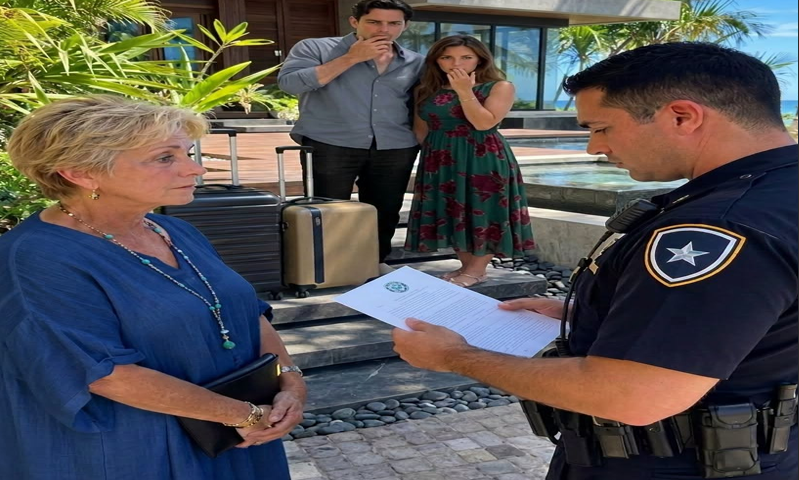
The second call was to the county sheriff’s non emergency line, where I explained, as calmly as I could manage, that I was the sole owner of a home that a family member and his spouse were currently occupying without my consent, that they had changed the locks and alarm code to keep me out, and that I had documentation proving I owned the property and had never granted them tenancy rights. The dispatcher told me this was a common enough situation, a civil matter that a deputy could stand by for, to prevent a breach of the peace while I exercised my lawful right to re enter my own home. She said a deputy could meet me there by late morning.
I called a locksmith third. He could be there by eleven.
By the time I turned back onto that quiet street with the blinking traffic light and the bait shop and the wind coming soft and salty off the Gulf, I had a deputy’s cruiser parked at the curb, my attorney on speakerphone from his office two counties over, and a young locksmith unloading his kit from a white van. It was, I will admit, not exactly the family weekend I had packed the sweet tea and taffy for. But it was, in its own way, exactly the homecoming that house deserved.
Lauren came out onto the porch barefoot, still in the white linen shirt, her hair pulled back, fury moving across her face like a squall line coming in off the water. The mustard pillows I had glimpsed the day before were nowhere in sight. Her suitcases, though, designer ones with little brass buckles, were already lined up along the porch rail where the locksmith’s assistant had set them after changing out the deadbolt, looking for all the world like a row of expensive apologies nobody had bothered to write.
“You can’t do this,” she snapped, her bare feet slapping against the wood planks Harold had sanded and sealed himself the summer before he died. “We live here.”
The deputy, a broad shouldered man not much older than Marcus with a name tag that read RUIZ, looked down at the copy of the deed and the occupancy letter Bill had faxed over an hour earlier. He read it once, calm as a man reading a grocery list, then looked up at her.
“No, ma’am,” he said. “You were allowed to stay here.”
He turned his gaze to me, standing at the bottom of the steps with the folder held against my chest like a shield I had finally learned how to use.
“And Mrs. Wells has ended that permission.”
Marcus came out onto the porch behind his wife, pale in a way I had not seen on him since he was seventeen and had wrecked Harold’s truck the week before his own driving test. He looked at the suitcases. He looked at the deputy. He looked, finally, at me.
“Mom,” he said, and his voice cracked on the word in a way that made him sound about nine years old, “what did you do?”
I have replayed that question a hundred times since. What did you do. Not what happened, not what’s going on, but what did you do, as though the crime in that yard belonged to me, as though a woman reclaiming her own front door was the aggressor and not the two people who had spent a year quietly convincing themselves it was theirs to take.
I looked at my son. Then I looked past him, at the house Harold and I had built with a Folgers can and thirty six years of packed lunches and used cars, not with anybody’s entitlement, and certainly not with anybody’s silence.
“I stopped letting guests act like owners,” I said.
Lauren lunged forward and snatched the occupancy page out of Bill’s assistant’s hand before he could stop her, scanning it fast, her eyes moving down the three short paragraphs like she was looking for the loophole that would make all of this go away. She found the clause about revocable license. She found the line about no rights of tenancy. And then, near the bottom, she found the signature line, and beneath Bill Kessler’s neat attorney’s script and my own looping cursive as witness, she found Marcus’s name, written in his own hand, dated the week they moved in.
Two years old. Two years, and he had never told her it existed.
I watched her face change in real time, watched the fury curdle into something colder and more complicated as she understood what she was actually looking at. It was not just that she had no legal claim to the house. It was that her own husband had known that from the very first week, had signed a document admitting exactly that, and had let her spend two years redecorating a home, hanging photographs of her own parents where mine used to sit, calling it “our beach house” to anyone who would listen, without ever once mentioning the paper with his own signature on it sitting quietly in a lawyer’s file two counties away.
“Marcus,” she said, and his name came out of her mouth like something breaking. “You signed this?”
He didn’t answer her. He didn’t have to. His silence answered for him, the same silence that had let him look away from me on that porch the day before, the same silence that had let two years pass without him ever correcting his wife on a single thing, because correcting her would have meant admitting, out loud, that none of it had ever been hers to claim.
The Drive Back
The locksmith finished his work in under twenty minutes. Deputy Ruiz stayed until the suitcases were loaded into Lauren’s car, standing by not because anyone expected real trouble but because his presence made sure nobody had to find out. Lauren did not speak to me again. She got in the driver’s seat, gripping the wheel with both hands, and waited, engine running, for Marcus to decide something.
He stood in the driveway a long moment, between his mother and his wife, in the particular kind of paralysis that comes to a man who has spent two years avoiding exactly this choice and has just run out of road.
“I need to think,” he finally told her, and got into the passenger seat instead of the driver’s, and they pulled away down the quiet street past the blinking light, past the bait shop, and out toward the highway.
I did not know, standing in that driveway with a deputy folding his notepad shut beside me, whether that was the end of my son’s marriage or simply a long overdue beginning of an honest one. That part was not mine to decide, and I have learned, at sixty nine, that some things simply are not.
What I did know was that I owned my house again.
Bill stayed another hour, going through the alarm settings with me, setting a new code that had nothing to do with Harold’s birthday this time, something only I would ever choose. Deputy Ruiz shook my hand before he left and told me, with the kind of plain kindness you only get from people who have seen a lot worse than a family squabble over a beach house, that he hoped the rest of my summer went easier than the start of it.
I spent that first evening back doing something almost embarrassingly small. I moved the mustard pillows to the hall closet. I blew out the eucalyptus candles and opened every window instead, letting the real Gulf air in, salt and low tide and somebody’s charcoal grill three houses down. I took Lauren’s parents’ cruise ship photograph off the side table, wrapped it carefully in a dish towel so it wouldn’t crack, and set it in a drawer where it would be safe until somebody wanted to come collect it. And then I walked to the hall closet where I had, in a fit of hurt I was not proud of, shoved Harold’s photograph the day I first noticed it missing from its place, and I set him back where he belonged. Red snapper held high, fishing hat crooked, grinning at whoever was holding the camera like the whole world was exactly as it should be.
I made coffee the next morning and carried it out to the screened porch, and I sat there a long while listening to the waves come in past the dunes, the shell wind chime turning slow in the breeze by the back door, Harold’s old fishing hat hanging right where it always had, untouched through all of it, because some things, it turns out, people are too afraid to move even when they’ve decided everything else is fair game.
What Came After
Marcus called me nine days later. Not a text, not a quick check in between errands, but an actual phone call, at seven in the evening on a Tuesday, his voice low in a way that told me he had been sitting with something for a while before he dialed.
He told me he and Lauren were staying at his sister in law’s place for now while they figured things out. He told me, in a voice that kept catching, that he had signed that occupancy page two years ago without thinking much of it, a formality, a favor to Bill, a way to make his dad happy without ever really imagining it would matter. He said he had not told Lauren about it because some small, cowardly part of him had liked the story she told about the house better than the truth. It made the summers feel like they belonged to something new the two of them were building together, instead of something they were only ever borrowing.
“I let her believe it, Mom,” he said. “That’s on me. Not her. Me.”
I did not tell him it was fine, because it was not, and I have never been in the business of handing my son comfortable lies just because they’re easier to say out loud than the truth. I told him I loved him. I told him that a house is not what makes a family, and that if he wanted to have one, a real one, he was going to have to learn to say hard things out loud before somebody’s alarm code did the saying for him.
He came down to visit me alone three weeks after that, without Lauren, and we sat on the porch with two cups of coffee and did not talk about the house at all for the first hour. We talked about his father instead. About the ridiculous lobster apron. About the year Harold tried to teach Marcus to cast a line and hooked his own ear instead. About the coffee can on the pantry shelf that started all of it, thirty six years and a whole life ago, one crumpled five dollar bill at a time.
Before he left, he stood at the door and looked at his father’s photograph on the side table for a long moment.
“I’m glad you put him back,” he said.
“He never left,” I told him. “Only the picture did, for a little while. There’s a difference.”
Lauren and I have not spoken since that morning in the driveway. I do not know yet whether we ever will, and I have stopped losing sleep over it. What I know is that the house is quiet again in the particular way it used to be quiet, waves and gulls and the shell chime by the back door, and when I sit on that screened porch in the mornings with my coffee, I am, once again, simply a woman waiting for her husband to come back in from checking the crab traps.
He never really left either. Only the code on the door changed, and then it changed back, and everything that mattered under that white siding and those blue shutters is still exactly where it always belonged. I earned that house one packed lunch and one worn out Ford at a time, and I will not spend whatever years I have left explaining that to anybody who forgot, even for a season, even by marriage, that some things are never up for a vote.
They are simply, and forever, mine.