The oil billionaire’s son and his football team chained my son to a pickup and dragged him down a gravel road for a mile, all because he beat him for valedictorian; they called it “a victory lap”; the sheriff showed up, unhooked the chain, and handed it back to them: “you boys might need this again”; my son gave his graduation speech from a hospital bed; they thought i was a farmhand; they didn’t know i spent 17 years as a green beret; i followed them for 3 miles in the woods—what i did to them in the dark…
The first thing my son said when I reached him wasn’t a name.
It was a promise.
“Dad. I took the long way. I promise.”
He was eighteen, lying across a cattle guard on County Road 19, and he needed me to know he had followed my instructions.
Behind me, six boys stood beside two pickups. One of them was still holding a phone.
“I know you did,” I told Mason. “I know. Don’t talk.”
My wife was already calling for help.
Then the sheriff arrived, and for a moment, I thought I could stop counting faces and license plates.
Until he said, “Evening, Wyatt.”
Not to my son. To the boy leaning against the black truck.
Three weeks earlier, our biggest concern had been how to pay for Texas A&M.
Mason studied under a clamp light in a barn because our house was small and the barn was quiet. He wanted to build bridges.
“A bridge doesn’t care who crosses it,” he said.
He finished first in his class by three hundredths of a point.
That evening, Bruce Kesler’s silver Range Rover stopped beside my driveway while I was fixing a gate hinge.
He left the engine running.
“You’re the fence guy.”
“That’s right.”
He offered to pay for everything. Tuition. Housing. Books. Then an internship and a job at Kesler Energy.
There was only one condition.
Mason would step aside and let Wyatt give the graduation speech.
“My boy gets the moment that’s been his since he was in kindergarten.”
I put down my drill.
“It’s not mine to sell. It’s his.”
Bruce looked past me at our small house and Mason’s bicycle on the porch. Then he mentioned the debt on Gary’s ranch, where I worked.
“Shame if the bank got nervous.”
Inside, Diane sat with the bills spread across the kitchen table.
I asked her not to tell Mason yet.
“Let him have the week.”
He didn’t get the week.
His chemistry teacher refused to change Wyatt’s grade and was told she’d be transferred. Mason’s tires were slashed. Somebody painted his locker. Then a black pickup followed him home.
“Take the highway,” I told him. “Long way. Every night.”
“Dad, it’s twenty minutes longer.”
“Then you’ll be twenty minutes older when you get home.”
He listened.
Even on bonfire night, he and Neil took the highway. But Neil had to go back for his phone, and Mason said he could walk the last mile and a half.
At 11:52, that missing phone called my wife.
A boy whispered, “They’re on Nineteen. You need to hurry.”
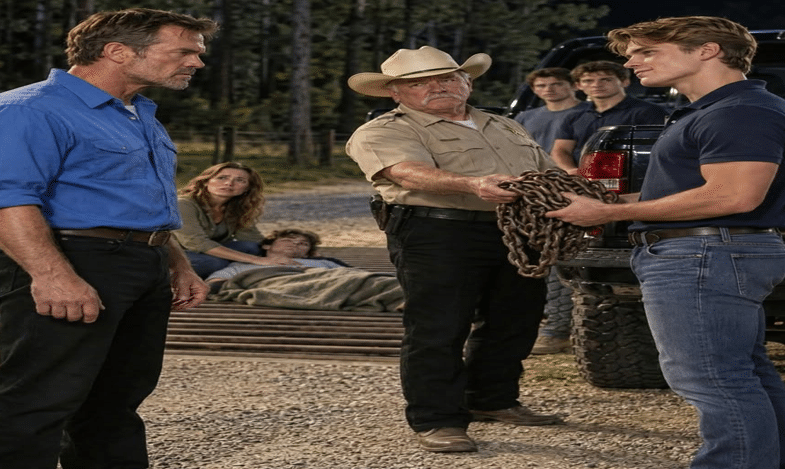
Now I was watching the sheriff study the chain around my son’s ankles.
“Key.”
Wyatt handed him one.
The sheriff opened the lock, coiled the chain, and returned it.
“You boys might need this again.”
A couple of them laughed.
I stood three feet away without saying a word. The youngest boy’s phone was still recording.
Later, the sheriff put a hand on my shoulder.
“I’m going to write it up as an accident, Hank. That’s what’s best for everybody.”
“Write it up however you want.”
He patted my shoulder again.
“That’s a smart man.”
I drove ninety miles to the hospital with both hands on the wheel, remembering everything.
The next afternoon, a deputy brought us a report.
“Horseplay.”
That was the word on the page.
No chain. No suspects. A line suggesting alcohol might have been involved.
My son had been drinking root beer.
Diane read it twice.
“I’m not signing that.”
“Ma’am, it’s just a formality.”
“Then you won’t mind formally leaving without my signature.”
I photographed the page before he took it away.
When Mason woke, he asked about graduation.
“I’m still giving the speech.”
“Son, you can’t even sit up.”
“Then I’ll give it lying down.”
He closed his eyes, then opened them again.
“They did this so I wouldn’t stand up there. If I don’t give it, they win.”
I leaned forward.
“Then you’ll give it.”
Outside that room, Pine Hollow was already choosing its version. At the feed store, my son had been showing off. At Dairy Queen, he’d had too much to drink.
Neil stopped answering messages.
Then Gary called. The bank wanted to review his loan.
“Hank, son, I’m seventy-eight years old. I can’t lose this place.”
“You won’t.”
Thursday night, I went back to the road with my yellow measuring wheel.
At the cattle guard, the counter read 5,280 feet.
Then I turned and walked back toward a green sign half hidden by a sapling.
I had set that post myself. I remembered the survey. I remembered exactly where the line ran.
I took out my phone and called a number I hadn’t used in two years.
“I need to tell you about something that happened on your land.”
On graduation morning, Diane combed Mason’s hair. His gown had been cut open down the back so it could rest over his dressings.
I placed a laptop beside his bed.
On the screen, Wyatt sat in the front row. Bruce and the sheriff sat above the fifty-yard line.
“I had an accident,” Mason began.
A pause.
“At least, that’s what it says on the report.”
He spoke about bridges. About roads. About people deciding you didn’t count.
Bruce leaned toward the principal.
The screen went black.
But Kathy Haskins had been recording. By Wednesday, more than a million people had watched.
Then Neil called from a blocked number.
“They figured out it was Troy who called your wife.”
Another party was planned. Another trip down the lease road. Wyatt was bringing the chain.
I told Neil to stay beside Troy and wait.
“For what?”
“For me.”
Friday night, I walked through three miles of pines in my work jacket, a folded survey in my pocket.
At the clearing, Troy sat on Wyatt’s tailgate. Neil stayed close.
Wyatt climbed onto the hood and thanked his father for the beer, the land, and “the best sheriff in Texas.”
Then he raised his new phone.
The old phones, the families had said, were lost at the lake.
But Wyatt pressed play, and the recording filled the clearing.
He had kept it.
I watched from the trees while he smiled at his friends.
Then the generator coughed.
The floodlights faded from white to orange.
And Wyatt stood beside his truck, holding the one thing his father’s lawyers had tried to make disappear, as the last light went out.