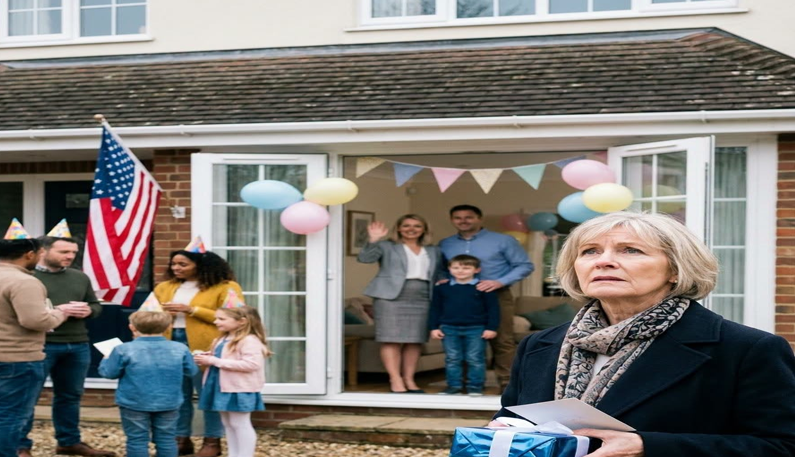
I stood on the front porch holding a carefully wrapped box, listening to my daughter-in-law uninvite me from my own grandson’s birthday party.
The autumn air was crisp, biting through my thin cardigan, but the chill spreading through my chest had nothing to do with the weather.
I had arrived 30 minutes early for Leo’s eighth birthday celebration. The driveway was empty, so I assumed they were still setting up.
As I reached for the doorbell, the living-room window, slightly ajar, caught my attention.
Voices drifted through the screen.
“I don’t understand why she has to come every year,” Sarah complained, her tone sharp and annoyed. “She just sits there judging my decorations.”
“Can’t you just tell her Leo is coming down with a bug?”
David, my son, mumbled something low and indecisive.
He always took the path of least resistance.
“I’m serious, David,” Sarah pressed, the clinking of glass cutting through her words. “We don’t need her hovering around our friends. Just call her right now. Tell her not to come.”
“Just tell her to send the money. We need that check for the new patio furniture anyway.”
My hand hovered inches from the doorbell.
The shiny blue wrapping paper on Leo’s gift crinkled slightly beneath my tightening grip.
For a decade, I had helped them.
I paid the down payment on this house.
I covered Leo’s private preschool.
I transferred funds whenever David hinted at a tight month.
And this was my value to them.
A checkbook with a heartbeat.
I didn’t knock.
I didn’t push open the door and demand respect.
Arguments never worked with Sarah. She thrived on playing the victim.
Instead, I quietly placed the wrapped gift on the welcome mat.
I turned around and walked back down the pristine concrete driveway.
Starting my car, I didn’t feel heartbroken.
I felt a sudden, sharp clarity.
The ride back to my house was completely silent.
The first thing I did when I got home was brew a strong cup of black tea and open my laptop.
The house was quiet, the afternoon light spilling across my kitchen table.
I logged into my online banking portal.
The screen loaded, displaying the checking account I had maintained since my husband passed away.
I navigated to the scheduled transfers tab.
There they were.
The automated pillars holding up my son’s comfortable life.
$800 on the first of every month, labeled “Car Loan.”
$400 on the fifteenth, labeled “Leo’s Activities.”
Another $500 sent directly to Sarah’s account for household groceries.
Month after month, year after year, the numbers flowed out of my account and into theirs.
Rarely acknowledged.
Simply expected.
I moved the cursor over the first recurring transfer.
My finger rested on the mouse.
A mother’s instinct is to provide, to cushion the fall, to make things easier.
But providing had turned into funding a lifestyle for a woman who didn’t want me in her house.
I clicked Cancel.
The screen refreshed.
I moved to the next one.
Cancel.
Then the next.
Cancel.
Right as I closed the browser, my phone buzzed on the table.
A text message lit up the screen.
Hey, Angela. So sorry for the late notice, but Leo is running a high fever. We have to cancel the party today to keep the other kids safe. So sad. We’ll miss you. You can just mail his birthday check to the house. Love you, Sarah.
I stared at the glowing letters.
She hadn’t even let David do the dirty work.
She lied effortlessly, banking on my usual compliant nature.
I picked up my mug, the hot tea warming my palms.
I didn’t type an angry reply.
I didn’t call her out on the lie.
I simply smiled faintly, already knowing exactly what I was going to mail her.
I never liked buying those overpriced greeting cards.
But the next morning, I bought the biggest, most elaborate envelope I could find at the pharmacy.
Returning home, I went into my home office and started the printer.
I didn’t write a long, emotional letter.
I didn’t demand apologies.
I simply opened a blank spreadsheet.
Column A was the date.
Column B was the amount.
Column C was the description.
I went back exactly three years.
The down payment assistance.
The luxury SUV installments.
The emergency fund for their broken HVAC system.
The boutique gym membership Sarah claimed was for physical therapy.
I listed every single dollar that had left my bank account to subsidize their lives.
The printer whirred to life, spitting out three full pages of neat, undeniable numbers.
The total at the bottom was a figure that made me shake my head.
I took a red pen and drew a thick, straight line beneath the final amount.
Under it, I wrote three words.
Account permanently closed.
I folded the pages sharply, tucking them inside the thick, decorative envelope.
I sealed it tightly.
I didn’t mail it through the post office.
I wanted to ensure it arrived immediately.
I drove back across town, navigating the familiar route to their suburban neighborhood.
The street was quiet, with most of their neighbors away at work.
Pulling up beside their mailbox, I rolled down my window.
I slipped the heavy envelope inside and raised the red metal flag.
I glanced toward the house.
The blue-wrapped present was no longer on the porch.
They had taken the gift, completely ignoring the fact that I had been there.
I put the car in drive and pulled away from the curb.
It would take them a few hours to check the mail, and I planned to enjoy every minute of the peace.
The phone rang at 7:15 a.m. on Tuesday.
David’s name flashed urgently across the screen.
I was sitting on my patio, enjoying a piece of toast and watching the neighborhood birds.
I let it ring three times before sliding my finger across the glass.
“Mom,” David panted, sounding entirely panicked. “Mom, my car payment just bounced. The bank sent an alert. Did your system glitch? The transfer didn’t come through.”
I took a slow bite of my toast, chewing deliberately.
“Good morning, David. No, the system didn’t glitch. I canceled the transfer.”
Silence stretched across the line, heavy and confused.
“You canceled it? Why, Mom? The late fee is insane. Can you just log in and push it through manually?”
“I won’t be doing that,” I replied, my voice steady and even. “I am no longer paying for your vehicles, your groceries, or your patio furniture.”
“I suggest you check your mailbox. I left something for you and Sarah yesterday.”
I heard a rustling sound.
Then the heavy thud of footsteps.
In the background, Sarah’s shrill voice cut through.
“Who is it? Is it the bank?”
A moment later, the sound of tearing paper echoed through the speaker.
David had opened the envelope.
“What is this?” David stammered. “Mom, this is a list of everything you’ve given us.”
Suddenly, the phone was snatched away.
“Angela!” Sarah yelled, her usual sweet tone completely gone. “What kind of sick joke is this?”
“You can’t just cut us off without warning. We have a lifestyle to maintain. You owe Leo that much.”
“I owe Leo love,” I answered calmly. “I owe you nothing.”
“You asked me to just send the money and not come over. I sent you a statement of what I’ve provided.”
“The Bank of Mom is closed.”
I ended the call.
I tapped her contact name, scrolled to the bottom, and pressed Block.
Hanging up wasn’t enough.
I needed to clean house physically, not just financially.
I walked into my garage and switched on the overhead fluorescent lights.
For the previous four years, David and Sarah had treated my home like their personal, rent-free storage unit.
Half the space was walled off with their belongings.
Cardboard boxes filled with Sarah’s out-of-season designer clothes.
Oversized plastic bins of holiday decorations.
An old leather armchair they didn’t have room for but refused to sell.
David’s expensive golf clubs.
They dropped things off whenever it suited them, crowding my space until I barely had room to park my own sedan.
I rolled up my sleeves.
I didn’t hire anybody.
I needed the physical work.
I started grabbing boxes.
One by one, I dragged them out of the garage and onto my concrete driveway.
The armchair was heavy, but I walked it out inch by inch.
The golf clubs clattered loudly as I leaned them against a stack of bins.
It took me three hours.
My back ached, and my hands were covered in dust.
But looking at my empty, swept garage floor brought a wave of immense satisfaction.
I pulled out my phone, took a wide-angle photograph of their belongings sitting in my driveway, and attached it to a text message to David.
Your items are on the driveway. You have until 5:00 p.m. today to retrieve them. After that, I am calling a junk-removal service to take everything to the county dump.
I pressed Send.
Five minutes later, the typing bubble appeared, disappeared, and appeared again.
Finally, a short message came through.
I’m leaving work now.
I locked the front door, poured myself a glass of cold water, and waited.
The tires of a heavy truck screeched against the asphalt of my driveway at exactly 4:30 p.m.
I watched through the front-window blinds as David jumped out of the cab.
His face was flushed.
His tie was loosened.
Sweat glistened on his forehead.
He practically sprinted toward his golf clubs, checking them for scratches before violently shoving boxes into the truck bed.
I opened the front door and stepped onto the porch.
He paused, wiping his brow and glaring at me.
“Are you out of your mind?” he snapped, tossing a box of winter coats over the tailgate. “Sarah is having a panic attack.”
“We can’t afford the car and the mortgage without your transfers. And now you’re throwing our stuff onto the street.”
“It’s my street and my garage,” I noted, leaning against the railing. “You are 34 years old, David. It is time to manage your own household.”
“You’re doing this just because Sarah didn’t want you at the party,” he accused, slamming the truck bed shut. “She was just stressed. You’re being vindictive.”
“I am being practical,” I corrected him.
I walked down the steps and extended my right hand, palm facing upward.
“My house key, David.”
He froze.
“What?”
“The spare key on your ring. Hand it over.”
He stared at me, his jaw working as if he wanted to shout.
But he saw the unyielding look in my eyes.
He realized that the mother who used to smooth over every conflict was gone.
He reached into his pocket, fumbled with his key chain, and aggressively slid the brass key off the ring.
He dropped it into my palm.
It felt heavy and warm.
“Don’t call us,” he muttered, climbing into the driver’s seat.
“I won’t,” I replied.
I walked back inside, locked the deadbolt, and dropped the key into my kitchen drawer.
Sarah thought the silent treatment would break me.
She assumed that a few weeks of isolation, combined with the threat of keeping my grandson away, would have me knocking on their door with an apology and a checkbook.
She was wrong.
The first two weeks were strange.
The silence in my house was thick, but soon it became peaceful.
Without the constant financial drain, my monthly budget expanded.
I didn’t sit beside the phone waiting for a text.
Instead, I drove down to the local community center.
I walked past the bingo halls and knitting circles, heading directly toward the back annex.
I signed up for a woodworking workshop.
The instructor was an older man named Thomas, with sawdust permanently embedded in his jeans.
He handed me a pair of safety goggles and pointed me toward a lathe.
The smell of cut cedar and pine filled the room.
For three days each week, I learned to measure, cut, and sand.
I made mistakes.
I ruined good wood.
But I learned.
Nobody in the workshop asked me for money.
Nobody expected me to babysit or fund a kitchen remodel.
We simply drank cheap coffee and talked about grain patterns.
I started crafting small things.
Birdhouses.
Picture frames.
Eventually, a small, intricate wooden boat.
One afternoon, I was running my thumb across the smoothed edge of the boat’s hull, satisfied with the finish, when the workshop door squeaked open, letting in a draft of cold autumn air.
I didn’t look up immediately.
I carefully wiped away the sawdust with a cloth.
“Mom.”
The voice was hesitant, lacking its usual entitlement.
I slowly lowered the cloth and turned around.
David stood in the doorway, looking entirely out of place among the workbenches and heavy machinery.
He shifted uncomfortably, his hands shoved deep inside his jacket pockets.
He looked exhausted.
The polished, carefree exterior he usually maintained was cracking.
Dark circles framed his eyes.
“Can I buy you a coffee?” he asked, gesturing vaguely toward the street.
I removed my safety goggles, wiped my hands, and nodded.
We walked to a small diner one block away.
We sat inside a vinyl booth, and the waitress dropped off two black coffees.
David wrapped his hands around his mug and stared into the dark liquid.
He didn’t know how to begin a conversation without asking for a favor.
“Things are tight,” he finally admitted, refusing to meet my eyes.
“Sarah had to pick up extra shifts. The car was repossessed last week. We traded down to a used sedan.”
I took a slow sip of coffee.
I felt a twinge of sympathy, but I kept my face neutral.
“Adjusting to a single income is difficult.”
He cleared his throat and finally looked up.
“We have a solution.”
“Sarah is going to return to work full-time, but childcare is impossible right now.”
“We were thinking that our basement is unfinished, but it has plumbing. We could put down some carpet.”
“You could move in with us. No rent. You would simply need to watch Leo during the day.”
I stared at him.
They had lost their free money, so their next logical step was to turn me into a free, live-in nanny banished to a concrete basement.
A sharp, genuine laugh escaped my chest.
I couldn’t stop it.
It echoed throughout the small diner.
David’s face dropped.
His forced smile vanished, replaced by a sudden, stark realization.
The mother he thought he could manipulate was completely and permanently gone.
“I am not a nanny,” I told him, sliding my coffee cup away. “And I am certainly not a basement tenant.”
David slumped inside the booth.
“Mom, please. Sarah is losing her mind. She’s angry all the time. We need help.”
“You needed money, David. Not me,” I corrected him.
“I heard Sarah through the window at Leo’s birthday. I heard you agree with her.”
“You built a life you couldn’t afford, relying on a woman you didn’t respect.”
“That was your choice.”
He buried his face in his hands, rubbing his temples aggressively.
“I know. I’m sorry. I never should have let her talk about you like that.”
“I just—I didn’t want to fight with her. But everything is falling apart.”
“It isn’t falling apart. It is resetting to reality,” I stated, picking up my purse.
“I love you, David, and I love Leo. But the financial support is finished. I am living my own life now.”
He looked up, panic setting in.
“So what? You’re just never going to see us again?”
“I didn’t say that,” I replied, standing and sliding a five-dollar bill onto the table for the coffee.
“If you want me to have a relationship with Leo, you will bring him to the park on Saturdays. Just you and him. Sarah stays home.”
“If you agree to those boundaries, I will be there. If you don’t, then I wish you both the best.”
He stared at the table, his shoulders heavy.
He finally understood that the rules had changed and that I was the one writing them.
He gave a slow, defeated nod.
The park bench was cold, but the midday autumn sun warmed my shoulders.
The leaves were turning brilliant shades of orange and red, scattering across the walking paths.
I sat with my hands folded in my lap, watching the parking lot.
A silver sedan, older and dented, pulled into a parking space.
David stepped out and unbuckled Leo from the back seat.
Sarah was nowhere in sight.
David had kept his word.
Leo spotted me immediately.
He sprinted across the grass, his jacket unzipped and his face lighting up.
“Grandma!” he yelled, throwing his arms around my waist.
I hugged him tightly, breathing in the scent of fresh air and laundry detergent.
“Look at you, getting so tall,” I said, smiling as I stepped back.
I reached into my canvas tote bag.
“I brought you something. I made it myself.”
I handed him the wooden boat.
I had painted the sides bright blue and sealed the wood so it could float properly in the water.
Leo’s eyes widened.
He ran his fingers across the smooth edges, thoroughly amazed.
“You made this? Really? Can we put it in the pond?”
“That’s exactly what it’s for,” I told him.
Leo took off toward the water.
David approached slowly and stopped at the edge of the bench.
He looked tired, but there was a new humility in his posture.
He didn’t ask for money.
He didn’t mention bills.
He simply sat at the far end of the bench, watching his son play at the water’s edge.
We didn’t speak much.
We didn’t need to.
The dynamic had shifted permanently.
I didn’t have their false gratitude or empty dinner invitations.
But I had my peace, my money, and my life back.
Sitting there, watching the little blue boat glide across the water, I knew that was worth more than any check.
Looking back at Angela’s story, it reminds me of a quiet truth.
We often forget that love is not a subscription service and respect cannot be bought.
As parents, we naturally want to cushion every fall for our children.
We give and give, thinking it is the best way to show we care.
But sometimes the healthiest thing we can do for them, and for ourselves, is to step back.
Setting boundaries doesn’t mean you stop loving your family.
It means you finally start valuing yourself enough not to be taken for granted.
Sometimes closing the bank is the only way to open their eyes.
If this story resonated with you, or if you have ever had to draw a difficult line with somebody you love, I would really like to hear your thoughts in the comments below.
How would you have handled Sarah and David?
If you enjoy these real, everyday stories about finding your voice and standing your ground, please hit the Subscribe button and click the notification bell.
It means the world to me and helps the channel grow.
Thank you so much for listening, and I’ll see you in the next one.