An 82-year-old woman hired me every Monday just to stare at an old diner. On our fourth trip, a stranger handed her something that brought her to tears. When she finally told me why, I knew I couldn’t just drive her home and forget about it.
I’ve driven rich people around for seven years.
Men with their mistresses.
Women with exotic pets.
Clients treating me like dirt.
Nothing prepared me for Eleanor.
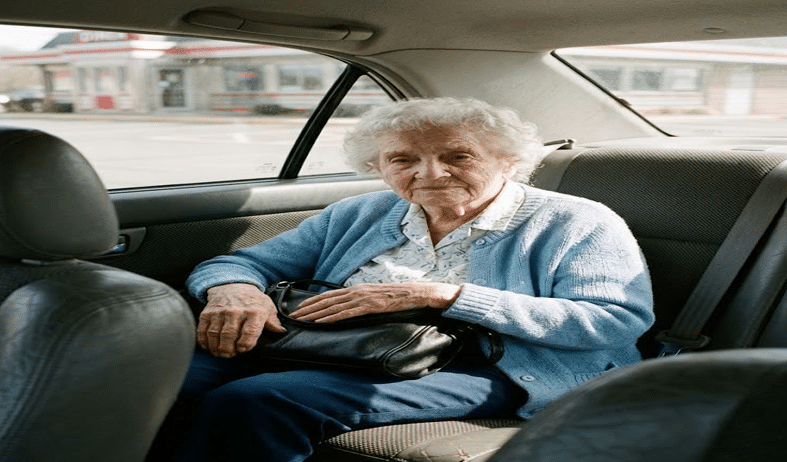
She booked me on a Monday, 11 a.m. Eighty-two years old, pressed coat, pearl earrings, tiny purse.
Nothing prepared me for Eleanor.
“Where to, ma’am?”
“The diner out on the old highway, dear.”
“That’s twenty minutes from here. Meeting someone?”
“Not exactly.”
Not exactly. Great. Very clear. Thank you.
When we got there, she pointed across the lot.
“Where to, ma’am?”
“Park there, please. Where I can see the door.”
“Want me to walk you in?”
“No, thank you.”
She sat for twenty minutes, staring at that door like it owed her money.
Then she said, “Take me home, please.”
I get paid by the mile, not by the question. Mostly.
Mostly.
The next Monday, same ride. Same spot. Same stare.
On the way back, she finally spoke.
“Is someone waiting for you at home, Emily?”
“My daughter. Lily. She’s eight.”
“And her father?”
“Left when she was eleven months old.”
Same spot. Same stare.
“I’m sorry.”
“Don’t be. He was bad at it anyway.”
I still remember that night word for word.
“Jason, Lily’s not even a year old!”
“I know.”
“Then what are you saying?”
“I’m sorry.”
“I’m saying I can’t do this anymore.”
“You can’t do what? Be a father?”
He didn’t answer. He just packed a bag.
He took the good blender, too. I never forgave him for the blender.
The third Monday, Eleanor brought a small paper bag. She never opened it.
I tried again.
He just packed a bag.
“Did you used to come here?”
“A long time ago.”
“Must’ve been good food.”
“The coffee was terrible.”
“Then why come back?”
She smiled and said nothing. Instead she asked, “How’s Lily’s spelling test?”
“Then why come back?”
I’d mentioned that once. In passing. Two weeks ago.
Okay, I thought. Mystery woman remembers everything. I’m in trouble.
The fourth Monday, someone was standing by the diner door.
An old man, maybe seventy, in a gray coat. He was looking straight at my car.
He froze.
Then he went inside, came back out, and walked right up to Eleanor’s window.
He was looking straight at my car.
She rolled it down.
“I’m Richard. And this belongs to you.”
He handed her a little velvet box.
Eleanor opened it.
An old ring. Thin gold band, tiny stone.
She put her hand over her mouth and started crying.
An old ring.
“Ma’am? Are you okay?”
She looked at the ring. Then at me.
“I think it’s time I told you everything.”
Before she told me her story, I had no idea fate could be so cruel.
“Sixty-two years ago, I was a waitress in that diner,” Eleanor said.
“You? Carrying plates?”
I’ve driven rich people around for seven years.
“I was twenty. I was very fast.”
“A young man came every morning. Coffee, two eggs, table three.”
“Let me guess. He sat there on purpose.”
“Every single day.”
She turned the ring over in her fingers.
“Thomas. Mechanic. Twenty-three.”
“Every single day.”
“What was he like?”
“Loud. Greasy hands. Terrible jokes.”
“Give me one.”
“‘Your coffee tastes like motor oil.’”
“That’s a joke?”
“I said, ‘Then stop ordering it.’”
“I was twenty. I was very fast.”
“And?”
“He said, ‘Can’t. The waitress is too pretty.’”
I laughed so hard I had to wipe my eyes.
“Okay. I’d have married him too.”
“That was the plan.”
Her smile went away.
“That was the plan.”
“A year later, he proposed. I said yes before he finished the sentence.”
“What went wrong?”
“My father.”
“He didn’t like Thomas?”
“He didn’t like mechanics. He wanted me to marry money.”
“Thomas got a great job offer out of state and asked me to come.”
“What went wrong?”
“And you said yes.”
“We agreed to meet at the diner Monday at eight.”
“And run away together?” I asked.
“He’d bring the tickets. I’d bring my suitcase.”
“So what happened?”
“The night before, my father told me my mother was very sick.”
“And you said yes.”
“Was she?”
Eleanor looked at her hands.
“I believed him. I was twenty. I got scared.”
“So you stayed.”
“I stayed. I wrote Thomas a letter and begged my father to deliver it.”
“Did Thomas answer?”
“So you stayed.”
“Not a word from him.”
“Did you ever find out why?”
“Months later, Dad said Thomas had married someone else.”
“Oh, Eleanor.”
“So I did what people do. I got on with it. I married a man named William. Fifty-one years.”
“Were you happy?”
“Not a word from him.”
“Very. That’s the part nobody believes.”
“I believe it.”
“He made terrible pancakes. I loved him.”
“And Thomas?”
“I never forgot him. Both things were true.”
I nodded slowly.
So what happened to Thomas himself?
“Both things were true.”
A thought tried to climb into my head. Surely not…
I shoved it right back out. Not today. Not in front of a woman holding a ring.
“Who’s the man with the box?” I asked instead.
“He said his name is Richard. Thomas’s younger brother.”
She looked at the diner door.
I picked my words like I was crossing a frozen pond.
Surely not…
“Would you like to go in? Talk to his brother?”
“I’ve wanted to for a month.”
“We can just sit. If it’s too much, we leave.”
“You’d come with me?”
“Eleanor, it’s been a month. I’m too invested now.”
Richard walked us to the third table by the window.
“You’d come with me?”
It had a new top and fresh vinyl seats.
Eleanor sat down like she was lowering herself into cold water.
“You’re the girl from the photograph,” Richard said.
“Which photograph?”
“The one my brother kept.”
She pressed her lips together.
“You’re the girl from the photograph.”
“He waited for you,” Richard said.
“I know. I wasn’t there.”
“No. I mean he waited. That Monday. Then the next day. Then every day for a week.”
“Richard…”
“He thought something had happened to you.”
“Nothing happened to me. I was scared.”
“He waited for you.”
“He didn’t know that.”
Richard set an old shoebox on the table.
“Copies of letters. He wrote it for years.”
Eleanor opened the lid with two fingers. She took out the top page and read.
I watched her lips move.
“What does it say?” I asked quietly.
“I was scared.”
“‘I don’t understand why you left. I hope you’re happy.’”
She folded it carefully.
Then her face broke.
“I wrote to him!”
Richard blinked. “I’m sorry?”
“I wrote him a letter! I told him why I couldn’t come!”
“‘I don’t understand why you left.”
“He never got a letter from you.”
“My father promised he’d deliver it.”
Nobody said anything.
Richard looked at the table. Eleanor looked at the box.
I looked at the ceiling, because someone had to.
Sixty-two years, I thought. All because her father couldn’t deliver one envelope.
“He never got a letter from you.”
I felt there was still something I could do. I just didn’t know what.
“He let us both think the other one gave up,” Eleanor whispered.
“I’m so sorry,” Richard said.
“Did Thomas ever stop wondering?”
“Never completely. He married. He raised kids. He had a good life.”
“I’m glad.”
“He had a good life.”
“But he kept the ring. I found it among the things he asked me to look after.”
After?
“And the letters.”
“And the photograph.”
“How did you know it was me in the car?”
“I didn’t. I held the photo up, squinted across the lot, and prayed.”
“I’m so sorry.”
Eleanor laughed weakly.
Then she asked, very quietly:
“All those years… did he forgive me?”
Richard looked at her for a long time.
“I don’t think he ever blamed you as much as you blamed yourself.”
Eleanor closed her eyes. She nodded once.
“But he kept the ring.”
Richard cleared his throat.
“Eleanor. Would you like to see him?”
See him.
My heart did a tiny, stupid jump.
Eleanor went white.
“No.”
See him.
What? Why?!
“Eleanor…”
“Thank you, Richard. I can’t. I just can’t.”
She stood up. She picked up her purse. She walked out, and she did not look back.
Richard stared at me.
“What did I say?”
She walked out, and she did not look back.
“I have no idea.”
He pulled a card from his pocket and pressed it into my hand.
“In case she changes her mind.”
I ran after her.
She was already in the back seat, staring at nothing.
I started the car. I didn’t pull out.
“No.”
“Eleanor. Why not?”
“I can’t, Emily.”
“He’s right there. Whatever it is…”
“How could I face him? I can’t even stand at his grave. I’m too ashamed.”
“His grave?”
“Yes, dear.”
“His grave?”
“Eleanor, what do you mean?”
“He’s gone. I saw the notice in the paper a month ago.”
“The notice.”
“I couldn’t read past the first line. I felt sick.”
“So that’s why you came.”
“I wanted to sit at our table and say goodbye. I kept losing my nerve.”
“So that’s why you came.”
Something snagged in the back of my head. I couldn’t tell what.
I didn’t say a word. She was crying, and she’d earned it.
“Sixty-two years, I thought he stopped loving me.”
I looked at her in the mirror.
“He didn’t.”
“No.”
“The notice.”
Her voice cracked.
“And now I’ll never get to tell him I didn’t stop either.”
She cried quietly, the way old people cry when they’ve had practice.
I gripped the steering wheel.
It was heartbreaking. But what my daughter did next surprised us all.
“He didn’t.”
Seven years ago, Jason walked out and never said goodbye to Lily. Not one word to a baby.
I wanted one honest conversation back then. Just one.
I never got it.
And here was this woman, eighty-two years old, about to go the rest of her life without hers.
I drove her home and waited until her lock clicked.
Lily was at the kitchen table, murdering a spelling list.
Just one.
“Mom, how do you spell ‘necessary’?”
“One collar, two sleeves.”
She wrote it down, unconvinced.
I sat across from her and opened my phone.
It took four minutes to find the notice. A name, an age, a few lines. The kind you skip over.
I read the first line. Then I just sat there.
I never got it.
Poor Eleanor. She’d carried this around for a month, and I’d driven her to it four Mondays in a row.
“Who died?” Lily asked.
“Nobody you know.”
“Then why are you reading it?”
“Because someone I know thought they did.”
Lily came around the table and leaned on my shoulder. She reads faster than I do. It’s annoying.
“Who died?”
“Mom, what does ‘survived by’ mean?”
“It means who’s left. The people he leaves behind.”
“So the brothers are still alive?”
“What brothers?”
She pointed.
“Here. ‘Survived by his brothers, Thomas and Richard.’”
“What brothers?”
I read the line. Then I read it again. Then a third time, slower, like it might change.
Thomas.
I looked at the age at the top.
I did the math on my fingers, like a kid.
Then I did it again.
“Mom, what’s wrong?”
Thomas.
“Nothing. Everything. I need to borrow the neighbor.”
“For what?”
“For you. I have to ask a man a question.”
I called Richard from the driveway. He picked up on the first ring.
“I’m still at the diner. I couldn’t make myself leave.”
“Stay there.”
I read the line. Then I read it again.
He was sitting at the third table, staring at the shoebox.
“Richard, I need you to answer something and not be weird about it.”
“Okay.”
“Is Thomas alive?”
He stared at me.
“Is Thomas alive?”
“Of course he’s alive!”
I sat down hard in the booth.
“What?!”
“Why would you think…”
“The notice! In the paper, a month ago!”
“That was Theodore. Our middle brother. He was seventy-nine.”
“Of course he’s alive!”
“And Thomas?”
“Eighty-five. Same as always.”
“Emily, what’s going on?”
“She thinks he’s dead, Richard.”
“Who does?”
“Eleanor! She saw the first line and couldn’t read the rest!”
“Emily, what’s going on?”
“Oh no.”
“You asked if she wanted to see him.”
“Yes! In his living room! In a cardigan!”
“She heard a grave!”
He covered his face with both hands.
Sixty-two years of heartbreak, I thought, and the only thing missing was one sentence.
“She heard a grave!”
“What happened to him?” I asked.
“Theodore’s death hit Thomas hard. Heart trouble.”
“And now?”
“Home. Weak, but improving.”
“Does he know she came?”
“Not yet. I wanted to tell him myself.”
“What happened to him?”
“Then tell him tonight.”
“And then?”
“Then I’ll bring her.”
Richard called me the next morning.
“He cried for an hour,” he said.
“Does he want to see her?”
“Then I’ll bring her.”
“He asked if he should shave.”
“Tell him yes.”
At nine, I called Eleanor.
“Emily? What’s wrong?”
“Nothing’s wrong. I need to take you somewhere.”
“Where?”
“He asked if he should shave.”
“I found something you need to see.”
I drove her to a small house with a white porch and tidy flower boxes.
Richard was waiting at the bottom of the steps.
“Richard? Why are we here?”
“Someone wants to see you.”
The front door opened.
“I found something you need to see.”
A white-haired man stepped onto the porch, holding the railing. He was thin, and his hands shook a little.
He saw her and stopped.
“Ellie?”
Eleanor grabbed my arm so hard it hurt.
“Thomas?”
He smiled.
The front door opened.
“You finally made it.”
Thomas came down the steps one at a time. Eleanor walked up to meet him.
They held on to each other.
“I’m sorry I didn’t come that Monday,” she whispered.
“Ellie, it was sixty-two years ago.”
“I wrote you a letter.”
“You finally made it.”
“I know. Richard told me.”
They stood there a long time, hands clasped.
Then Thomas looked down.
“Is that my ring?”
“Your brother gave it to me.”
“Good. I was afraid he’d pawned it.”
They held on to each other.
Eleanor burst out laughing.
He held out his arm.
“Come inside. I’ll make you some coffee.”
“Is it terrible?”
“It’s the worst.”
I was already sneaking back to the car when Eleanor called out.
“It’s the worst.”
“Emily, wait. Thank you for bringing me here.”
I shrugged.
“You’ve waited long enough.”
A week later, my phone buzzed.
Monday. 11 a.m.
Same name. Same address.
“Thank you for bringing me here.”
When I pulled up, Eleanor was waiting at the curb, hair done, lipstick on.
Thomas stood next to her, holding her purse like it might explode.
He helped her in.
“Where to today?”
“The diner, please,” Eleanor said.
“Same parking spot?”
“The diner, please.”
Thomas laughed. “Not this time. We’re going inside.”
I parked, and he helped Eleanor out.
“Coming, Emily?” she asked.
“I’m working.”
“Twenty minutes won’t hurt. Come on!”
I followed them in.
“Same parking spot?”
They sat at the third table by the window.
Thomas ordered coffee and two eggs.
Eleanor stared at him.
“You still order the same thing?”
“Some things never change.”
“Even after sixty-two years?”
They sat at the third table by the window.
“Especially after sixty-two years.”
I took a sip of my coffee.
It was terrible.
I wasn’t going to tell them.
In seven years, I’ve driven people to weddings, funerals, first dates, and last goodbyes.
I wasn’t going to tell them.
But I’d never before delivered someone to a date that was sixty-two years late.
And I’d never been so glad to be the one driving.